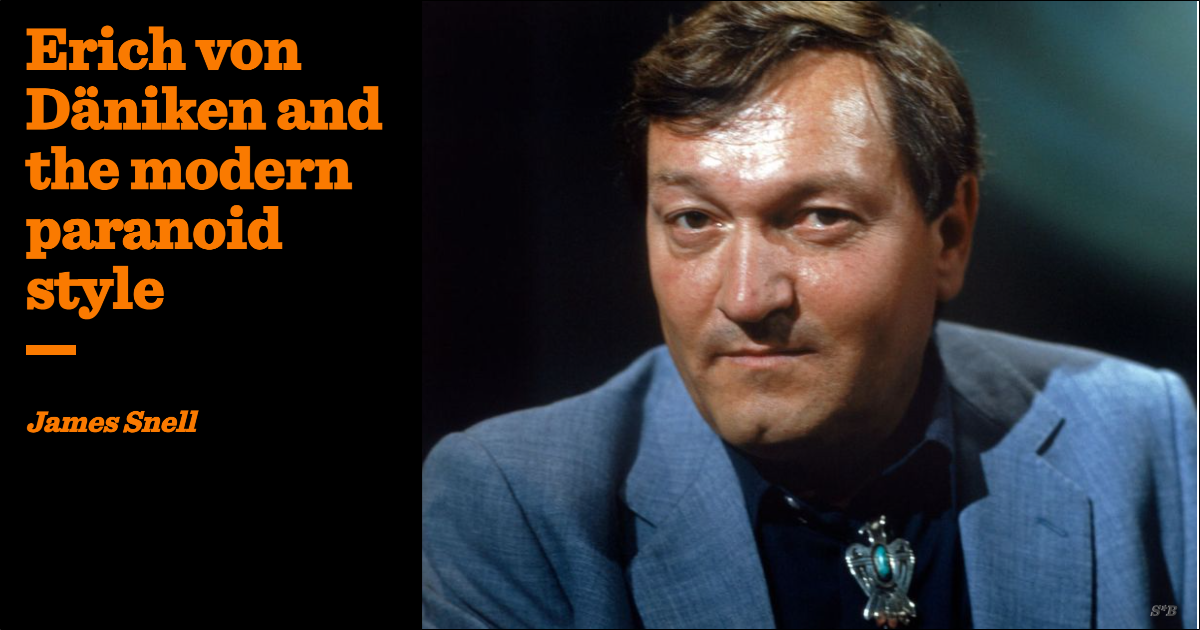
Last week, one of the most famous and bestselling authors of the last century died. Erich von Däniken was ninety. The peak of his fame and influence fell before the millennium, but Däniken was a pioneer, a populariser, a man whose work has been copied by many thousands of latter-day media figures, many of whom will never have heard of him.
Some readers will remember Däniken. They may still, if they look hard enough, find his ageing paperbacks in cardboard boxes in their attic — foremost among them his bestseller Chariots of the Gods? To those for whom Däniken’s name does not ring any bells, I heartily recommend this book. If you read it, you’ll begin to see Däniken’s influence everywhere — in much popular discussion of his favoured subject (archaeology) and broader, more widely across the modern internet and social media.
What Däniken sold was a suite of theories and a series of bold, grand narratives about the human past. The history of the ancient world, he said, was wrong and false. It had to be rewritten. Instead of the archaeological evidence we have and the conclusions drawn by scholars, Däniken argued that instead, there were two clear things academics and gatekeepers ignored: evidence of aliens, and evidence of what was almost supernatural.
Däniken posited that all ancient societies were linked by something beyond human understanding. Their mysteries and achievements, like the pyramids of Giza, were the product of cooperation with, or rule by, godlike beings that came from the stars. The evidence of this, and for the reinvention of mankind’s history, Däniken said, is surely all around us. He was not the first to claim something like this. But when Däniken said it, people listened.
When I tell you that this book first appeared in English in 1969 — after almost two decades of space-mania and many decades of hardcore, pulpy science fiction — you will begin to see Däniken’s influences. That his work also coincided with the beginning of hippiedom, and the gathering new age movement, deepens the connection.
What Däniken was selling was not only an exciting introduction to a complex and, for most, inscrutable topic, usually trapped in academic prose and aired at conferences to which ordinary people are not invited. He was also giving humanity a new story — one that transcended this planet, escaped our dull ordinariness and short, meaningless lives. If we were the creation of an alien super race, a corollary of that must be that great progress, perhaps interstellar progress, might be within reach. We are not just one species, alone in the universe. We once had supernatural protectors, or overlords.
This was an exciting story, and because — to many — Däniken’s evidence, culled from dozens of separate archaeological sites and artefacts (Stonehenge, the Nazca lines), and evidence from textual sources and holy books, seemed exhilarating and plausible, his book, and many subsequent volumes, sold fabulously well. Däniken deepened his stories over time. He replied to his archaeological critics with more examples of what he said were ancient aliens.
His books sold many millions of copies.
I ought to tell you that in his life, Däniken had many occupations. He spent some time in prison for fraud. I’d be remiss if I did not tell you. And I would be remiss, too, if I omitted to mention the unpleasantness that came along with Däniken’s theories. Almost none of this came from Däniken himself. But it was not good.
Online, in our own day, discussion of archaeology is a poisoned well
As Däniken quickly became the most famous — and possibly the most broadly believed — writer on archaeological subjects, his academic and professional critics were attacked as frauds and liars and cowardly advocates of a discredited, dying field.
Over time, this vitriol deepened and grew. Online, in our own day, discussion of archaeology is a poisoned well.
The archaeology content that does best is not just largely false — think of claims about batteries that are supposedly thousands of years old, or the idea that ancient monuments like the pyramids in Egypt are all linked together by immense underground superstructures built by another species. That would be one thing. But discussion is also often undergirded by suspicion or outright hatred for many of the people actually doing serious archaeological work.
They are the paid shills of a deceitful consensus, we — and they — hear. All of them are actively conspiring to hide the truth. They must be sinister people.
Däniken did not do this first. Nor was he the first pseudo-archaeologist (there were plenty of them in the nineteenth and twentieth centuries, and Plato’s supposed claims of a lost Atlantis are almost two and a half thousand years old). But his work pointed the way. Without him, there may not have been ancient aliens programmes on supposedly history-themed TV channels. There would possibly not have been a rising tide of bile aimed at archaeologists.
And Däniken’s work led to other things, just as a compelling theory in mathematics can have applications in physics and computer science. If the ancients were really ruled by gods who came to earth, it naturally followed that all history, all technology (and in consequence all religion and all medicine) must be wrong and thus rewritten.
Many people who these days are primarily known as political or scientific or medical conspiracy theorists also have an interest — sincere or feigned — in fake archaeology. There is no friction between disbelieving the official stories about the JFK assassination, the moon landing, or whether the earth is round, and not trusting what you’re told at school or by archaeologists about the ancient world.
If elite science is lying about the pyramids, after all, it could just as easily be lying about the pandemic, the efficacy or safety of vaccines, and essentially all government statistics — and the Jews, paedophiles, satanists and Freemasons who may or may not rule the world. If mere archaeologists are misleading us, after all, why should we not expect anyone with power and influence to be doing it?
In the podcast sphere and on social media, some of the easiest and most profitable content to make is conspiracy theory themed, and among it all, ancient aliens and pseudo-archaeology generally have their reliable place.
Däniken had long before made his money; he was extremely famous, in an earlier era. He lived just long enough to see tens of thousands of people use his theories in new media, to provide part of our internet’s consistent background noise. And part of our world’s new paranoid style.