
Sex isn’t new, it evolved roughly two billion years ago. Last year, the Supreme Court caught up, recognising male and female as biological categories. Now an employment tribunal has ruled that County Durham and Darlington NHS Foundation Trust harassed women for objecting to a man in their changing rooms. A panel chaired by Employment Judge Seamus Sweeney found that the Trust created a “hostile, humiliating and degrading environment” by compelling female nurses to share facilities with a “biological male trans woman” and brushing aside their concerns. In 2026, British women have at last been informed by the courts that they are not, in fact, required to strip in front of men at work.
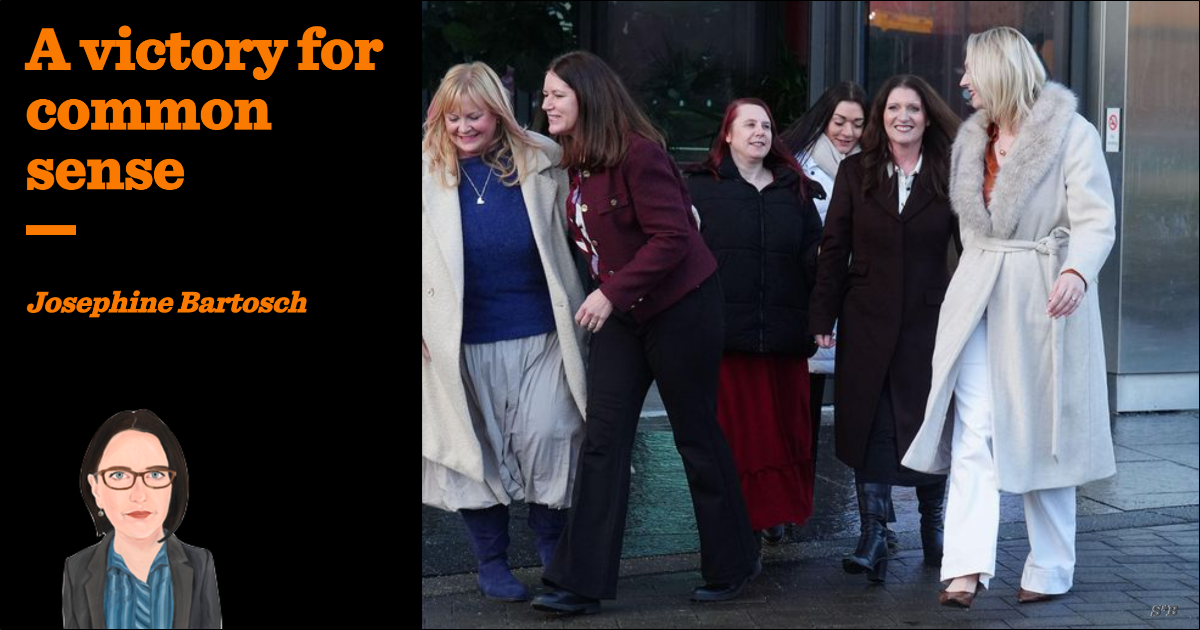
The case concerned eight nurses at Darlington Memorial Hospital who objected to sharing facilities with a male colleague known as “Rose” Henderson, who identifies as a transwoman and believes this entitles him to use the women’s changing room. The tribunal heard claims that Henderson lingered in the open plan area in hole-y boxer shorts and stared at colleagues while they were undressing — allegations it ultimately called “not well founded” and did not uphold as harassment. What it did accept was the impact on the nurses themselves. One claimant, Karen Danson, said the situation triggered traumatic childhood memories of sexual abuse, leaving her with months of panic attacks and sleepless nights.
Henderson does not hold a gender recognition certificate. The tribunal noted that colleagues’ perceptions of his biological sex were reinforced by comments he had made about trying for a baby with his female partner, which the panel described, “rightly or wrongly”, as emphasising his maleness in their eyes.
Single-sex spaces exist not because women are prudes, but because a minority of men are predators
Ultimately, the allegations about Henderson’s behaviour should be beside the point. Nor should the nurses ever have been required to parade personal trauma to justify not wanting to change in front of a man. Single-sex spaces exist not because women are prudes, but because a minority of men are predators. This was acknowledged by the tribunal, which found that compelling women to change in front of a biological male “violated their dignity … by failing to respect their personal bodily privacy and sense of dignity” and was likely to cause “fear, distress and/or humiliation”. What the tribunal did not say is the more direct and impolite truth: whether he sports frilly knickers or knackered boxer shorts, a man who insists on forcing his way into women’s space is not challenging stereotypes; he is identifying himself as a risk.
So why did NHS managers fail to see what’s obvious to every woman in that changing room? Because they believed it would be “discriminatory” to exclude Henderson from female spaces. Instead of resolving the problem, the Trust instructed the nurses to “be more inclusive”, to “broaden their mindset”, and to “be educated and attend training”. When the nurses’ union shamefully declined to support them, the women founded the Darlington Nurses Union with legal backing from the Christian Legal Centre.
The tribunal accepted that the Trust’s trans inclusion policy had been developed with an “admirable and noble purpose”, but concluded that it was applied in a way that harassed and indirectly discriminated against the nurses because it was “simply accepted by management” that Henderson would use the changing room of his choice. This amounted to “a prioritisation of one group over another”. The judgment also makes clear that managers deliberately shielded Henderson from complaints, believing that asking him to change elsewhere would itself be “wrong and discriminatory”.
Predictably, this judicial recalibration in favour of women’s rights provoked outrage among those who boast of being on the right side of history. The “anti-establishment” tax lawyer Jolyon Maugham KC whined that the ruling “demonstrates pretty clearly that whatever else the Supreme Court delivered it did not deliver clarity.” Meanwhile, former presenter India Willoughby stamped his size 10s, claiming that “the equivalent of playground mean girl terfs are championed by a UK court — who say THEIR dignity was violated by being near a woman who is trans”, before insisting that it was in fact the women who had been “doing the harassing and being vile”.
To such trans supremacists, anything short of women’s total capitulation to men’s demands is intolerable. It does not trouble them if women are pushed out of public space, forced to relive sexual trauma, or made to spend their working lives fearful and humiliated. In this they have been ably assisted by legions of human resources professionals and managers, for whom women’s safety is, at best, an inconvenience and, at worst, acceptable collateral in the gender jihad.
In this, the trans ideology that has colonised British institutions operates as a form of Sharia — a system in which the testimony of multiple women is rendered meaningless when it conflicts with the demands of a single man. Expectations of privacy and dignity, once understood as the minimum conditions for women’s participation in public life, are dismissed as hysterical or bigoted demands. Yesterday’s ruling does not establish new rights; it simply reaffirms that women are not obliged, legally or morally, to surrender their boundaries or beliefs to institutional cowardice.
One of the nurses called the ruling “a victory for common sense”. Quite so.