On March 24, 1992, a scruffy-looking older man with a duffel bag showed up at the door of the British Embassy in Vilnius, Lithuania, and asked to speak with a member of diplomatic staff. He claimed he had important information. He had made the same pitch at the U.S. Embassy but was sent away. The British were prepared to hear him out, appearances notwithstanding. He said he lived in Russia and worked for the KGB, Russia’s former secret police and intelligence agency. It soon became clear that the documents he was carrying were not the usual dross offered by low-level spooks or fantasists but rather valuable nuggets from a gold mine.
This “walk-in” was Vasili Mitrokhin, the KGB’s in-house archivist. He had access to volumes of sensitive Soviet material. He also had two demands for MI6, Britain’s Secret Intelligence Service: The first was the guarantee of asylum for himself and his family back in Moscow. The second was a more unexpected stipulation. He wanted his material to be published. Only by exposing the “filth,” as he termed it, of the Soviet regime’s dirty tricks and bloody deeds, could he rescue Russia and free its people.
Gordon Corera’s latest book, “The Spy in the Archive,” gets off to an intriguing start. From here, the journalist and writer, whose books have shone a light into the murky world of espionage, plays to his strengths by telling the remarkable story of both a stunning intelligence triumph and a devastating network of Russian spies in the West.
Why We Wrote This
Vasili Mitrokhin’s journey from poor Russian village boy to custodian of state secrets is a fascinating tale. While working among the files at KGB headquarters, he learned about the sheer scale of Soviet crimes – how countless lives were compromised or destroyed and history was erased. In 1992, he took steps to expose the government’s lies.
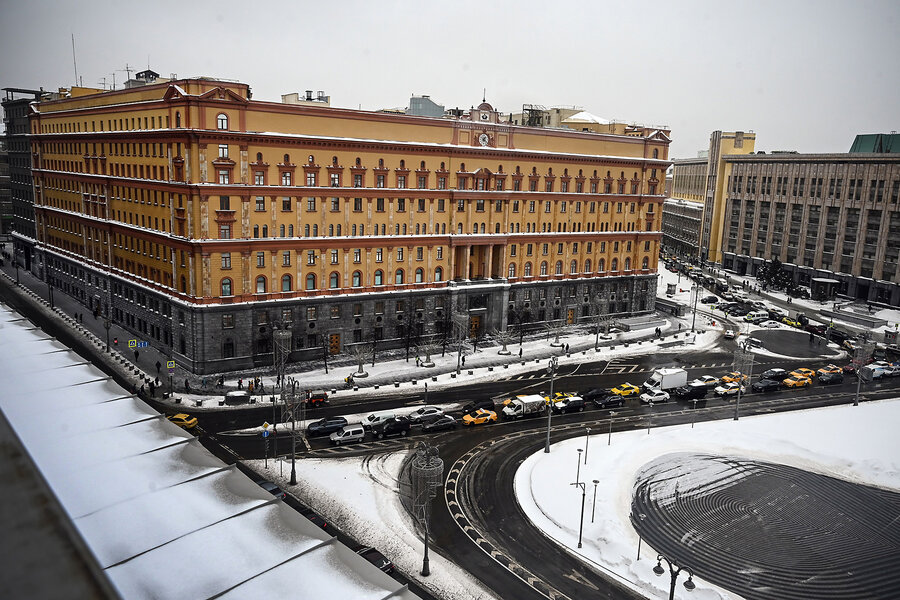
The book unfolds by way of two alternating narratives. In one strand, Corera traces Mitrokhin’s life from poor village boy to custodian of state secrets. Following a checkered career as a spy, whose overseas postings culminated all too often in failure, Mitrokhin was labeled an operational liability and, in 1956, shunted to the KGB archive. It was while working among the files in the basement of Moscow’s infamous Lubyanka building, headquarters to the KGB and once home to Josef Stalin’s torture chambers, that this “clerical rat” first learned about the sheer scale of Soviet crimes – how countless lives were compromised or destroyed and history was erased or rewritten. “I was deep in horrors,” Mitrokhin later declared.

When Mitrokhin was charged with supervising the transfer of 300,000 files to a new facility outside Moscow, he began covertly making notes of documents in a personal code and smuggling them out in his shoes and socks. Hiding them in milk churns under the floorboards of his country house, he gradually reconstituted his notes, turning them into readable, salable, and actionable intelligence.
Corera’s second narrative plays out in 1992, and encompasses the fraught period from Mitrokhin’s contact with the British in Lithuania in March to his defection to the West eight months later. We discover how MI6 evaluated Mitrokhin’s trove and learned from it the identities of various Russian deep-cover agents, or “illegals,” who had burrowed into Western society – and, more specifically, Western intelligence services. MI6 shared Mitrokhin’s archive with its “cousins,” the CIA. Both agencies were overwhelmed by the amount of leads it yielded, and stunned by the damage caused from the enemy within.
Some readers may already be familiar with this tale. The British historian Christopher Andrew collaborated with Mitrokhin on two books based on his material. However, “The Spy in the Archive” is not a retread. Corera has drawn on a range of different sources to provide a more thorough account of Mitrokhin’s life, work, and character.
Mitrokhin emerges as a fascinatingly complex individual. He is taciturn and truculent. But he is also focused and driven: inspired by fellow dissident Alexander Solzhenitsyn to speak out and relay the truth; at pains to stress he is a Russian patriot, not a traitor; and intent on slaying what he regards as a marauding dragon with three heads – the Communist Party; the nomenklatura, or Soviet elite; and, above all, the KGB.

Corera has mixed success when he veers from Mitrokhin to chronicle episodes from 20th-century Russian history. Some of his detours serve up background that gives useful insight and context; some digressions impede narrative flow.
But, for the most part, Corera routinely impresses. Meticulously researched and elegantly written, “The Spy in the Archive” manages to be, by turn, illuminating and riveting. We read on, rapt, as an increasingly disillusioned Mitrokhin takes stock of the KGB’s catalog of insidious cloak-and-dagger tactics against dissenters, whether ruining reputations through smear campaigns, damaging health in psychiatric prisons, or, in one case, hatching a failed plan to break the legs of ballet dancer Rudolf Nureyev.
At certain junctures the book is genuinely thrilling, such as its depictions of FBI agents tracking down and confronting traitors who have been siphoning off secrets to their KGB masters. Even the buildup to the publication of Mitrokhin’s book proves suspenseful. But the standout section charts a great, yet perilous escape. Corera’s description of Mitrokhin’s high-stakes exfiltration from Lithuania to England – an operation that coincided with the 75th anniversary of the Bolshevik Revolution – makes for a white-knuckle reading experience.
According to the CIA, Mitrokhin’s archive was “the biggest CI [counterintelligence] bonanza of the postwar period.” A tale about such a coup and such a windfall deserves to be compellingly told. Corera has done just that.