The Iranian mechanical engineer hadn’t slept for days, fearful his masked presence at the peak of anti-regime protests last week would prompt his arrest at home at any moment.
Still in shock, his voice shaking and sometimes choking with emotion, he describes over the phone what he witnessed in Tehran of the Iranian government security forces’ lethal crackdown on protests that had swept the country.
“Almost everyone knows someone within their circle who has been killed,” says the engineer, who asked not to be named for fear of retribution. He says he saw a government sniper on a rooftop, using a laser sight to target protesters burning trash dumpsters.
Why We Wrote This
A brutal Iranian crackdown has appeared to quash most protests, and officials are seeking to portray a sense of “national solidarity.” But images and eyewitness accounts of shocking “atrocities” are accumulating that paint a different picture.
The violence was unprecedented in its savage ferocity as the Islamic Republic sought to quell the most severe challenge to its power in decades. Thousands of people reportedly were killed, most of them young men and women, many shot from behind and at close range.
Spilling out of Iran this week have been eyewitness accounts of the violence, accompanied by videos of security forces firing indiscriminately at protesters, and gruesome scenes of the results.
From the streets to overwhelmed morgues, the images give credence to claims of widespread social shock and grief about what has unfolded behind the cover of a near-complete communications blackout.
Official vision of “national solidarity”
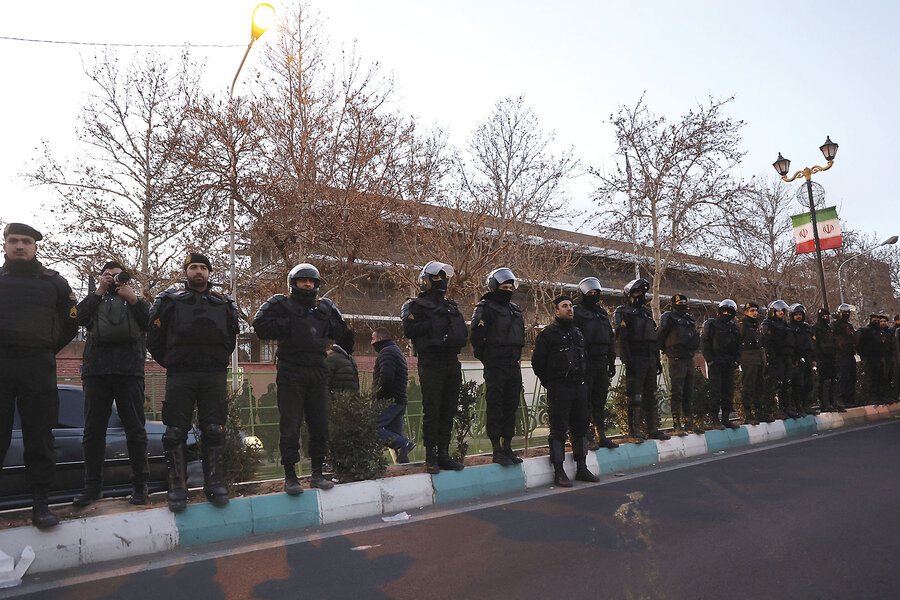
Yet Iran’s embattled leadership sought to portray a sense of calm normalcy, even triumph, after the violent weekend crackdown appeared to quash most protests, along with the existential risk they posed to the regime.
Answering a call from hard-line officials Monday, tens of thousands of regime supporters took to the streets in rallies. On Wednesday, a mass funeral march was held in Tehran for more than 100 members of the security forces killed in the clashes.

State-run TV channels described the rallies as proof of “national solidarity” and a “decisive” response to two weeks of unrest. The protests, which began over legitimate economic grievances, were “hijacked,” the state channels said, by Israeli- and American-backed mercenary “terrorists” bent on destruction and regime change.
Israeli and U.S. officials voiced support for the Iranian protests, and hinted at clandestine support already underway. A surprise Israeli attack on Iran last June led to a 12-day war of airstrikes and missile exchanges, capped by American strikes on deeply buried Iranian nuclear facilities.
Analysts say the regime, despite its confident messaging, is nevertheless clear-eyed about the real challenges it confronts.
For Iranian leaders, “it’s not really a settled matter. They understand the chain of events, the process they are in right now, and the risks that they face,” says Farzan Sabet, an Iran expert at the Geneva Graduate Institute.
“So it’s very important for them to quickly get the situation under control, because that perception of control – or lack of control – is something that could shape how the next steps of this process play out,” he says.
“It’s trying to say to their supporters: ‘Look at the enemy we face. If these are the things the enemy is doing, then any measure is suitable, especially if we are at war,’” says Dr. Sabet. “And they say of the uprising: ‘This is the 13th day of the [Israel-U.S.-Iran] war.’”
A Trump pivot?
U.S. President Donald Trump repeatedly warned Iran’s leaders that they would be “hit very hard” if protesters were killed. On Tuesday he encouraged Iranian protesters and promised that “help is on its way.”
But Mr. Trump appeared to reverse course Wednesday. He said Iran’s crackdown was over, and that the executions of protesters – which he had earlier described as a new trigger for action – would not take place. On Thursday the White House said that 800 executions that were planned to take place in Iran Wednesday had been “halted.”
Iranian Foreign Minister Abbas Araghchi told Fox News that Iran rejected lethal force against the protesters, forswore executions, and blamed “terrorists” working for Israel and the U.S. for the high death toll, in a bid to “provoke” Mr. Trump to “start a new war against Iran.”

Hard-line officials inside Iran, however, take a starkly different rhetorical tack, saying they consider “every” person on the streets since the Jan. 8 crackdown to be a “criminal.”
Officials have also stated that protesters would be quickly tried on charges of “waging war against God,” which carries the death penalty. Chief Justice Gholam-Hossein Mohseni-Ejei said Wednesday there could be no mercy because “the enemy has openly declared support” for protests.
“They are trying to portray themselves as stable, as having reasserted control, that there is no challenge to them – both for domestic political reasons, and signaling to the U.S. and Israel,” says Sina Toossi, a senior fellow at the Center for International Policy in Washington.
“But obviously that’s not the case. And the continued, unprecedented internet shutdown … shows how much they were afraid [and] ultimately betrays fear, insecurity, vulnerability,” he says. “Now they are trying to project confidence, but a lot of their actions don’t reflect confidence – it reflects that they feel very paranoid, and they’re very aggressive.”
Traumatic searches, explicit accounts
Indeed, official claims of “normal” would barely register with Iranian families searching for loved ones among the overflow of body bags laid out in parking lots at morgues, south of Tehran and elsewhere. Heard on videos of such searing scenes are the sounds of wailing and shouting.
“For many, and I’d say everyone I know, this is something way beyond trauma,” says an Iranian outside the country, with family still inside, who has spent hours a day looking at videos of the crackdown.
“I don’t know how to explain it: You feel numb with disbelief. Even those with the most cynical views toward the regime had never imagined such atrocities in that scale of ruthlessness to actually be committed right on the streets,” says the Iranian, who asked not to be further identified.
“I can’t get any proper sleep these days. I’m just … filled with endless rage and frustration,” he says.

Human rights organizations estimate a death toll of more than 2,500, which is far higher than any previous wave of protest in Iran. But they note that communication restrictions mean the actual toll could be much greater.
Eyewitness accounts have been explicit, and even a smattering of them point to some humiliating cruelty at play – and an unmatched scale of carnage. “I saw it with my own eyes – they fired directly into lines of protesters, and people fell where they stood,” the BBC Persian service quoted a man from a small southern town as saying.
Another example was a young woman: “Even remote neighborhoods of Tehran were packed with protesters – places you wouldn’t believe,” she told BBC Persian. “But on Friday, security forces only killed and killed and killed. Seeing it with my own eyes … I completely lost morale.”
Accounts undercut government line
Body bags at Tehran’s sprawling Behesht-e Zahra cemetery reportedly were piled by neighborhood, with grieving families told to search them according to their address.
And one mortuary worker in the northeastern city of Mashhad described 180 to 200 bodies arriving before sunrise last Friday, then immediately buried, according to the BBC.
With each passing day, more eyewitness accounts emerge – increasing the challenge for Iran’s leaders of portraying post-protest Iran as business-as-usual.
The protests and lethal reaction now add up to the most significant challenge to the Islamic Republic since its first decade, when the revolution consolidated power with bloody street battles, fought the Iran-Iraq war of the 1980s, and survived the 1989 succession of the supreme leader, says Dr. Sabet.
“This is not the same system that it was back then. In many ways, it is more sophisticated [but] a lot less resilient,” he says. “The sources of its power are arguably much more under strain.”
“There are constant shocks to the system,” says Dr. Sabet. “The system manages these shocks, but it becomes less resilient each time. And there are more shocks ahead.”
An Iranian researcher contributed to this report.