As the Arab world’s two most influential powers turn against one another, a young era of Middle East cooperation is at risk of ending early.
It started as a spat over the movement of United Arab Emirates-backed southern Yemeni separatists toward the Saudi border. But it quickly spiraled into what some observers are calling a diplomatic “divorce” between Saudi Arabia and the UAE, laying bare their rival approaches for the region and competition for leadership.
The two deep-pocketed Gulf countries’ contrasting visions of achieving Middle East stability – from Yemen to Sudan, and from Libya to Syria – are colliding, ostensibly over support for states versus non-state actors.
Why We Wrote This
A spat over Yemen has spiraled into what is being called a diplomatic “divorce” between the United Arab Emirates and Saudi Arabia, both of which are vying to lead the Middle East into a new era of stability. How does this affect post-civil-war Syria and a path forward in Gaza?
The split has emerged with the regional influence of Iran, weakened by war and internal unrest, at its lowest point in four decades, and just as a joint UAE- and Saudi-led moderate “axis of cooperation” was ascending to fill the void.
But that alliance’s standing is now in doubt, as the Saudi government in Riyadh engages in an apparent test of wills over who steers the Arab world.
At stake is nascent cooperation over such goals as stabilizing post-civil-war Syria and securing an end to conflict and a path to reconstruction in Gaza.

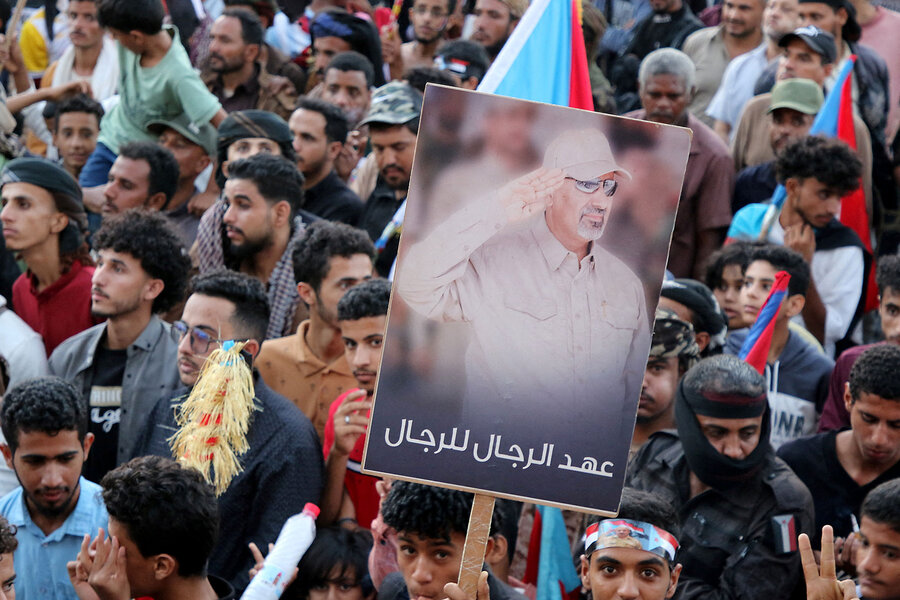
The rift became public on Dec. 29 after UAE-backed Yemeni separatists made rapid gains in Hadhramaut governorate, which borders Saudi Arabia. Riyadh then publicly criticized the UAE’s role in Yemen, more than 10 years after the two nations formed a military coalition to uproot Iran-backed groups from the country.
Under Saudi pressure, the separatists disbanded and the UAE withdrew their last troops from Yemen. As of Saturday, Saudi-backed Yemeni government forces had recaptured lost territory.
Contrasting paths to stability
Yet Riyadh has not let up the pressure on Abu Dhabi. Saudi Arabia reportedly is pressing allies to restrain the Emiratis’ influence, its state-run Al Arabiya news channel is indirectly criticizing the UAE, and military officials have publicly accused Emirati military aircraft of operating in Ethiopia, Libya, and Somalia.
“The UAE is choosing the path of deescalation, and it seems Saudi Arabia is in the mood for escalation,” says Abdulkhaleq Abdulla, an Emirati political analyst.
“The rift reflects a broader divergence in regional visions and strategic priorities between the two countries,” says Hesham Alghannam, a Saudi political analyst and nonresident scholar at the Carnegie Middle East Center, writing in an email.
“The Saudi approach rests on a clear and simple premise: Regional stability is built through a capable national state, a dynamic economy, and a network of regional relations grounded in respecting sovereignty and territorial integrity.
“This vision,” he continues, “collides with [the Emirati] approach based on backing militias and secessionist movements across multiple arenas, from Yemen to Libya and Sudan – an approach that undermines the nation-state and feeds chronic instability.”

Ricard Garcia Vilanova/AP/File
In eastern Libya, the UAE is supporting Khalifa Haftar and the self-described Libyan National Army, which opposes the U.N.-recognized government in Tripoli. In Sudan, the Emiratis are allegedly supporting the Rapid Support Forces (RSF), which is accused of war crimes.
Riyadh now sees this strategy as a threat.
Officials in the UAE have pushed back against Saudi allegations, saying they prioritize regional stability over impulsive action.
“The UAE’s decisions have consistently favored restraint over escalation, reinforcing a clear preference for regional stability and long-term security,” a UAE official who asked not to be named told the Monitor in a statement on Tuesday. “The UAE remains committed to dialogue, de-escalation, and internationally supported processes as the only sustainable path to peace.”
The UAE government has vehemently denied backing the RSF multiple times in the past few months, insisting that it aims to be a neutral mediator for all parties to the Sudanese conflict.
The Emirati official said the UAE was pursuing diplomacy with other Arab states and the United States to “secure an immediate and lasting unconditional ceasefire” to address “the severe humanitarian crisis” in Sudan.
Israeli-Emirati alliance?
Riyadh reportedly also remains troubled by what it views as increased regional coordination between the UAE and Israel, which normalized relations in 2020. The Saudi government has expressed concern over the UAE’s undeclared backing of the breakaway Somaliland region and Israel’s recent official recognition of the enclave in late December. It is also worried that the UAE might lend support to Syrian Druze separatists currently supported by Israel.
Diplomatic sources say Saudi officials have concluded that the UAE and Israel are pursuing a joint strategy of “fragmenting” the Arab world to secure influence and resources.
According to a non-Gulf Arab diplomat who was unauthorized to speak to the press and requested anonymity, Saudi Arabia is pushing a narrative that coordinated, joint Emirati and Israeli actions are threatening to “undo progress made in regional stability” over the past five years.

“Taken together, these dynamics are producing what can be described as a new Israeli-Emirati arc of influence, extending around the Kingdom through fragile and open arenas,” Dr. Alghannam, the Saudi analyst, says of the country’s official thinking.
But Gulf observers say that beneath the differing approaches is a power struggle.
Saudi Arabia reportedly sees the UAE’s rapid economic, political, and military ascent as challenging Saudi Crown Prince Mohammed bin Salman’s efforts to position Riyadh as the undisputed Arab powerbroker.
Saudi Arabia is taking the position, “I am the leader here; not just of the Arab world, but also the Islamic world. You need to follow us and pay attention to what your big brother dictates,” says Mr. Abdulla, the Emirati analyst. “I think the UAE is not in the mood to cave in to that kind of ‘little brother’ role.”
“The question now,” adds the Arab diplomat, who works with both countries, “is whether Saudi Arabia will see the UAE’s withdrawal from Yemen as enough to prove its point, or whether it will push the rift further and force states to pick a side.”
Gulf bloc at stake
The dispute threatens to split the heavyweight Gulf bloc of Saudi Arabia, Qatar, and the UAE.
The rift could undermine the bloc’s joint efforts to advance the Gaza ceasefire to the second stage, prevent the post-revolution government’s collapse in Syria, and bolster the Lebanese government to disarm Iran-backed Hezbollah.
Riyadh and Abu Dhabi have stopped short of dividing the Arab world between the two powers; so far, none of their mutual allies, such as Egypt and Jordan, has publicly taken sides.
However, reverberations of the rift are being felt in Africa.
Middle East Eye, a Qatari-backed outlet, and on-the-ground reporters say the UAE has withdrawn from its military bases in Somalia as demanded by Mogadishu.
The loss of Emirati military bases in Somalia would disrupt the flow of any UAE weapons and funds to the RSF in Sudan – an alleged arms route that Abu Dhabi denies.

Farah Abdi Warsameh/AP/File
News reports and flight trackers say Egypt and Saudi Arabia appear to have closed their airspace to Emirati military flights destined for Libya, a lifeline to Mr. Haftar.
As for Saudi-UAE cooperation, observers say the two will work together – at a distance.
“Saudi Arabia and the UAE can continue to work together as a regional diplomatic bloc, but no longer on the basis of the comprehensive partnership that characterized earlier phases,” writes Dr. Alghannam. “Instead, cooperation will be on clearly defined and limited areas of shared interest,” such as Red Sea maritime corridors, conflict resolution diplomacy, and energy security.
Joint ally Washington could bring the two back together, though several Arab observers and a Western diplomat expressed doubt the Trump administration has the bandwidth to mediate between its Gulf partners.
“The UAE and Saudi Arabia agree on more central issues than they disagree,” says the Arab diplomat, categorizing the spat as a “separation, not a divorce.”
What might keep Saudi Arabia and the UAE from a wider rift might not be allies or priorities, but the weakening of rival Iran.
“There is a mutual understanding that if the two countries fall too far apart, the axis of cooperation will be no more and the current vacuum in the Middle East could be filled by Turkey, Israel, or chaos,” says the diplomat, “and the opportunity of the post-Iran Middle East will be lost.”