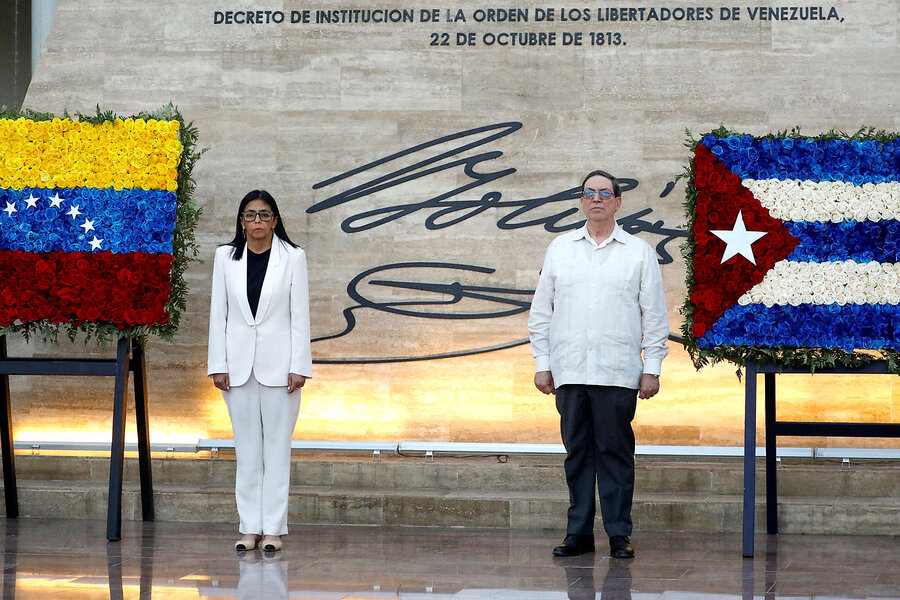
In the wake of the U.S. operation to capture authoritarian Venezuelan leader Nicolás Maduro, several Latin American countries have been put on alert by the White House. From threats of a similar operation in Colombia to promises of ground invasions in Mexico, perhaps the most vulnerable country in the region to U.S. meddling right now is Cuba. President Donald Trump posted on social media Jan. 11 that Cuba should “make a deal” with the United States “BEFORE IT IS TOO LATE.” Cuban President Miguel Díaz-Canel responded that Cuba is a “sovereign nation. No one dictates what we do.”
Over the past two decades, Cuba has developed a reliance on Venezuelan oil to help keep its communist political project afloat. It’s a relationship that has worked both ways: Cuba has sent citizens to serve in Venezuela. Almost a third of the victims of the U.S. operation in Venezuela on Jan. 3 were Cuban.
Why were so many Cubans killed when the U.S. struck Venezuela Jan. 3?
Why We Wrote This
When the United States struck Venezuela on Jan. 3, almost a third of the victims were Cuban nationals. Their presence in the country shows Cuba’s soft power in Venezuela and elsewhere.
The Cuban government labeled “heroic” the 32 nationals killed “in combat actions” during the U.S. operation to capture Mr. Maduro in January.
Former Venezuelan President Hugo Chávez first visited Cuba in 1994, where he and former Cuban President Fidel Castro famously embraced on the runway in Havana. Their relationship solidified – personally and politically – once Mr. Chávez was democratically elected in 1998, and even more so when oil prices climbed to historic levels in the early 2000s.
“Hugo Chávez changed everything for Cuba,” says Lillian Guerra, director of the Cuba program at the University of Florida. “He had lots of cash that he used to create not just a more stable economy for Cuba, but the possibility of working hand-in-hand with Castro.”

Their governments signed a list of cooperation agreements on issues like public health, social welfare, and sports. Cuba sent tens of thousands of trained medical professionals to serve in low-income areas of Venezuela in exchange for oil shipments, which bolstered the isolated country’s economy and electrical grid.
But it wasn’t just doctors: Cuba provided Venezuela with decades of political know-how, including lessons on intelligence gathering, espionage, and repression that it learned from former Soviet and East German security apparatuses. When Mr. Maduro came to office in 2014, Cuba doubled down on its supply of intelligence and security, says Eduardo Gamarra, a professor of political science at Florida International University.
“Cuba moved in hard and soft power,” he says. ”There were very high-ranking Cubans in Venezuela almost permanently.”
Is Venezuela the only place in the world where Cuban nationals serve as sponsors of soft power?
No, the export of laborers – whether soldiers or teachers – has long been one of the island’s biggest sources of income, experts say.
Cuba has projected its international influence in mostly low-income nations across Africa and Latin America, where it has sent doctors and teachers for medical missions and education programs. It also invites foreigners to study medicine in Cuba.
Not long after Fidel and his brother Raúl Castro rose to power in 1959, they were sending physicians to Algeria as a symbol of revolutionary solidarity in its war for independence, and bodyguards to protect Chile’s socialist President Salvador Allende before the 1973 coup.
Cuba has also sent troops and supported conflicts abroad – fighting in Angola and Ethiopia in the 1970s, Grenada in the 1980s, and for Russia in Ukraine today. One human rights researcher estimates there are up to 25,000 Cubans fighting for Russia.
I thought the relationship between the U.S. and Cuba had thawed. Why is the U.S. threatening the Cuban government now?
Cuba was the closest geographic threat to the United States during the Cold War, but few see it as a risk to U.S. democracy today.
Cuba is facing its worst economic crisis since the Cold War. If U.S. blockades on sanctioned Venezuelan oil continue, the knock-on effects for Cuba – already struggling with nationwide rolling blackouts and a historic level of out-migration – could be swift.
Relations between the U.S. and Cuba thawed under President Barack Obama, but in his first term Mr. Trump rolled those changes back.
Secretary of State Marco Rubio grew up as part of the Cuban diaspora in South Florida, and as a kid, he says he dreamed of overthrowing the communist regime to become president of a free Cuba. Many see his worldview behind the operation to oust Mr. Maduro, with overthrowing the Cuban government as his end goal.
“Rubio claims to support freedom and liberty for Cuba, but he has no idea what it would take to create an alternative to this regime” after seven decades of Communist rule, says Dr. Guerra.
The Trump administration’s goal, she believes, is revenge – against the regime’s history, and its staying power.