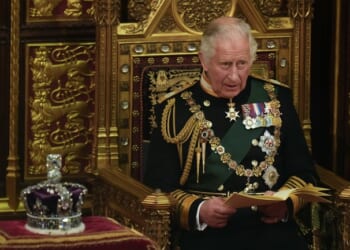
Like many sub-Saharan African countries, Uganda is a very youthful nation ruled by a much older man. The median age here is 16, but the country’s president, Yoweri Museveni, was born the same year that Allied forces stormed the beaches of Normandy.
He became president in 1986, long before most of his countrymen and countrywomen were born. But ahead of Thursday’s presidential election, both Mr. Museveni and his leading challenger, former pop star Robert Kyagulanyi – better known as Bobi Wine – have gone to great lengths to woo young voters.
In the camp of Mr. Museveni – who has never lost an election in 40 years – the pitch is stability and continuity; in Mr. Wine’s, it is a clean break from the past. And young Ugandans are rallying around both sides.
Why We Wrote This
Africa has some of the world’s youngest populations, and some of its oldest leaders. In Uganda, young voters must decide between a 40-something former pop star and a sitting president in his 80s.
The “ghetto president”
The Sunday before the election, morning sunlight slants through the orange-tinted windows of a church in Kampala’s working-class Kamwokya neighborhood. A priest raises his arms and prays for peace ahead of election day. On the rutted road outside, the thick air smells of sewage and frying fish. Weathered campaign flyers paper rickety stalls, promising that Mr. Wine’s National Unity Platform (NUP) party will deliver “a new Uganda now.”
Kamwokya is Mr. Wine’s childhood home. The self-styled “ghetto president” was a popular singer before winning a seat in Parliament in 2017. That year, the government announced it would eradicate presidential age limits, a move designed to allow Mr. Museveni to remain in office.

Mr. Wine became the face of a movement to defend the constitution, both on the floor of Parliament and in fiery protest songs. That movement helped cement his status as one of Mr. Museveni’s most vocal critics. In 2021, he lost to Mr. Museveni in a presidential election marred by arrests and abductions.
Just over half Mr. Museveni’s age, Mr. Wine says he speaks for young people in a country where nearly 80% of the population is under 35.
Many of them feel that President Museveni “has overstayed in power,” explains Mukisa Hussien, a nephew of Mr. Wine who is also running for local office in Kamwokya. Mr. Wine’s supporters point to credible accusations of intimidation and manipulation that have tailed Mr. Museveni’s previous victories.
Ahead of Thursday’s vote, Amnesty International has accused Ugandan authorities of a “brutal campaign of repression” against the opposition, and the United Nations says the Ugandan government is intimidating the opposition, human rights activists, and journalists.
One Kamwokya resident, speaking on condition of anonymity, says that the day before a Monitor contributor visited the area, a young person was arrested on suspicion of planning street demonstrations. “We are in total fear,” the resident says.
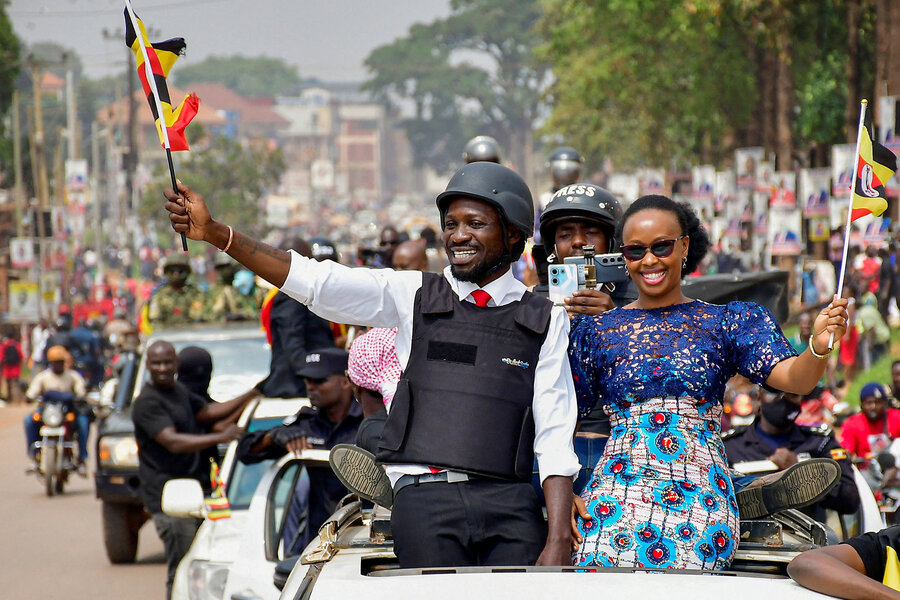
Meanwhile, over the past several weeks, Mr. Wine has campaigned amid clouds of tear gas wearing a slim bulletproof vest. The youthful crowds following him, dressed in Mr. Wine’s signature red and waving Ugandan flags, have often been pepper-sprayed and beaten.
Mr. Wine also says that hundreds of members of his campaign team have been arrested. In December, a teenage boy died while attending an NUP rally in the northern city of Gulu. The NUP says he was attacked by a criminal gang loyal to Mr. Museveni. The Ugandan government denies the charge.
Preparing for election day
Israel Kyarisiima has a different vision for the future. Little more than a mile from Kamwokya, the 20-something sits in an austere government office, wearing a highlighter-yellow shirt emblazoned with Mr. Museveni’s face.
The coordinator of “Gen Z for Gen 7” – that is, Generation Z for General Museveni – Mr. Kyarisiima has his own grievances, ranging from unemployment and corruption to overpriced internet data. But unlike Mr. Hussien, he sees working within the ruling party as the only way to create real change.
“We have to sit at the same table as the leadership that is established in the country,” he says. “That guy is 81 in age, but his physique and his brains are like a Gen Z.”

On the other side of the country, in the western city of Mbarara, the yellow National Resistance Movement flags erected at traffic circles wave in the breeze like a field of sunflowers. If Kamwokya is Mr. Wine’s stronghold, this is Mr. Museveni’s. He was born in a nearby village and went to high school here.
Where Mr. Wine is calling for a new Uganda, Mr. Museveni’s slogan is “protecting the gains.”
“It’s very, very easy for someone who has been in power for 40 years to campaign because you have a lot to show,” explains Tumwebaze Mwine, the NRM candidate for one of the five seats in Uganda’s Parliament reserved for young people.
Mr. Mwine feels that Uganda’s youth must build on the foundation Mr. Museveni has built for the country. “At the end of the day, it is the youth that need to drive [the NRM and Uganda]. It is our vehicle,” Mr. Mwine says.
Uncertain prospects
Other young people in Mbarara aren’t so sure.
Motorcycle driver Amos Tumwesigye, who is in his mid-20s, has adorned his bike with stickers for the NRM parliamentary candidate, but refuses to say whom he will vote for.
“A piece of paper cannot change a government,” he says. “Even if I vote or don’t vote, they are same.”

Back in Kampala, security forces have deployed heavily across the city, with grim-faced men in army uniforms stationed outside businesses and shopping malls.
Still, many young people hold out hope for change.
In Kamwokya, Najjuma Babirye, who is in her early 20s, ekes out a living selling crimson T-shirts emblazoned with Mr. Wine’s face, moving her stock whenever the police chase her away. She admires his bravery and supports his run, regardless of the danger it poses for her.
“They will tear-gas us, arrest us, even kill us,” she says. “But they can’t kill all of us.”
Felix Ainebyoona and Derrick Wandera contributed reporting.