Lawrence of Arabia’s portraits have been given a trigger warning for the cultural appropriation of a traditional Arab outfit.
The National Portrait Gallery cautioned the ‘sensitive’ images of the British Army officer dressed in his thobe and keffiyeh over fears they differ from ‘today’s attitudes’.
Born in Wales in 1888, Thomas Edward Lawrence went on to fight alongside the Arabs against the Ottoman Empire during the First World War and was presented with the robes as a gift by the Arab ruler Emir Faisal.
Pictures of Lord Byron and other Europeans in the dress of predominantly Muslim cultures have also been marked as sensitive.
Under a series of online images, including the portraits of Lawrence, the National Portrait Gallery said: ‘This is a historical work of art which reflects the attitudes and viewpoints of the time in which it was made.
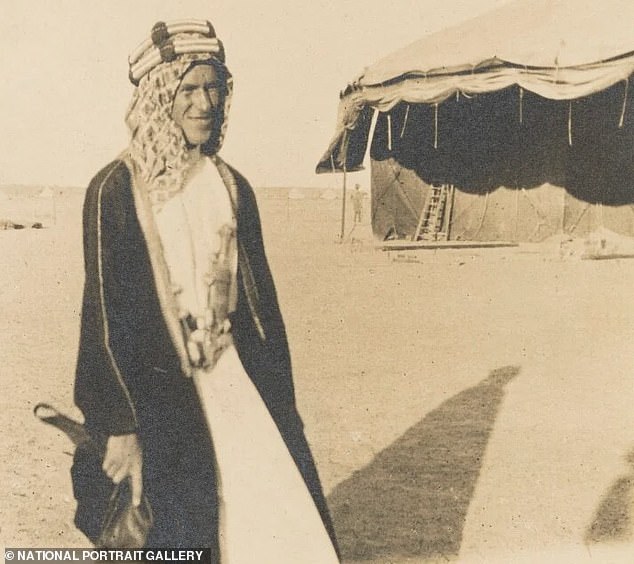
Lawrence of Arabia’s pictures have been given a trigger warning for the cultural appropriation of a traditional Arab outfit. Pictured is the 1917 photograph that triggered the warning
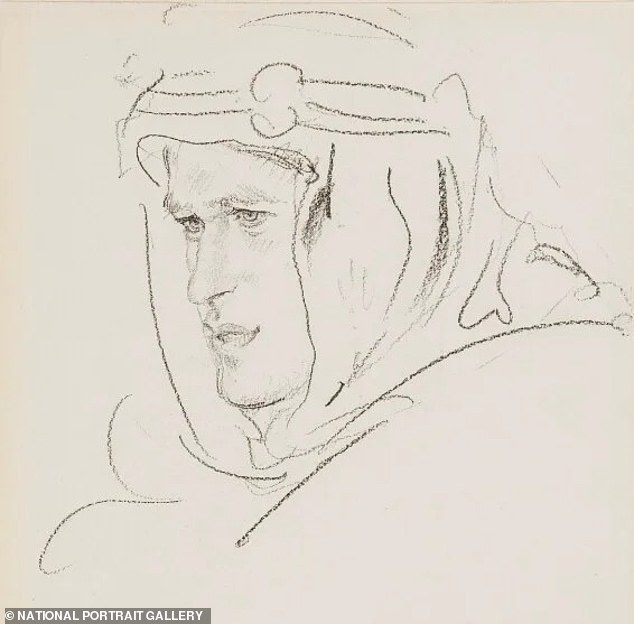
Lawrence was encouraged by Emir Faisal, the future King of Iraq, to adopt the clothing of an Arab ‘sherif’, or royalty. Pictured is a 1918 sketch by the renowned artist Augustus John that triggered a warning
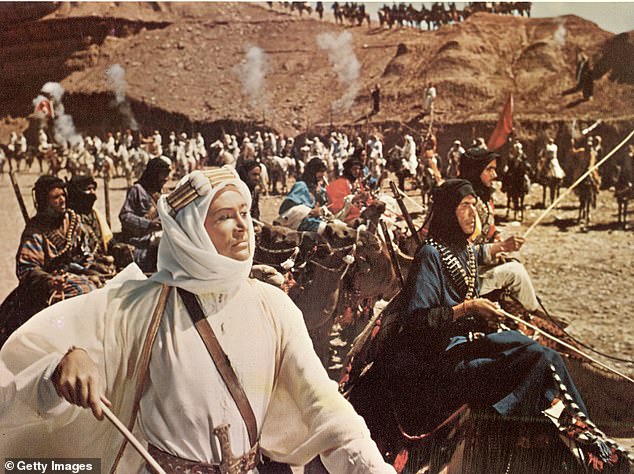
T.E. Lawrence was immortalised on screen by Peter O’Toole in David Lean’s 1962 biopic Lawrence of Arabia
‘Whilst these may differ from today’s attitudes, this image is an important historical document.’
The warning accompanied two portraits of Lawrence in Arab clothing – one a 1917 photograph and the other a 1918 sketch by the renowned artist Augustus John.
Images of the officer without the Arab outfit do not carry the warning.
Lawrence was encouraged by Emir Faisal, the future King of Iraq, to adopt the clothing of an Arab ‘sherif’, or royalty.
Writing in his 1926 autobiographical work, The Seven Pillars of Wisdom, Lawrence said: ‘[Faisal] asked me if I would wear Arab clothes like his own while in the camp.
‘I should find it better for my own part, since it was a comfortable dress in which to live Arab-fashion as we must do.
‘Besides, the tribesmen would then understand how to take me… If I wore Meccan clothes, they would behave to me as though I were really one of the leaders.’
T.E. Lawrence was immortalised on screen by Peter O’Toole in David Lean’s 1962 biopic Lawrence of Arabia.
The English poet Lord Byron was also subjected to a trigger warning after he posed for a portrait in the folk dress of Albania in 1813, The Telegraph reports.
He had acquired the outfit on a visit to the country, which he admired a great deal, going on to feature its landscape and people in his poem Childe Harold’s Pilgrimage.
Other portraits flagged as sensitive included the 1820 depiction of Giovanni Belzoni, an Italian explorer – who was depicted dressed in an Egyptian turban.
An 1828 sculpture showing the Arabic translator Edward Lane in traditional Arab clothing and an 1850 portrait of British officer Sir Herbert Benjamin Edwardes dressed as an Indian nobleman were also given a warning.
Among the other cultural appropriation rows to crop up in recent times are Dulwich Prep School in south London dropping its traditional house names based on Native American tribes.
Olympic poster boy Tom Daley also found himself at the centre of a cultural appropriation row for his Channel 4 show Game of Wool: Britain’s Best Knitter.
Shetland knitters said they were ‘shocked and saddened’ by the way the traditional craft had been depicted, claiming the show was riddled with ‘clear’ errors in terminology and mispronunciations – including calling the island ‘the Shetlands’.
Shetland’s Organisation of Knitters (SOK) said in relation to Daley’s presenting: ‘The over application of the term Fair Isle to refer to any colourwork not only muddies the boundaries of this living heritage craft, but it erases the other forms of colourwork knitting in the world, which deserve to be named.’