In our world of rainbow lanyards and microaggression sensitivity training, it’s hard to say which British institution is the most unbearably self-righteous.
The Church of England, though, must surely be on the podium. Its determination to plough on with its ill-conceived slavery reparations project — dubbed “Project Spire” — is remarkable. The plan to give away £100 million of parish money to its vanity project was a mess from the beginning, and the problems are mounting up.
New polling released over the weekend shows that 80 per cent of Anglicans say they expect the Church of England to support local churches, rather than spend money on what it sees as past wrongs. The gulf between those who sit at the top of this institution and those who fill its pews could scarcely be wider.
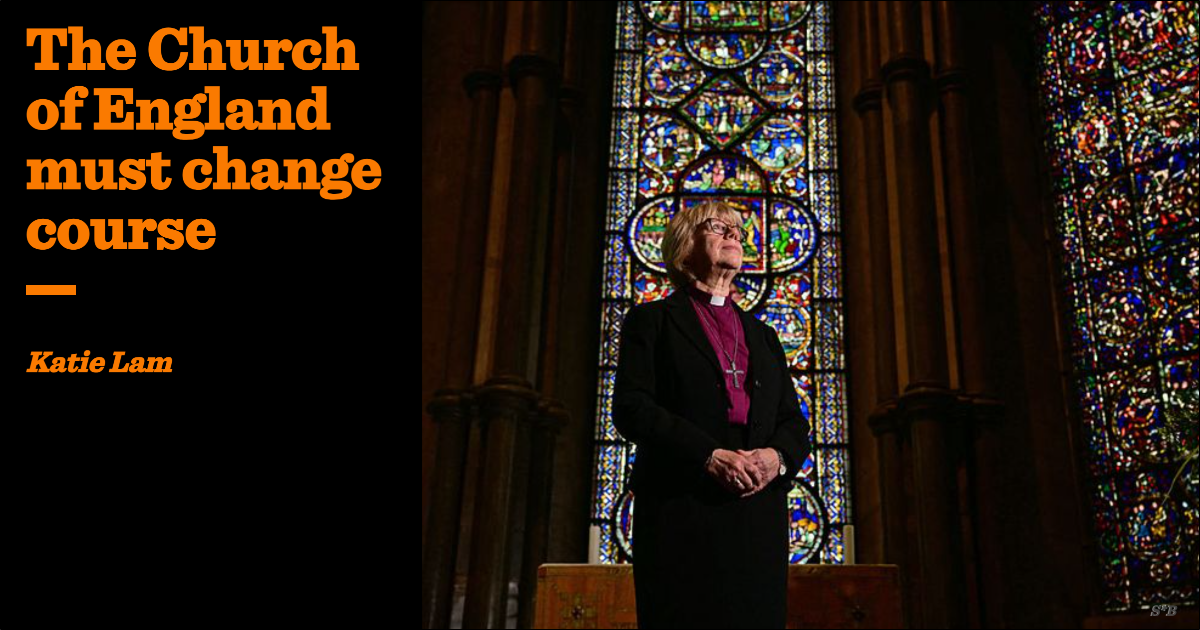
Just before Christmas, I joined a group of parliamentarians in writing to the incoming Archbishop of Canterbury, Sarah Mullally, urging her to put a stop to these egregious plans.
First, the historical basis for the whole thing has been proven to be wrong. The Church commissioned a report into its “links” with the slave trade in 2019, overseen by a “Black-led” group of reparations activists and post-colonialism academics. To the surprise of exactly nobody it concluded that the Church had profited from slavery and was on the hook for millions of pounds’ worth of compensation to atone: grants and “impact investments” to be made “through a reparative and intersectional lens”. The report — accepted in full by the Church Commissioners’ Board of Governors — made clear this was only the beginning: “We recommend that the Church Commissioners deliver on their commitment of £100m as an initial allocation from the endowment that may be re-evaluated and expanded in the future.”
No matter that this is divisive. No matter that this was hundreds of years ago and all the victims are long dead. No matter that it embeds a narrative of victimhood that many black people rightly hate. No matter that human history is an intricate tapestry that cannot be unpicked. No matter that the British were pioneers in ending slavery — an abhorrent practice widespread throughout history — and spent money, political capital, ships and the lives of Navy sailors to tackle it across the world. And no matter that the Church was a huge part of that project. Here was a chance for the Church of England to self-flagellate, to flaunt its virtue, and to insert itself into the “discourse”, and Justin Welby took it with relish.
The original report was not peer reviewed, or indeed challenged in any way. If it had been, they might have realised that the fundamental conclusion was in fact wrong. The research confused two similarly named assets (South Sea Company shares and South Sea annuities), and when this misunderstanding was untangled, it turned out that though the Church had made investments in slave trade organisations, these were small, brief, and loss-making.
Church leaders could have responded to this error with honesty and humility. Instead, they doubled down. They stand by the research, and either (depending on the day) claim that it doesn’t matter that the investments didn’t make any money, or instead that they “received benefactions from individuals likely to have profited” from slavery — an unproven assertion so general as to be worthless.
By this point, various journalists, policy experts, academics and Parliamentarians were starting to notice that something was awry. The CofE, which had previously been merrily firing out press releases about its munificence, took public examination badly. Questions asked in Parliament were dismissed with generic answers; the details were, “matters for the Board of Governors of the Church Commissioners”. The Church responded to accusations of secrecy with breathtaking arrogance clothed in the patronising language of moral largesse: they claimed not to be hiding their activity, merely that they were “especially careful to not publicly respond to, and thereby expose more people to, arguments that are distasteful and offensive to some people”.
If this were a wealthy philanthropist making foolish decisions about his own wealth, the sanctimony of it all might be irritating, but fundamentally it wouldn’t be anyone’s business. But the money that the Church leadership is happily throwing around does not belong to them. The Church Commissioners’ Board is a charity, bound by law. Its funds were given for the support of parish churches, primarily to aid poor clergy. How, people reasonably began asking, can they be used for something else?
As with all other questions, the Church attempted to dismiss this. Then they acknowledged some “technical issues” that would be resolved. Finally, after much wrangling and fobbing off, the Church accepted that this whole business was, “not within its charitable objects”. But even this hasn’t stopped them. Instead, they are about to apply to the Charity Commission for permission to set up a new charity, which they will fund with £100 million from the existing charity.
This seems an obvious attempt to rewrite the rules and laws governing charitable giving. If you give money to a charity, it must be used for the cause to which you donated. If you donate to a donkey sanctuary charity, that money must be used for donkey sanctuaries and it cannot be used for something else, no matter how worthwhile. If every charity could simply set up a new charity with totally different objectives and give it a chunk of its money, what would be the point in the rules in the first place?
Whether or not one has a religious faith, the Church of England is a national institution. What it does, others may choose or feel forced to emulate. Any organisation, any building, any institution that operated before about 1830 (and in our ancient country, there are many) may have somehow been linked to someone who might have profited from slavery. If the Charity Commission allows the rules to be rewritten like this, all these entities are just one activist leader away from their own Project Spire.
And why stop at slavery? Every organisation, unless perhaps it is a woodland charity, has committed the mortal sin of modern times — carbon emission. What about “climate justice”? Why couldn’t every entity be forced to hand over all its cash to that? Next thing you know the money you thought you gave to help the elderly, or educate underprivileged children, or for women’s shelters, has all been spent instead on carbon capture and storage.
The final insult of all this is that the Church desperately needs to show this sort of tenacity, but for its actual job: supporting England’s 16,000 Anglican churches. Nearly 1,000 historic cathedrals, churches and chapels across England are at risk of falling into disrepair due to lack of funds and over the past decade 3,500 churches have closed their doors. Legally and morally, this £100 million must be spent as it was intended: to bolster and protect parish churches, clergy and congregations.
This is a fantastic opportunity to “clean house” and sweep Project Spire away as an ill-conceived legacy of a previous era
There are several ways out of this. Firstly, the Church Commissioners I’ve met seem genuinely good people. It is not too late for them to acknowledge that they never had permission to do this, and shut the project down. Substantial sums have already been spent on reports and staff, but this is a drop in the ocean compared to the overall budget. Second, the Charity Commission may well save the Church from itself. Back in October, a group of MPs and Lords also wrote to the Charity Commission, urging it to reject the Church’s proposal — and we hope it will do so. Only half of new charity applications are accepted, and this structure (setting up a new charity with different objectives using funds of an existing one) is unprecedented.
And finally, there is hope that the new Archbishop will see sense. Sarah Mullally should send a clear signal that the focus of the Church under her leadership will be the strengthening of parishes, not high-profile and legally dubious vanity projects. This is a fantastic opportunity to “clean house” and sweep Project Spire away as an ill-conceived legacy of a previous era.
Let us pray at least one of those eventualities comes to pass.