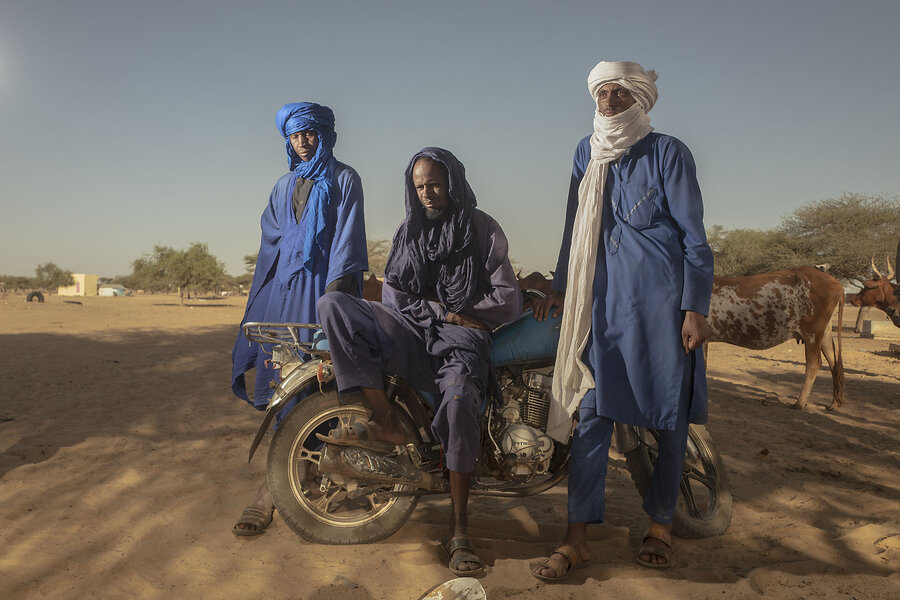
At the southeastern edge of Mauritania, the border with Mali dissolves into a long stretch of sand, broken only by thorny acacias reaching their bare arms toward the sky. The line on the map means little here. At least 7,500 Malians have crossed into Mauritania on foot since the end of October, fleeing a jihadist insurgency and a state that can no longer protect them from the fighting.
They joined more than 300,000 Malians who have escaped to this remote triangle of Mauritania’s Hodh Chargui region in the last decade, according to the United Nations refugee agency.
The stories told by these new arrivals illustrate how Mali is buckling under the strains of a collapsing economy, military abuses, and a grinding insurgency. Once limited to the country’s northern and central regions, the powerful Al Qaeda-linked Jama’at Nusrat al-Islam wal-Muslimin (JNIM) is now creeping southward.
Why We Wrote This
Al Qaeda-linked insurgents. Military coups. Russian mercenaries. These are the global headlines out of Mali. But behind each of them are communities uprooted and lives upended.
Since September, the group has attacked hundreds of fuel tankers headed for the capital, Bamako, causing ruinous fuel shortages there. While military escorts have since eased the blockade’s impact on Bamako, fuel supplies remain uncertain and shortages persist elsewhere.

Courtesy of EU/Michele Cattani
Meanwhile, near the border, Mauritanian Red Crescent volunteers register exhausted families who have walked for days. Mohammed Ali, a coordinator with the Red Crescent, says the new arrivals are a bellwether for a larger crisis.
“The security situation [in Mali] is worsening,” he says simply.
Nothing in, nothing out
Those arriving in Hodh Chargui are mostly fleeing Léré, a midsize town in the Timbuktu region of central Mali.
When JNIM seized Léré last year, the takeover followed a common pattern. Fighters announced their intention to “block” the town for its supposed cooperation with the Malian army. Ultimatums followed.
“They told us we had 24 hours to get out,” says a former resident, clutching his phone in the Mauritanian desert as he searches for signal. “After that, no one would be allowed to leave.” For security reasons, this man, as well as all other refugees interviewed for this story, have been anonymized.
JNIM emerged from the turmoil that shook Mali in 2012, when a rebellion by Tuareg rebels in the north and a military coup weakened the state and gave insurgents an opportunity to sweep in. Drawing on local Islamist factions and recruiting fighters returning from Libya, JNIM gradually entrenched itself by exploiting local grievances and the absence of state authority.

Courtesy of EU/Michele Cattani
Today, blockades of towns like Léré are a mainstay of the insurgency. Their goal isn’t to hold territory, but to show that the state cannot protect its citizens.
Operating from the surrounding countryside, jihadi fighters seal off roads around a town. Nothing enters, nothing leaves. No trucks, no food, no fuel. Prices skyrocket, animals starve. Leaving becomes nearly impossible, but staying is life-threatening too. “People from our neighborhood were executed the day after we fled,” explains the man.
When Malian soldiers and Russian mercenaries arrive to patrol the town, jihadi fighters melt back into the surrounding countryside. When the troops pull out, the fighters return, a vicious cycle that has left lasting scars on towns across the country.
“We don’t see Mali anymore”
However, many Malians say they fear their own rulers as much as they fear the insurgents. The country’s current military government took power in a series of coups in 2020 and 2021, promising to crush JNIM and improve security. It ejected the French and United Nations forces that had once helped contain the insurgency, and in their place hired hundreds of soldiers from Russia’s Wagner Group and its successor, the Africa Corps.
These new troops, however, have proved unable to force the jihadis to retreat; indeed, JNIM attacks on civilians increased. Meanwhile, Malian and Russian forces earned a fearsome reputation for executing civilians and displacing entire communities.

Courtesy of EU/Michele Cattani
When asked why they fled, three herders sheltering near the Mauritanian border answer in unison. “Wagner,” they say. One man recounts hearing drones overhead. “If they see you, they kill you,” he says. “They killed my brother.”
A young woman from a small village in the Ségou region explains that for her, the Russians are a bigger threat than the jihadis. The insurgents impose strict rules like the payment of zakat taxes – an obligatory Islamic levy – as well as black veils and bans on music, she says. But at least they are predictable.
“If you respect their conditions, you have no problem,” she explains. Mercenaries, on the other hand, mete out violence more indiscriminately, she says, often accusing civilians of having ties to the jihadis simply because they live in areas the Malian government no longer controls.
“The Russians kill without warning,” the young woman says.
Two women from the Goundam area in the Timbuktu region say they fled their homes six months ago after watching Russian soldiers execute their husbands.
“The truth is that we don’t see Mali anymore,” one of them says. “Mali is chasing its own citizens away.”

Courtesy of EU/Michele Cattani
Paying the price
Hundreds of miles away, Bamako is slowly recovering from the jihadi fuel blockade. But long lines at petrol stations, empty shelves, and rising prices have exposed the government’s vulnerability.
Experts say a takeover of Bamako remains unlikely. JNIM lacks the means and structure to run major cities – never mind an entire country – and it is hard to imagine a capital built on music and dense social life easily submitting to a rural-based jihadist order.
Still, without a state powerful enough to quash them, many fear the jihadis can sustain blockades and insecurity indefinitely.
In a dim room in a hamlet on the Mauritanian side of the border, a village chief from central Mali waits for displaced members of his community. He says that by refusing to negotiate, the military authorities are prolonging a war they cannot win.
“Everyone wants peace except the man in power,” he says, referring to Malian president Assimi Goïta.
In the meantime, he adds, one thing is clear: As long as the fighting continues, “civilians pay the price.”