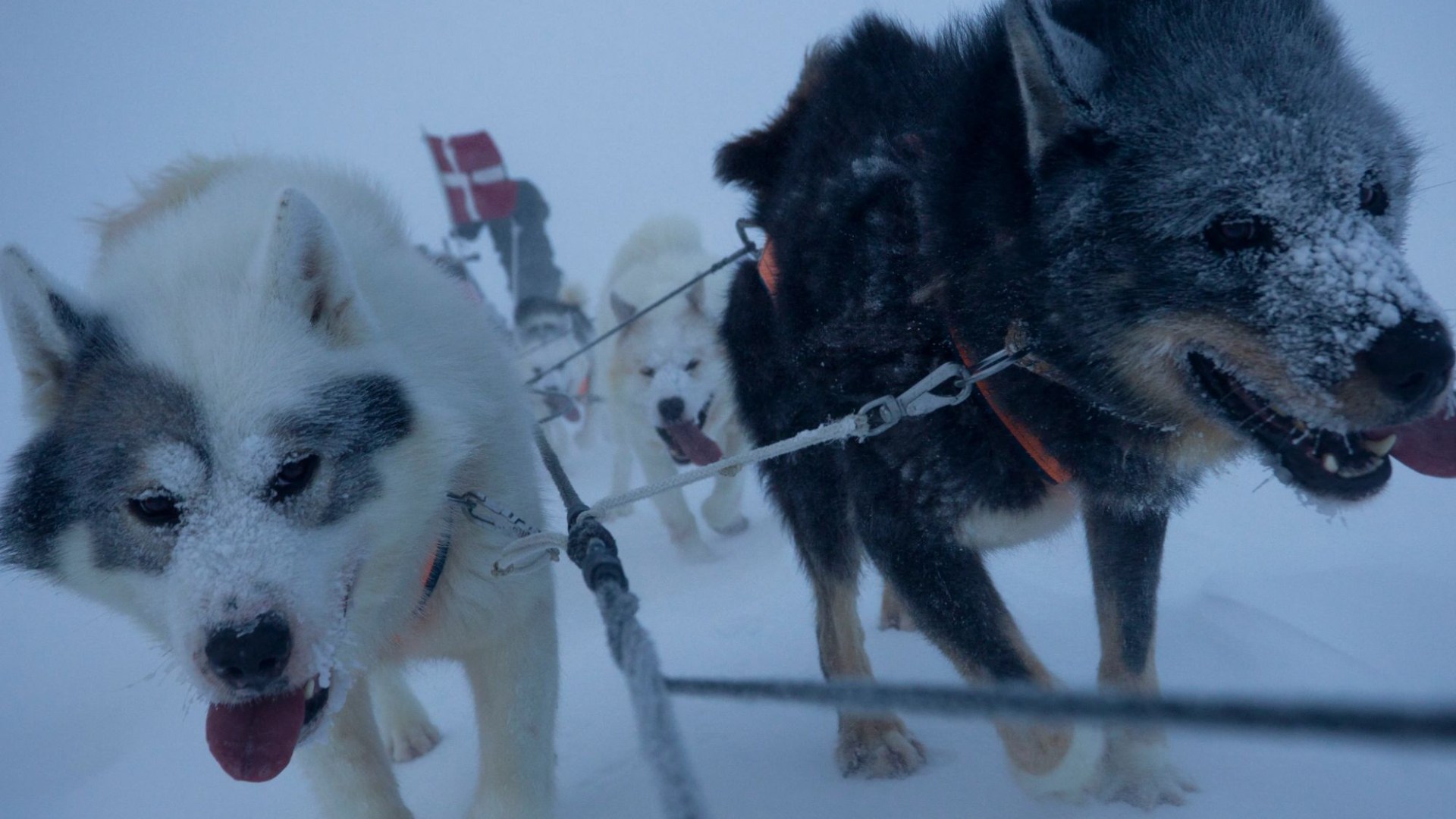
ARMED to the teeth and hurtling through Greenland’s icebound vastness by dog sled, they are the elite special forces accustomed to fighting off savage polar bears.
Now the Sirius Dog Sled Patrol could be pitched against US forces if Donald Trump goes ahead with his threats to invade this mineral-rich Arctic wilderness.
The specialist Danish naval unit would be daunting adversaries. Braving hunger and frostbite — in a world where one mistake can be fatal — they have become masters of their environment.
For up to five months at a time, they conduct long-range reconnaissance missions through this harsh land where the sun never rises in winter and temperatures can drop to -55C.
The Royal Danish Navy unit’s battle honours include seeing off Nazi en- croachments on Greenland’s coast in World War Two.
Face disaster
Now Sirius Patrol is in the international spotlight after Donald Trump mocked Greenland’s defensive capabilities.


Trump believes it’s a piece of cake to take an island like Greenland. But it’s a large, unfriendly environment and if you have absolutely no knowledge of how to operate there you will just face disaster
Danish former rear admiral Torben Orting Jorgensen
He told a gaggle of reporters on board the presidential plane Air Force One: “You know what Denmark did recently to boost security on Greenland? They added one more dog sled.
“It’s true. They thought that was a great move.”
Trump was trying to ram home his view that Danish defences are inadequate to secure strategic Greenland against Russian or Chinese incursions.
Yet Danish former rear admiral Torben Orting Jorgensen called Trump’s remarks about the Sirius sled teams an “insult of stupidity”.
Now running Denmark’s influential People And Security defence policy network, Torben, 66, told The Sun: “The fact that Trump is laughing at an additional dog sled patrol only emphasised his ignorance about the conditions up in that area.
“They [the unit] are utilising a means of transport that for centuries has been adapted to the conditions up there and we are augmenting that with drones and other facilities.
“Trump believes it’s a piece of cake to take an island like Greenland. But it’s a large, unfriendly environment and if you have absolutely no knowledge of how to operate there you will just face disaster.”
The melting Arctic has become a crucible for competing world powers keen to exploit minerals and fossil fuels as well as to establish shipping routes through once ice-bound seas.
With Trump sabre-rattling, the Danes have unveiled a new £4.8billion military package to protect Greenland — an autonomous territory of the Kingdom of Denmark — including a new radar station, five patrol ships and four long-range drones.
Yet in the brutal landscape in Greenland’s frozen north — which is impassable to modern military hardware — the Sirius Patrol remains the first line of defence.
Taking its name from Sirius the Dog Star, the brightest in the night sky, the world’s only dog sled special forces operate where others fear to tread.
Every autumn, six sled teams, each manned by two soldiers from the Royal Danish Navy, patrol an area equal to Britain and France combined, for up to five months.
The white-out solitude is a stern test of the men’s resilience.
Apart from just one visit to civilisation allowed during a 26-month tour of duty, there is no opportunity to see family or friends.
Instead, a close and respectful bond develops between man and dog, who become a cohesive unit, each depending on the other for survival.
The huskies have developed a hissing growl which they use to warn of an approaching polar bear.
It gives the soldiers time to reach for their 10mm Glock pistols or bolt-action M53 rifles.
The sled — pulled by 11 to 15 Greenland huskies — traverse ocean pack ice and rugged snow for an average of 19 miles a day.
At night, the men retire to a hi-tech tent or a collection of huts dotted along the patrol route.
Their monotonous diet of canned foods is bereft of fresh fruit or vegetables for their entire time on patrol.
And although they change their socks weekly, they go for as long as two months without a shower or full change of clothes.
Their hardy huskies sleep outside, braving the worst of the Arctic weather.
The Navy unit’s selection and training procedures are some of the toughest for any nation’s special forces and have been described as “exceptional”.
Potential recruits undergo vigorous trials for endurance and strength as well as psychological testing to ensure they can withstand the months of solitude.
For the few who make it through, at least eight months of rigorous instruction follows, with hunting techniques, sewing and veterinary skills among the disciplines taught.
Proud history
Patrolman Jesper Olsen described how, as part of his final training, he had to simulate a sled accident by leaping into icy water.
Then he tested his survival skills by living for five days with only a small bag of emergency supplies.
Hunting Arctic hare and musk ox to feed himself, he slept in a snow cave dug with his mess tin.
The unit has a proud history.
First known as the North-East Greenland Sledge Patrol, it was formed in summer 1941 with much of mainland Europe under Nazi control.
Its mission was to collect meteorological data to aid military planning in Europe.
The Germans also acknowledged Greenland’s potential and secretly built four weather stations on its rugged coast to help their U-boat campaign.
Peter Harmsen, author of Fury And Ice: Greenland, The United States And Germany In World War II, said: “Germans called Greenland the ‘weather kitchen’, the place where weather was made, to be served the following day in Europe.”
They’re transportation and they’re your warning system while you’re sleeping
Retired US Coast Guard Captain Bob Desh
Before Sirius, finding the monitoring stations amid the snowy wastes was next to impossible.
US Coast Guard ships struggled to navigate through the pack ice, while spotter aircraft’s visibility was hampered by snow storms and winter’s constant darkness.
So US Coast Guard Commander Edward “Iceberg” Smith teamed up with Greenland’s Governor Eske Brun to create the husky patrols.
A force of ten Danes, four Greenlandic Inuits and one Norwegian was assembled to fight what became known as the “weather wars”.
The Inuit presence was vital, with US Coast Guard HQ writing: “In that large expanse of snow and ice, where men can scarcely be recognized at a little distance, only the natives covering the territory on sleds and well- acquainted with the regular inhabitants could detect a stranger.”
Then sled teams from the hardy local breed of Greenland husky were put together.
Known for their stamina and strength plus a keen sense of smell to detect dangerous animals and enemy soldiers alike, the dogs were acclimatised to the unforgiving Arctic environment.
Retired US Coast Guard Captain Bob Desh said: “They’re elite sensor packages with a tail.
“They’re transportation and they’re your warning system while you’re sleeping.”
The unit was split into three groups and began patrolling along Greenland’s north east coast.
At night they slept in tents or tiny shacks called “hunting stations” which were stocked with paraffin, coal and dog food.
Bob added: “They were the nastiest, crudest shacks that you could possibly think of, but it was a place to sleep.”
You have to be acquainted with that harsh environment and that knowledge is not something you just can study in Alaska or with high tech or whatever
Former Danish rear-admiral Jorgensen
Armed with rifles, the soldiers shot musk ox, polar bear and Arctic fox as food for themselves and their dogs. Soon the covert unit made their mark.
In autumn 1941 a patrol saw a suspicious Norwegian trawler in a remote fjord.
Detained by Allied forces, German soldiers and kit were found on board.
In 1943 patrolmen Marius Jensen, Mikael Kunak and William Arke discovered a small hut with smoke billowing from its chimney on Sabine Island.
Seeing two men run from the hut, they decided to set up camp in a nearby hunting shack.
Later alerted by their howling dogs, they were confronted by two heavily armed German units.
The sled drivers were forced to flee, leaving behind their dogs and equipment, before embarking on a two-day, 100-mile trek back to camp.
Later, Nazi soldiers opened fire on Danish patrolman Eli Knudsen and his sled dogs. Killed in the melee, he was the unit’s first casualty.
After the war the sled unit was disbanded, but in 1950, as the Cold War turned glacial and concerns grew over Soviet designs on the Arctic, it was reconstituted.
It was renamed the Resolute Dog Sled Patrol, before becoming the Sirius Dog Sled Patrol.
A world away from high-tech modern warfare of AI-controlled drones and satellites, Sirius’s boots on the ground deter Chinese and Russian incursions.
And if Trump is serious about sending US forces to seize Greenland, these Dogs of War will be waiting for them.
Former Danish rear-admiral Jorgensen told The Sun: “You have to be acquainted with that harsh environment and that knowledge is not something you just can study in Alaska or with high tech or whatever.
“Sirius have battle-proven skills.”
A vlaued oil land
GREENLAND has become a key strategic and resource-rich crossroads as global warming melts the Arctic ice.
It’s why US President Donald Trump has refused to rule out taking the world’s biggest island by force.
As the ice recedes, billions of untapped barrels of oil and a vast supply of natural gas are becoming easier to extract.
And rich seams of gold, copper, lithium, cobalt, nickel and uranium lie waiting to be exploited.
The melting Arctic ice is also opening up new transport routes.
Ships will increasingly be able to sail from east Asia to Western Europe through the Arctic, instead of using the Suez Canal, cutting the journey time by almost half.
Trump believes US control of the island is key to America’s national security and warding off the influence of the Russians and Chinese.
He said: “I love the people of China. I love the people of Russia. But I don’t want them as a neighbour in Greenland.”
Trump added: “We need Greenland for national security – and that includes Europe.”
He also stated that the US will act on Greenland “whether they like it or not”.