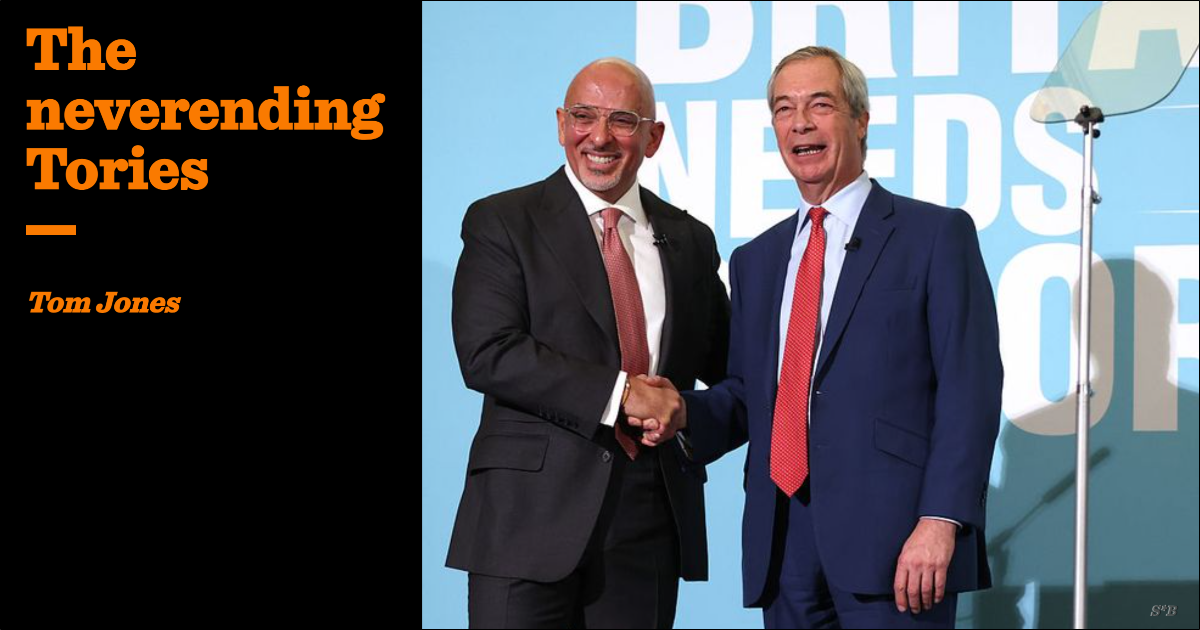
It’s often written that one of the most worrying things about a potential Reform government is that they have no experience of government. With the defection of Nadhim Zahawi this morning, they have added undoubtedly their most experienced defector so far; a former Vaccines Minister, Education Minister, Equalities Minister Chancellor (and to the Duchy of Lancaster) and Chairman of the Conservative Party.
Announcing his defection, Zahawi said; “I also know a thing or two about growing up in a country that is fundamentally broken, riven by secratian strife, economic depression and cratering living standards.” Zahawi was born in Iraq in 1967, the year before the Baathist coup that saw Ahmed al-Bakr overthrow Abdul Arif. It is a little unfair to compare Iraq at that time to Britain now; al-Bakr’s regime saw Saddam Hussein elevated to Vice President, and there is no one today even approaching the levels of ruthlessly efficiency of the Lion of Tikrit.
In 1968 a wave of ferocious purges was unleashed, lasting for almost a year. It began with the systematic removal of all non-Baʿthists from state institutions, before expanding into the repression of organised political opposition and individual dissidents, accompanied by the brutal suppression of a series of alleged “plots”. Officially, Saddam presented these measures as an effort to cleanse government and society of conspirators. In reality, the campaign served to consolidate his grip over both the Party and the state apparatus, and to signal unmistakably that his and Bakr’s Baʿth Party regime was permanent.
Zahawi, too, spoke of the need to reclaim the machinery of state. Reflecting on the failures of the Conservatives in government, he bemoaned their “timidity and weakness” in taking on what he described as the main culprit of Britain’s problems; an “over-mighty bureaucratic inertia that now dominates and runs the country, that has taken control of swathes of the economy and with barely a shrug of the shoulders has restricted the personal liberty of each and every one of us.”
Many of the journalist’s questions focussed on the potential problems in bringing a former Vaccines Minister to a party that plays host to more anti-vaccine voices than any other (even if Farage’s personal views remain somewhat murky). There have been, as yet, not questions as to how a man who once called for all illegal immigrants to be given an amnesty might square with Reform’s base, nor his remarks that Farage’s previous calls to scrap race discrimination laws “a remark that Goebbels would be proud of.” He has, no doubt, been on a journey; perhaps the most pressing dissonance related, however, to his time as Education Minister.
As Fraser Nelson noted nearly 5 years ago, in 2022 the Johnson regime was flailing in panic, scrambling for laws — any laws — to get passed. The Schools Bill was offered up by Zahawi; it constituted an unravelling of the Gove schools reform agenda, ending the independence of academies and free schools – reforms which Zahawi himself identified, in his speech, as a highlight of the Conservative time in government. The problem with the legislation was “that Nadhim Zahawi, the Education Secretary, had not gone through the legislation properly” wrote Nelson; “Even he is alarmed at what it says and is now working with Agnew and Nash to remedy things as best he can. But let’s pause to consider the real question this debacle raises. If the Education Secretary isn’t really in charge of education policy, who is?”
Zahawi offered up an answer today, speaking of the ‘administrative state, regulators and quangos’ who “have had power pushed onto them by successive parliaments and governments. These parliaments have been full of politicians terrified of the awesome power and sacred responsibility bestowed upon our ancient and sovereign parliament.”
Here is the thing rotten in the state of Denmark; there are, simply put, too few politicians capable of, or interested in, effectively wielding power or governing. Talking of the Conservative’s failure to “overhaul the Blairite constitutional vandalism” is all well and good, but physicians should heal themselves.
Talking of the Conservative’s failure to “overhaul the Blairite constitutional vandalism” is all well and good, but physicians should heal themselves.
Given his experience, Zahawi is certainly something of a ‘get’ for Farage, yet his defection does show Farage’s bind. If he wants to prepare for government by bringing in experience from government, they are only coming from the Conservatives. Asked by Tim Stanley if there was any former Conservatives he would say no to, Farage said there were, and only wanted people who believed in what Reform were doing. There are plenty currently in the party currently talking to him, he said, and some would fit whilst others wouldn’t.
But it is obvious that Farage would prefer not to be reliant on taking former Tories; it is notable that almost every defection speech from a former Conservatives has contained a plea, no doubt inserted at the behest of Reform HQ, urging people “who until now felt that politics isn’t for them” to get involved. This is Farage’s dilemma; Reform needs experience to be taken seriously as a governing party, but the only experience available comes from a Conservative Party that demonstrably failed to wield power when it had it. Recruiting ex-Tories may plug gaps in the short term, yet it also imports the habits, evasions and learned helplessness of the very era Reform defines itself against. Zahawi’s defection stands as both an asset and an indictment; proof that Britain’s problem is not a shortage of diagnoses, but a chronic lack of politicians prepared — and able — to govern.