In Minnesota, long-simmering tensions between federal and local power have spilled over. Last week’s fatal shooting of Renee Good by an immigration officer in Minneapolis turned the city into a symbol of national resistance to federal immigration enforcement. The tragedy also thrust deteriorating relations between state leaders and President Donald Trump into the spotlight.
State and federal officials say an Immigration and Customs Enforcement officer shot Ms. Good on a residential street during a surge of immigration arrests in the city. Beyond those facts, reaction stands sharply divided: Senior Trump administration officials likened the woman killed to a domestic terrorist and claimed she attempted to kill officers with her car. Minnesota officials vehemently reject that account, arguing video footage shows the U.S. citizen and mother of three tried to leave the scene. The Minneapolis mayor has told ICE to leave, but more federal law enforcement personnel are on their way.
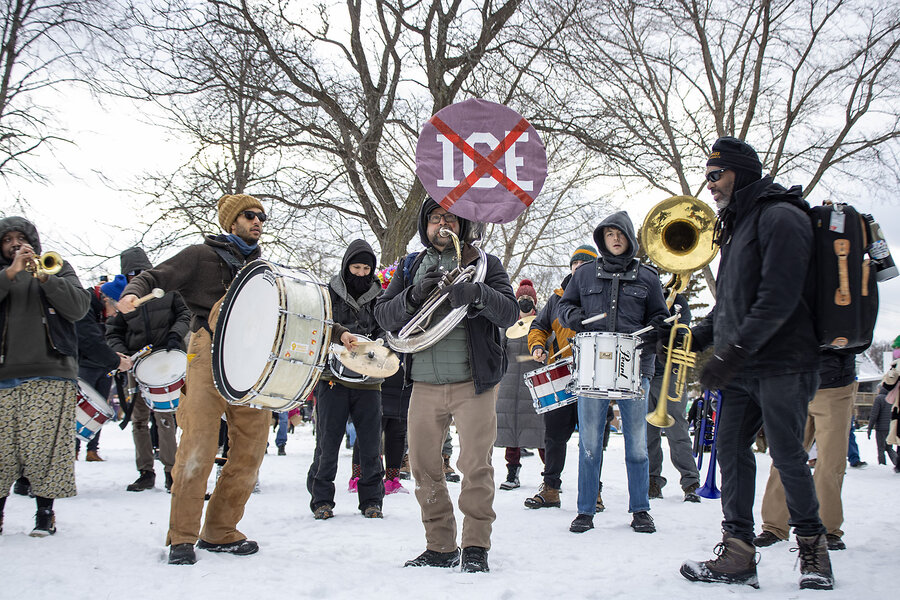
Under the United States’ federal system, set up by the Constitution, states and the federal government are given their own spheres of influence – and an expectation of collaboration. The friction in Minnesota highlights how, at a time of deep political division, the risks of intensifying confrontations are heightened, analysts say. And the divide is not just among political leaders. In Minneapolis and across the U.S. this weekend, thousands of protesters gathered to honor Ms. Good and decry the administration’s aggressive immigration enforcement tactics – echoing protests in 2020 after George Floyd was killed in Minneapolis by a local police officer.
Why We Wrote This
Immigration is a federal responsibility, yet opposition to federal enforcement has been rising in some states and cities. Now, a Trump administration crackdown is increasing the strains.
“Certainly Minnesota and the federal government, or the Trump administration, has had some difficulties, but it really seems to have hit an inflection point and heated up,” says Amy Koch, a Republican political strategist and former Minnesota Senate majority leader. “Both sides have become so divided that they can’t even agree on things that seem obvious.”
Separate investigations into Ms. Good’s death by officials in Washington, D.C., and in Minnesota, breaking from tradition, mirror the split-screen political fissure of the broader United States. The showdown here builds on power struggles between Mr. Trump and other Democratic strongholds, like in California, Illinois, and Oregon, where the administration has sent or attempted to send National Guard troops in recent months.

Christopher Katsarov/The Canadian Press/AP
On the ground in Minneapolis, the immigration enforcement surge looks disproportionate to the size of the immigrant population, says Ryan Allen, associate dean for research at the University of Minnesota. About 2% of the state’s population is made up of immigrants without legal status, according to the Pew Research Center, much lower than some other states including California, Texas, Florida, and New York.
Sanctuary policies versus federal law
Yet nationwide, the conflict between federal and local government over immigration has long roots. For decades, Congress has failed to agree on comprehensive policies to address border security and unauthorized immigrants. Some largely Democratic states and cities, Minneapolis among them, developed what are often called sanctuary policies for immigrants.
In turn, the Trump administration has targeted those states and cities, with Minnesota in its sights long before this winter. Sanctuary status lacks a firm definition, but suggests a city, county, or state that limits cooperation with federal immigration enforcement. In Minneapolis, one recently revised city ordinance underscores the tension. The policy says no government entity is authorized to use city-owned parking lots, vacant lots, or garages for immigration operations.
Still, ICE has law-enforcement allies in the state. Out of Minnesota’s 87 counties, seven sheriffs have cooperative agreements with the agency, which deputize state and local law enforcement for certain immigration actions. Those seven counties voted for Mr. Trump in 2024, and inked their ICE agreements after his return.
In recent weeks, Mr. Trump has also pledged to target Minnesota over pandemic-era fraud in social services programs, over which several people of Somali descent have been convicted or charged. A top U.S. prosecutor estimates fraud from Medicaid programs in the state could top $9 billion. After the yearslong fraud investigations resurfaced through right-wing media attention, the Department of Homeland Security announced plans to send 2,000 federal agents to the state in early January.
While the state’s Somali population was impacted by a travel ban under Mr. Trump’s first term, the current crackdown in Minneapolis is a “much more focused attention that has been, if anything, ramped up over the past month,” Professor Allen says.
A divide over the shooting investigation
One sign of the breakdown in trust is the dissolution of a partnership between state and federal officials on investigating Ms. Good’s death.

Sarah Matusek/The Christian Science Monitor
Minnesota investigators initially worked on the case of Ms. Good’s shooting in collaboration with federal investigators. But that process halted, according to the state’s Bureau of Criminal Apprehension, which said the FBI would take over the investigation. The state and Hennepin County, which includes Minneapolis, have put out calls to crowdsource evidence for their own investigation.
Data sharing is a key part of federal-state cooperation, says Paul Nolette, professor of political science at Marquette University. The absence of that sharing, in the Good case, “really is an escalation of tensions,” he says.
“Typically the baseline, regardless of the administration, usually is cooperation,” says Dr. Nolette. That means “state and federal agencies – as well as local agencies and prosecutors – working to build cases against the accused and carry out justice.”
At an anti-ICE march in Minneapolis on Saturday, where thousands faced subfreezing temperatures, a woman named Sarah called for the state’s Bureau of Criminal Apprehension to be included by the FBI in the shooting investigation. The high school teacher, like others interviewed, declined to share her full name for privacy concerns.
“When we all stand together, it feels really powerful,” Sarah says as the chanting crowd passes by.
Some Minnesotans worry about how to address fraud – and keep people safe amid the federal-state tension.
In a parking lot in Blaine, a suburb north of Minneapolis, a man named Tim says he is concerned about fraud in the state, and supports more immigrant arrests. “You want to be humanitarian. At the same time, what can we afford?” he asks.
The Minneapolis shooting last week was “tragic,” says the construction worker who also drives semitrucks, though it seems she “put herself in that situation by interfering and obstructing ICE.” He expects more people to get hurt on “both sides.”

Before thousands marched Saturday, anti-federal fervor in Minneapolis had turned aggressive late in the week. The city announced an unlawful assembly, with 30 people detained for blocking roads and damaging property downtown. Near the airport, clashes between federal agents and protesters have continued at a federal building.
Trump and Walz at odds since 2024
Disputes between President Trump and Minnesota politicians – including Gov. Tim Walz – aren’t new.
The May 2020 murder of George Floyd by a Minneapolis police officer – about a mile from Ms. Good’s killing – sparked countrywide protests and a national reckoning over race. Local demonstrations at times turned violent, with arson, looting, and property damage, which Mr. Trump and fellow Republicans condemned. Governor Walz declared a “peacetime emergency” at the time and called up the Minnesota National Guard. In recent days, the governor asked those service members to prepare in case they’re tapped again.
In 2024, Mr. Trump and Governor Walz faced off on the campaign trail, with Vice President Kamala Harris picking Mr. Walz as her running mate. Mr. Trump has repeatedly called the governor incompetent.
Governor Walz has taken heat for calling immigration officers “Donald Trump’s modern-day Gestapo.” The administration says such language incites violence, and affirms agents’ use of masks to hide their faces.
“The vice president candidate usually becomes the chief attack dog. And so Governor Walz started doing that job,” says Ms. Koch. “Postelection, Governor Walz continued to be a really vocal, outspoken detractor of this administration.”
In June, political violence rocked the state with the fatal shooting of Minnesota’s Democratic House Speaker Melissa Hortman, along with her husband. A Democratic state senator and his wife were also shot. President Trump, himself a survivor of political assassination attempts, posted a conspiracy video insinuating the governor’s involvement in Ms. Hortman’s death, which her children have asked the president to remove.
Federal action meets grassroots activism
The White House has seized before on serious but isolated incidents involving immigrant suspects to justify crackdowns on broader groups. In Minnesota, federal goals include investigating people for fraudulently acquired lawful status, including some admitted as refugees.

Sarah Matusek/The Christian Science Monitor
Meanwhile, grassroots anti-Trump activism has surged in response to more immigration enforcement in Minnesota, including information networks on federal sightings, anti-ICE signs at businesses, and meal deliveries to families who fear leaving home. While local activists have learned from other cities responding to upticks in immigrant arrests, Minneapolis also has experience building organizing networks around the protests of 2020, says Professor Allen.
“I think part of what we’re seeing is a reliance on some of that knowledge and infrastructure that has been built over a number of years,” he says.
Some efforts are more recent. The nonprofit COPAL, an advocacy group for Latino families, started training legal observers, who monitor federal law enforcement, after the 2024 election. The group trained around 400 people the night after Ms. Good’s death. Trainees are told to record arrests in public spaces while keeping several feet from officers, says Francisco Segovia, the executive director.
“We are not going to obstruct or intervene,” he says. Local documentation of Ms. Good’s killing on a residential street proves that videos are key “to make our government accountable,” he says. Activism aside, however, many immigrants live with fear of arrest.
“We know people who have documents, but they are afraid to go out or go to work,” says Mr. Segovia. “The psychological impact of this is huge.”
Nationally, beyond scenes of division, Americans may actually want compromise on immigration. Polling suggests strong support for strong border security and easier paths to citizenship for immigrants already here. Last year, concern about immigration’s effects on the U.S. also declined.
“They can’t come out”
How big a blow Mr. Trump will land in Minnesota remains to be seen. For now, a federal judge in New York has stopped his plan to freeze federal child care funding there and in four other Democrat-led states.
Still, citing fraud concerns and anti-ICE hostility, several agencies are tightening the vise. The Treasury Department has said it will ramp up fraud investigations. The Small Business Administration announced the relocation of its Minneapolis office. And the Agriculture Department pledged to pause financial awards to the city and the state.
On the ground, immigration arrests continue, with more agents on the way. Secretary of Homeland Security Kristi Noem announced Sunday that “hundreds” more federal officers were headed to Minnesota to boost the safety of officers already present. Many lawfully present Minnesotans – and U.S. citizens – carry their passport or other paperwork in case officers stop them on the street. Others have retreated from public view.
On Saturday, a Minneapolis school bus driver named Luis marched alone on his family’s behalf. The U.S. citizen says several loved ones fear arrest.
“My mom, my dad, my nephews, my wife – they’re at home,” says Luis. “They can’t come out.”
Staff writers Caitlin Babcock in Washington and Victoria Hoffmann in Boston contributed to this article.