
Christmas is traditionally panto season, which is no bad thing, but some of the more high-minded theatres eschew the usual joys, or clichés, of the genre for rather more literate entertainment. At the Old Vic, this translates to an annual helping of A Christmas Carol, but elsewhere, artistic directors are attempting to combine laughter with the classics. In two recent cases — neither of which would remotely call themselves pantomime — this has proved an intriguing experiment.
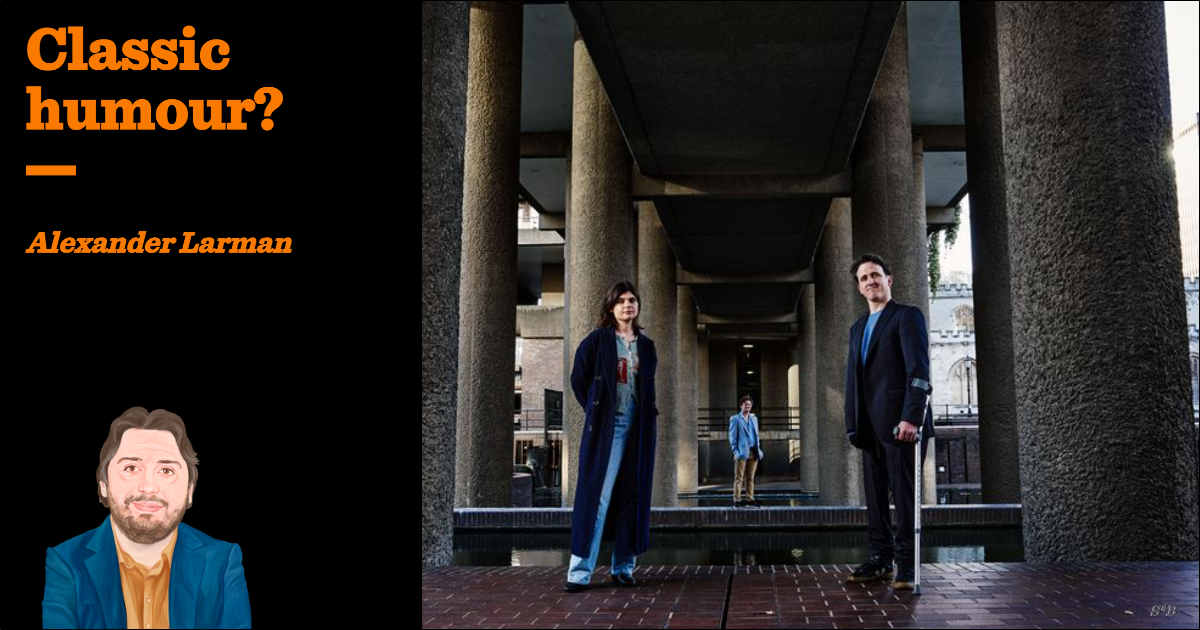
The RSC has been on a spectacular winning streak of late, since the appointment of artistic directors Daniel Evans and Tamara Harvey. Production after production of theirs, including Rupert Goold’s peerless Hamlet and the wonderful Adrian Lester-starring Cyrano de Bergerac, represent the best in contemporary classical theatre. Which is why it’s a shame that the usually estimable Prasanna Puwanarajah’s new staging of Twelfth Night, first seen in Stratford in 2024 and now transferring to the Barbican, is an unfortunate disappointment.
Twelfth Night remains one of Shakespeare’s most problematic comedies to stage. If it’s done in too broad and farcical a way, it can be deeply wearying, but productions that lean too heavily on the Chekhovian and wintry aspects of the play can be about as funny as a colonoscopy. Puwanarajah splits the difference and unfortunately the results are both laborious and laboured; it feels less like an autumnal romp and more like a trudge through various half-formed ideas that never cohere into a satisfying or rousing whole.
If the production has one saving grace, it is Samuel West as Malvolio. West is one of the RSC’s great actors — his Hamlet and Richard II were things of beauty and joy — and he is wholly attuned to the ironies and complexities of the lovelorn steward. His Malvolio is no censorious prig but a professional member of staff who deals with the dismal behaviour exemplified by Joplin Sibtain’s Sir Toby Belch and Demetri Goritsas’s Andrew Aguecheek with seen-it-all world-weariness. Perhaps West’s Estuary-tinged performance means that the gulling scene lands more in the realms of poignancy than hilarity — this is not a Twelfth Night with many laughs — but the moment when Malvolio, falsely convinced that his mistress Olivia harbours feelings for him, says, dumbstruck, “my lady loves … me”, and West’s stress on the final word is beautifully, heartbreakingly achieved.
Would that the rest of the evening lived up to its star. (The company’s 2007 John Lithgow staging had a similar problem.) Puwanarajah has not approached his production with one overwhelming concept, save the presence of a giant pipe organ behind the cast, which is occasionally incorporated into the action. Instead, it’s a slouching hotchpotch of ideas and half-affecting moments, whether it’s Freema Agyeman’s stern girlboss Olivia, Sibtain’s manic Belch or Daniel Monks’s narcissistic Orsino. Few of the cast appear to be in the same play as one another, and Michael Grady-Hall’s doleful, Peter Sellers-esque Feste sums up a largely frustrating evening when he remarks, of some fool-born jest, “yes, that went over better in Stratford”.
Far greater entertainment is to be had at the Orange Tree in Richmond, where artistic director Tom Littler has staged Sheridan’s The Rivals to riotous effect. The production updates Sheridan to the Twenties — cue flapper dresses and an awful lot of Wodehousian jokes and references — and it’s probably fair to describe the play as an adaptation of Sheridan rather than a faithful staging, so plentiful are the additional gags and allusions. (Interestingly, the play doesn’t credit a playwright for these interpolations, which seem to be the work of Littler himself and the wonderfully named Rosie Tricks, his assistant script editor.)
Let’s hope that 2026 can come up with many more similar delights
Sheridan purists will be both outraged and surprised by many of the changes, but those less in thrall to the original will enjoy the irreverence with which Littler approaches the old warhorse. He is helped by a crack cast, of which Patricia Hodge’s doddery and linguistically challenged Mrs Malaprop and Robert Bathurst’s unusually laid-back, softly spoken patriarch Sir Anthony Absolute are the box office draws, but the stand-out is Kit Young’s protagonist Jack Absolute, who — for various farcical reasons — finds himself having to impersonate a down-at-heel military officer, Sergeant Beverley, in order to woo Zoe Brough’s dreamily idealistic Lydia Languish. Young has a magnificent speaking voice, fine comic timing and innate charisma, and his dashing performance anchors the play in some vague semblance of reality.
He is helped by some fine comic cameos from Pete Ashmore as the Jeeves-esque manservant (who, wittily, is named “Frederick Arnold Gieves” or “Fag”), James Sheldon as the comically neurotic “Faulty” Faulkland and Joëlle Brabban as the witty servant Lucy; Brabban also shows off an impressive voice in some of the pastiche Twenties numbers that are threaded through the evening. This may not be revelatory theatre, but it’s a lot of fun, and some of the new jokes — “What does ‘L, O, V, E’ spell?” “Vole?” — still have me chuckling in happy reminiscence of a thoroughly jolly and silly evening out. Let’s hope that 2026 can come up with many more similar delights.