We moved into a semi-detached house just over a year ago. Unfortunately, our closest neighbour is pretty awful.
He has already threatened to take us to court to show he owns the driveway and front garden, even though he does not own either outright.
A deed for the shared driveway shows we each own half the driveway and need to give access to each other.
The deed gives car access to the garages at the back of the house. The garages don’t exist as we have both properties have been extended.
Our neighbour insists we can’t use his half of the driveway to take our car in when we like. He has threatened to take out an injunction against us. We’re planning to get a dropped kerb sorted to get our car in.
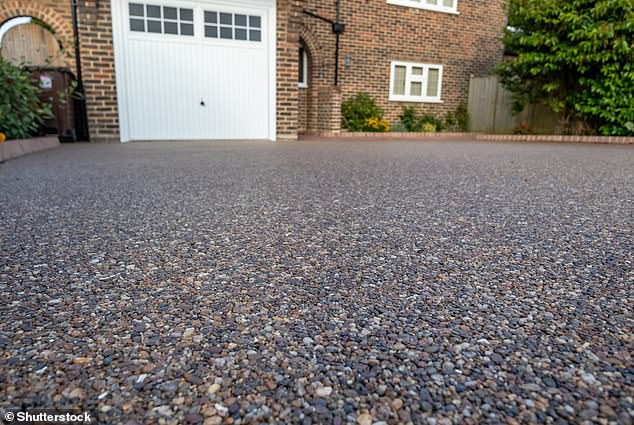
Gravel wars: A This is Money reader wants to put a fence down the middle of a shared driveway (stock image)
Just before Christmas, our neighbour said he wants to null and void the deed and build a wall down the shared driveway.
Again, he threatened to take us to court if we don’t agree to this. The letter about the deed was written by his solicitor.
We’d be fine with the wall being built, but we wouldn’t want it down our side. Plus, if he wanted to get the deed axed, we’d want him to pay for this to be done.
We think a proper face-to-face conversation is needed about this. If we meet with our neighbour in person and ask him to pay the costs involved and we say no, can he still take us to court and get the deed scrapped?
We are keen to avoid a messy and expensive legal saga.
Jane Denton, of This is Money, replies: Shared driveways aren’t uncommon – some modern developers use them on new-build sites to economise on space, others pre-date the 1930s.
Some people living with shared driveways will never run into difficulties, but for others, they can be troublesome.
Re-read the property deeds carefully to check how access and ownership to the shared driveway works.
Your neighbour will not be able to simply null and void the deed unilaterally. This would require the approval of both parties involved or going through a court.
I’m not convinced a judge or court would take too kindly to your neighbour’s threatening approach.
Your neighbour may also have trouble putting a wall through the shared driveway if it would interfere with access to your property.
Meeting with your neighbour face-to-face to discuss these issues is a good idea, as is avoiding letting this matter cascade into a full-blown legal dispute.
If you manage to agree anything between yourselves, make sure everything is in writing.
Manjinder Kaur Atwal, director of housing law at Duncan Lewis, says: In my line of work, I see disputes like this frequently – but the good news is that your neighbour’s threats have little legal standing.
Firstly, the key document here is the deed governing the shared driveway.

Manjinder Kaur Atwal is director of housing law at Duncan Lewis
If, as you say, it states each of you owns one half and grants mutual rights of access, that is what is known as a legal easement.
Easements are not casual arrangements that one party can simply ‘null and void’ because it suits them.
They run with the land and bind successive owners.
In plain English, your neighbour cannot scrap the deed unilaterally, no matter how many letters his solicitor sends.
The fact that the garages no longer exist does not automatically extinguish the right of way.
A court would look at the wording and purpose of the easement.
If the deed grants vehicular access generally, rather than access solely for existing garages, the right is likely to remain valid.
Even where the original purpose has changed, easements are rarely discharged unless they are clearly obsolete and serve no practical benefit – a high legal bar.
Your neighbour’s claim that you cannot use ‘his half’ of the driveway when you wish is also misplaced.
Shared access means exactly that. Provided you are using the driveway reasonably and for its intended purpose, he cannot lawfully restrict your use or dictate timings.
An injunction would only be granted if your actions were obstructive or outside the scope of the deed.
As for building a wall, again, he cannot do this if it interferes with your legal right of access.
Any structure that prevents or substantially impedes use of the driveway would amount to an actionable interference.
Even if you are open to a wall in principle, it would need to be entirely on his land, properly surveyed, and must not compromise your rights.
On costs, you are correct: any variation or release of the deed requires your consent, and your neighbour would be expected to cover legal fees. Deeds cannot be ‘axed’ by threats. They can only be changed by mutual agreement or, rarely, by a court.
Could he still take you to court if you say no? Yes, anyone can issue a claim. However, success is another matter entirely.
On the facts described in your letter, his prospects appear weak, and courts take a dim view of aggressive, unnecessary litigation between neighbours.
My advice is to keep communications calm, factual and preferably in writing.
Face-to-face meetings can help, but avoid agreeing to anything informally.
Mediation can also be a sensible next step. Judges expect neighbours to try resolving disputes amicably before heading to court, and refusals without good reason risk being punished on costs. It is quicker, cheaper and less confrontational.
If matters escalate, a solicitor’s measured response, rather than a full-blown court battle, is often enough to bring an over-assertive neighbour back to reality and spare you the legal saga you are rightly keen to avoid.
Joanne Ellis, a partner and dispute resolution specialist at Stephensons, says: The first thing to do is check the documents you received from your conveyancing solicitor when you bought the property.
These should include a copy of the deed, any legal advice, and information from the seller confirming whether there were previous issues with the neighbour.

Joanne Ellis is a partner and dispute resolution specialist at Stephensons
In most cases, a right of way remains in place unless the property owners agree to change it.
Other rights, such as restrictive covenants, can sometimes be amended by the Lands Tribunal, but only if strict criteria are met.
From what you’ve said, your neighbour accepts that the right of way exists. That makes it difficult for them to persuade a court to alter the deed.
Whether you can use their half of the driveway whenever you wish depends on the exact wording of the deed.
Courts interpret deeds based on the ordinary meaning of the words and what they would have been understood to mean at the time they were signed.
The fact that garages are no longer there could be relevant, so the wording needs careful review.
The letter from your neighbour’s solicitor should explain the legal grounds they are relying on. If there is no valid argument, you are in a strong position and can reasonably ask for your costs to be covered.
You may even have a claim for interference with your right of way if you’ve been prevented from using it. Keep a detailed record of all events.
While it’s always best to reach an amicable agreement, make sure you understand your legal position and any practical issues before agreeing to anything.
If you are in a strong position, you have more room to negotiate.
If your neighbour is likely to succeed, it may be fair for each party to cover their own costs for a new deed.
Also think practically: will you still be able to access the rear of your property if a wall is built?
Do you need vehicle access? It may help to have an open conversation with your neighbour about what they want before deciding your next steps.
Finally, check whether the seller gave accurate information when you bought the property.
If not, you might have grounds for a misrepresentation claim. If they were honest, it could be worth contacting them for historical details about how the right of way has been used.