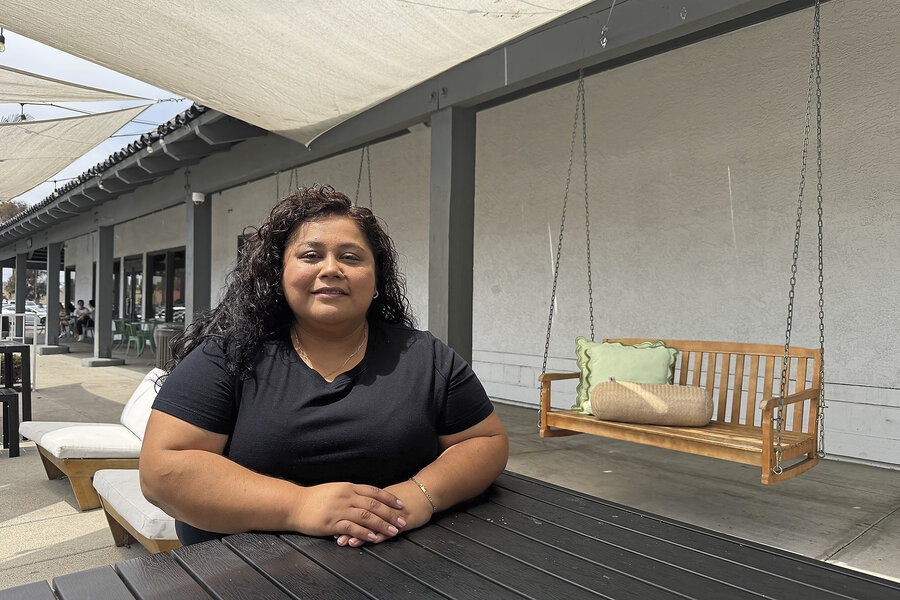
“Women are God’s ‘Plan B,’ the backup in case men don’t take the lead.” That’s the teaching Selene Gutierrez grew up with in the Latino Christian churches of her childhood. When she was 18 years old, Ms. Gutierrez ministered in a men’s prison – something she had been told was a man’s job. “I thought, ‘OK, when men go, I’ll stop going,’” she says.
Two decades later, now a pastor, she sees her ongoing contributions as of equal importance to the church as those of her male colleagues. “All along, [working in the prison] was my training,” she says. “That was my boot camp for me in ministry, and that has … allowed me to have a ministry where I can relate to men at any level and be respected.”
As an ordained minister, she has held leadership roles in nondenominational Christian churches – though it’s often a tough path, and she’s surrounded by few other female leaders to help show the way.
Why We Wrote This
While traditional male hierarchies persist in some Latino Christian churches in the United States, more women are emerging into leadership roles. In this installment of our occasional series on women of faith, a pastor explains how she remains grounded in her love of God and in the community.
When it comes to gender parity in the Latino church, the tide seems to be turning the most among the youngest generations, she says. Many won’t put up with inequality and will leave instead. “Our church cultures are responsible right now for what the future culture will look like, because if we just find ourselves as churches encouraging [only] men, then we’re just going to be in that same cycle again,” Pastor Gutierrez says.
Role of women in Latino churches
Many Christian denominations have long grappled with diverging views over the roles of women in ministry. And while women are leaving other denominations at higher rates than in the past, that’s not the case for Latino evangelical churches, many of which have roots in the Pentecostal tradition that emphasizes divine healing, prophecy, and speaking in tongues.
But Latino churches still face many of the same questions about the roles of women. The Monitor has been speaking with women of various backgrounds to understand more about their spiritual beliefs and decisions, and what about their religion’s teachings keeps them coming back.
Women in Latino churches face “paradoxical domesticity,” says Gastón Espinosa, a religion professor at Claremont McKenna College. “They’re called to be strong women … but they’re also called to be good wives.”
“There are a lot of glass ceilings,” he adds, although women can be ordained. For example, the International Assemblies of God Fellowship, a collection of churches with Pentecostal roots – through which Pastor Gutierrez was ordained – has elevated women to ministry since at least 1916, he says. Women usually serve as pastors when they’re the wife of the lead male pastor.
Navigating the changes takes a lot of wisdom from women, Pastor Gutierrez says. “Too vocal” is one way a senior male pastor described various women in a previous church.
While Pastor Gutierrez has held formal church roles in the past, at the moment she views herself as a community pastor, working in and out of her church. “I’m a leader in my church, and I’m a leader in the community,” she says. “Whether it’s doing a food bank station or whether I’m called … to go to the [immigration] court and be present as a minister, I’ll do that,” she says.
From her immigrant roots
Pastor Gutierrez is an immigrant herself, and her faith has been her guide through years of separation from family members. She immigrated to California from Mexico with her family when she was a child, but in 2009, they were deported and she remained.
Alone, she stayed in the country without authorization until 2012, when she turned herself in to Immigration and Customs Enforcement. She was able to remain under an immigration policy from the Obama administration known as Deferred Action for Childhood Arrivals, or DACA.
“You really feel like a citizen,” she says. “You just don’t know anything else. You just don’t know any different. I don’t remember much of Mexico.” Still, she missed her mother and sister and struggled with whether to follow them to Mexico. “I’m not going to be like those families that do not see their moms for 20 years,” she recalls thinking. “I said, in one year, if God doesn’t do anything, I’m leaving [the U.S.].”
Her pastor encouraged her to pray, and a few days later, while she was sitting in her car, a Bible verse from the Book of Matthew popped into her head: “He who loves father or mother more than me is not worthy of me.”
She heard a message that she felt was from God, saying, “It’s not your will, but it’s what I’m asking of you; to stay.”
She parked the car and cried, overwhelmed by the thought of remaining away from her mother and sister. But she decided to put her faith in that message, and remembers saying to God, “If I stay, you’re going to take care of me.”
And she has stayed in the United States since, although it hasn’t been easy. “But I’ve found that He’s been faithful,” she says, adding that her mom lives back in the U.S. now. Her sister was not able to get permanent residency and now lives in the Czech Republic with her husband and children.
Challenges to her faith
It has been challenging, at times, for Pastor Gutierrez to remain in church. There have been moments when, so discouraged by dismissiveness toward women, she has either withdrawn to attend church online for a short time or moved to a different church. But the organizational issues don’t shake her faith in a higher power, she says.
“One of the things that has kept me in the faith has been my own personal experience and relationship with God, just knowing that whatever culture has been represented from the church, it’s not who Jesus is,” says Pastor Gutierrez. “It’s not what He intended to be. And that is soothing, and that brings hope and peace.”
“Many Latino churches, organizations, and traditions see women as the foundation of their ministry efforts, managing prayer groups, discipleship, hospitality,” and more, says Gretchen Ávila-Torres, a professor of theology, in an email to the Monitor.
“There’s an ongoing conversation about how to elevate this informal leadership into formal, visible roles where women can preach, teach, and lead at various levels,” says Dr. Ávila-Torres, who also co-directs the Hispanic Ministries Program at Western Theological Seminary.
Pastor Gutierrez hasn’t left the faith, or the church. “But have I been frustrated? Yes,” she says.
That’s similar to what Dr. Espinosa from Claremont McKenna College has seen throughout his field research. Religious affiliation may be declining overall in America, but he doesn’t see the same trend among Latinos. When women leave the church, he says, it’s usually a particular church, not leaving the faith or God. And many find a new church.
“Usually, the losses are replenished by people converting to the [Pentecostal] movement,” he says.
Giving women space to lead
Women held leadership roles in the early church centuries ago, Dr. Ávila-Torres points out. But today, partially because culture plays a role in defining organizational structures, women are often still denied a role.
“Many Latino churches mirror family and social hierarchies where leadership has traditionally been male, and these patterns often persist in church life without conscious challenge,” she writes in her email. “Over time, cultural norms can become as authoritative as doctrine, even though Scripture itself offers a broader perspective.”
When the culture within a church doesn’t allow space for women, or when male leaders aren’t “confident enough to give women space,” it can feel like running up against a wall, Pastor Gutierrez says.
“Those moments have been very frustrating, and I have been just kind of like, ‘I just need to leave,’” she says. But, in those moments, she turns to prayer and looks to mentors, and a path forward emerges – whether at that church or a new one.
She mentions Christine Caine, who founded Propel Women, a Christian organization that provides women with leadership training. Together with her husband, a pastor, she establishes churches in Europe and leads a campaign against human trafficking. Examples like Ms. Caine, who is the face of her own ministry and whose husband supports her in that, are encouraging to Pastor Gutierrez.
In addition to Ms. Caine, many women Bible scholars and pastors are among the first in their fields, and the number is always growing, says Pastor Gutierrez.
“We’re still pioneering.”