For years in Venezuela, almost anytime the lights went out – a frequent occurrence – someone was likely to quip that the United States was behind it, preparing to swoop in to take out the president.
The oft-repeated wisecrack reflects a century of American intervention in Latin America as much as a decade of increasing political repression and economic devastation. But what was once a running joke has turned into reality, with a leadership change this past week that, though broadly welcomed, feels increasingly out of their hands.
On Jan. 3, the large-scale U.S. military strikes knocked out electricity in parts of Venezuela, as authoritarian leader Nicolás Maduro was whisked away on questionable legal grounds to face a battery of federal charges on U.S. soil.
Why We Wrote This
Euphoria often follows the fall of an unpopular leader. But in Venezuela, where the new, U.S.-backed president comes from the same political movement as ousted President Nicolás Maduro, residents are unsure if the political rupture will herald true change.
The news of Mr. Maduro’s ouster was met by celebrations among the Venezuelan diaspora from Madrid to Mexico City. The response inside the country was more muted, as government repression accelerated following his capture. Even among Mr. Maduro’s harshest critics, the sense of initial jubilation has started to sour with fear that Venezuela could face more of the same – political repression, shortages of essential goods, human rights abuses – even with Mr. Maduro out of the picture.
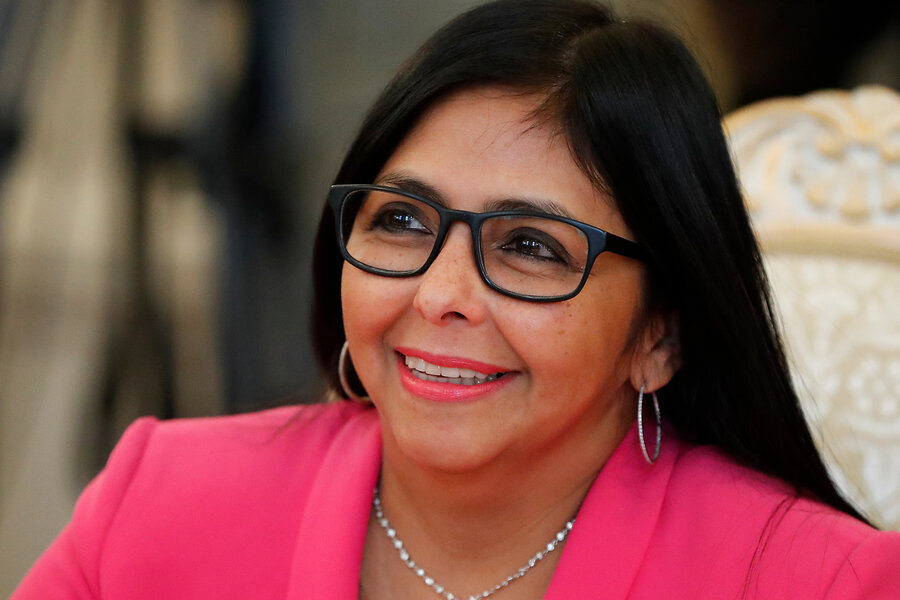
Vice President and oil minister Delcy Rodríguez, part of a powerful faction that made up the Maduro regime, was sworn in as interim president Jan. 3. That transition was dictated by the Venezuelan Constitution – but it surprised many when she was backed by the U.S. president. Donald Trump said in a press conference that Ms. Rodríguez was “essentially willing to do what we think is necessary.”
Ms. Rodríguez, who initially called the U.S. administration “extremists” who violated international law, changed her position a day after the strikes. Writing on social media Jan. 4, she declared, “We invite the U.S. government to collaborate with us on an agenda of cooperation.”
“Putting Delcy [Rodríguez] in charge is … just more of the same,” says a retired teacher, F.B., who lives in the capital, Caracas. Like others in this story, she is identified by her initials to protect her safety amid escalating government repression. Ms. Rodríguez “played a part in getting our country to where it is today. … Venezuela is destroyed.”
Who should lead the nation?
Since Mr. Maduro was first narrowly elected president in 2013 following the death of his charismatic predecessor, Hugo Chávez, a long-divided Venezuelan opposition has come together. It briefly held a majority in the National Assembly in 2015 and boycotted elections it deemed unfair in 2017 and 2020. It declared a separate “legitimate” president in 2019, who was recognized by the U.S. and other international powers, and led widespread pro-democracy protests in the past decade that were stamped out by violent government repression.

In July 2024, Venezuelans overwhelmingly voted in presidential elections for opposition candidate Edmundo González. He was a surrogate for opposition leader María Corina Machado, this year’s Nobel Peace Prize laureate, who was barred by the government from running. Official vote tallies obtained by the opposition showed Mr. Gonzaléz earning nearly 70% of the ballots; Mr. Maduro clamped down, claimed electoral victory without proof, and began his third consecutive term.
Over the past year and a half, many inside the country started to feel Venezuela’s situation would never be resolved without outside military support. But if that happened, many say they expected the “rightful” winner of the 2024 vote would step in to lead.
A “tigress”
Ms. Rodríguez, who studied labor law in Caracas, grew up in the shadow of the Cold War. Her Marxist guerrilla father was allegedly tortured and killed in the 1970s at the hands of Venezuelan police. He was arrested for his suspected role in the kidnapping of a U.S. businessman.
She sought postgraduate education in Europe and returned to eventually take up public office in Venezuela, fully entrenched in what’s known as Chavismo, a political movement named after the late president. She was dubbed a “tigress” by Mr. Maduro for her unrelenting defense of his government, of which she became vice president in 2018.
“There’s a certain satisfaction with Maduro’s detention, but we know this just cut off one of Hydra’s heads,” says A.V., a young history professor in Caracas. With Ms. Rodríguez, the U.S. and Venezuela will be able to “maintain the illusion of following Venezuela’s Constitution, but in reality it’s just a change in CEO, the arrival of new investors, because the former ones” – Cuba, Iran, and Russia – “were weakening,” he says.
In the meantime, the security situation worsens in Venezuela. On Monday, armed civilian gangs loyal to Chavismo set up checkpoints across Caracas, stopping passersby at random to review their phones for photos or messages that might show support for Mr. Maduro’s capture, locals say.
Analysts say the U.S. might have wanted to find a partner within the existing government apparatus in Venezuela for multiple reasons. Members of Mr. Maduro’s regime hold power over the military, intelligence agencies, and the heavily armed paramilitary gangs. Relying on top regime power brokers was recommended to Mr. Trump by the Central Intelligence Agency as a way to maintain stability after extricating Mr. Maduro, according to reporting by The Wall Street Journal.

Foreign journalists were detained, with many subsequently released, in the past week. On Thursday, the president of the National Assembly, Ms. Rodríguez’s brother, announced the government would be releasing an “important number” of political prisoners. Between 800 and 1,000 are behind bars, according to local watchdog groups.
What’s next
So far, the U.S. has made no public demands on Venezuela to release prisoners or lay off public intimidation and repression.
But, “Trump never said this was about democracy,” says David Smilde, a Venezuela expert at Tulane University. “He always just talked about Venezuela as this source of crime, violence, drugs, and immigrants – and also having all these oil resources.”
The opposition led by Ms. Machado also didn’t lean in to a pro-democracy argument for Mr. Maduro’s ouster, because it was clear that this wasn’t going to appeal to the Trump administration. It “goaded him” into taking military action by talking about national security and economic opportunities, Dr. Smilde says. But he anticipates the opposition’s approach could change in coming weeks, especially now that it’s clear its “fantasy” of leading Venezuela was passed over in favor of Ms. Rodríguez, he says.
“This transition couldn’t have begun without the U.S. pulling Maduro out of the country. That’s enough for many in the diaspora,” says Silvia Pedraza, a professor at the University of Michigan who has written about the political role of the Venezuelan diaspora.
“Finally, it’s all over,” says Sergio Rodríguez, who fled Venezuela in 2017 and now works for a private car service in Miami. “It’s a feeling that things are going to get better and that our people will get the country we deserve,” he says by telephone Monday.
For those inside Venezuela, the situation feels far from over.
“It’s those left inside Venezuela who we should be listening to now, because they’ve suffered the most,” says Dr. Pedraza.
Whitney Eulich reported this story from Mexico City, and Valentina Gil from Caracas.