To Duane Quam, the story that unfolded last month in a gritty online exposé was, in some ways, old news that had finally gotten national attention.
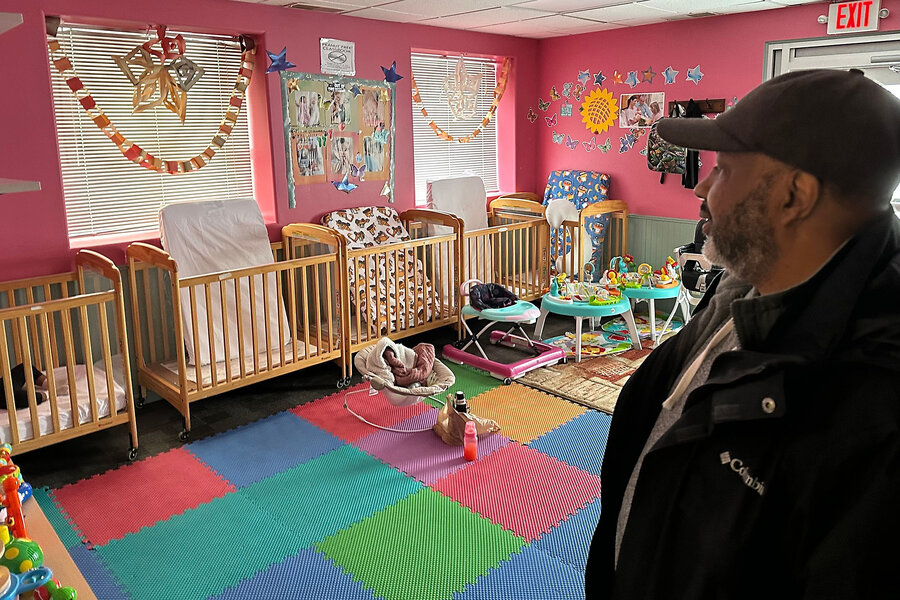
A 43-minute video, released just after Christmas, showed what appeared to be empty day care centers that had purportedly received large sums of government subsidies.
And it wasn’t just Mr. Quam, a Republican state lawmaker, who noticed it. Produced by a young, self-described independent journalist named Nick Shirley, the video went viral.
Why We Wrote This
The documentation of society, once the purview of traditional media, is being increasingly challenged by nontraditional reporters, as evidenced by Nick Shirley’s viral video. It triggered dramatic White House action, even amid questions about the veracity of his claims.
Now it has become an accelerant for the growing political tension between the Trump administration and the state of Minnesota. That tension has fueled larger federal scrutiny of day care centers nationwide. And it intersects with a Trump crackdown on unauthorized immigrants that, on Wednesday, flared into controversy when an immigration agent shot and killed a woman driver in Minneapolis.
After its release, the day care video by Mr. Shirley quickly gained traction among top Trump administration officials, who cited it as they launched significant federal penalties, even as questions were emerging about the validity of the video’s claims.
That the story about alleged day care fraud catapulted into national headlines not through a traditional media outlet but via an unaffiliated newshound highlights a profound shift in the way Americans now absorb information – often through unverified or incomplete reports – and how those reports can impact lives and communities.
Mr. Quam and others had been reading local reports about fraud for years. Yet the new video, now viewed over 140 million times on social media, added fuel to an already white-hot debate about scams in Minnesota, particularly within its Somali community. It built upon the attention President Donald Trump had thrust upon a years-long, multimillion-dollar fraud investigation, starting in early December.
Moving swiftly following the video’s publication, the Trump administration first announced a freeze on all child care payments to Minnesota, then extended that penalty to all 50 states, with the promise of restored funding once states provided new levels of verification. The administration followed up by deploying 2,000 agents to Minnesota to investigate alleged fraud and immigration violations. And on Tuesday, the administration announced a $10 billion funding freeze for child care, social services, and cash support, specifically targeting five Democratic-led states: Minnesota, New York, California, Illinois, and Colorado.
On Monday, Minnesota Gov. Tim Walz, the 2024 Democratic vice presidential nominee, announced that he was ending his bid for a third term as governor, in part due to growing attention to the fraud reports and investigations.
Old story, new platform
Mr. Shirley’s report did not tackle an unknown issue. Local news outlets, such as The Minnesota Star Tribune and Sahan Journal, had been on the case for years, tracking federal investigations into several pandemic-era schemes in Minnesota in which 98 people – the majority of Somali background – were indicted for allegedly stealing taxpayer funds. A November report in the conservative City Journal raised claims that some of the money was routed back to a terrorist group in Somalia, capturing Mr. Trump’s attention. The president criticized the fraud and also referred to the Somali population in derogatory terms.

When it appeared just after Christmas, Mr. Shirley’s viral video added claims that many of the state’s day care centers were inactive.
Those claims have not been independently verified.
The Star Tribune visited four of the featured facilities and found children present. State officials and local media report that all but two of the 10 centers Mr. Shirley visited were licensed and had passed recent inspections. One official noted that Mr. Shirley had recorded empty spaces or locked doors without considering that centers often lock doors and bar unexpected visitors for safety reasons.
Some media law experts also characterized Mr. Shirley’s report as biased and sensationalized, saying it pushed an “anti-immigrant” and “anti-Muslim” narrative and targeted Somali-run businesses.
Mr. Shirley, for his part, has responded to critics by saying that “fraud is fraud,” regardless of the ethnicity of those involved.
Reporters’ rules and responsibilities
Still, a new reality is apparent: The documentation of society by established media institutions is being increasingly challenged by new narratives from individual influencers. In part, these nontraditional reporters, who often work without fact-checkers, are feeding demands for news that confirms suspicions about the federal government and immigrants. Mr. Shirley’s report came on the heels of the three-year, pandemic-era probe of what Acting U.S. Attorney for Minnesota Joe Thompson called “industrial-scale fraud.”
“The people who are bringing these stories out are looking for a different type of thing,’’ says Representative Quam, a Republican who represents a rural district outside Rochester, Minnesota. “But it’s also the sharing of tips or pieces of information that, when you put them together, is a large enough story to break through the glass ceiling of mainstream media and reach the public.”
Vice President JD Vance, for one, mused online on Dec. 28 that Mr. Shirley’s work had already had a greater impact than that of past Pulitzer Prize winners. It was not, perhaps, irrelevant that Mr. Shirley’s video was favored – and boosted – by a media-savvy White House.
“This is absolutely a paradox of the First Amendment, which is that anybody who wants to be a journalist can be a journalist,” says Kevin Lerner, author of “Provoking the Press,” a book about a crisis of confidence in the news business. “The news-consuming public needs to kind of set the standard for what good journalism is, and if people think … Nick Shirley [is] good journalism, then you’re going to get a lot of that.”
In at least seven states, small teams of influencers and independent journalists have begun approaching day care centers, including many run by Somali Americans, to inquire about attendance and funding, according to media reports.

Kerem Yücel/Minnesota Public Radio/AP
“We are in a different media environment where the White House, in particular, is apt to take cues and reference points from para-journalists to a degree that far surpasses anything we’ve seen before,” says Seth Lewis, co-author of “News After Trump: Journalism’s Crisis of Relevance in a Changed Media Culture.’’
Unpacking storylines
The growing ranks of modern-day muckrakers, who range from former missionaries for the Church of Jesus Christ of Latter-day Saints like Mr. Shirley to urban lawyers, are often bonded, in their views, by a mission to reveal truths, expose lies, and poke at societal norms.
At a White House roundtable in October, Mr. Shirley described himself as a “100 percent independent YouTube journalist,” although critics argue that his findings are often tailored to support conservative viewpoints and include deceptive practices.
Regardless, the perception that these reporters, even if their work is uneven, might uncover fundamental truths or expose rough edges of reality attracts audiences.
This content “does not look as professionally polished and produced, and people see that as being somehow more authentic and believable,” says Mr. Lewis, a journalism professor at the University of Oregon.
And while many findings can be corroborated, whether the work of Mr. Shirley and others provides reliable evidence of illegal behavior is far from certain. Meanwhile, concern has arisen that their work could perpetuate biases.
Cam Higby, another documentarian who has published videos from his visits to day care centers in Washington state, told NBC News that the day care providers in his videos may not have been breaking any laws.
What’s more, in Mr. Shirley’s video, “it turns out that some of the places had already been investigated, other places were not open over the holidays, and others had not been charged or accused of any wrongdoing,” says Edward Ahmed Mitchell, the national deputy director of the Council on American-Islamic Relations (CAIR) in Washington, D.C.
“No journalist in their right mind would make such a serious allegation against an individual or a business unless they triple-check the facts. So the big question is: Will this individual face legal consequences for defamation? When you say something of consequence, there can be consequences for it.”