If the Office for Budget Responsibility cannot prevent catastrophe, what purpose does it serve?
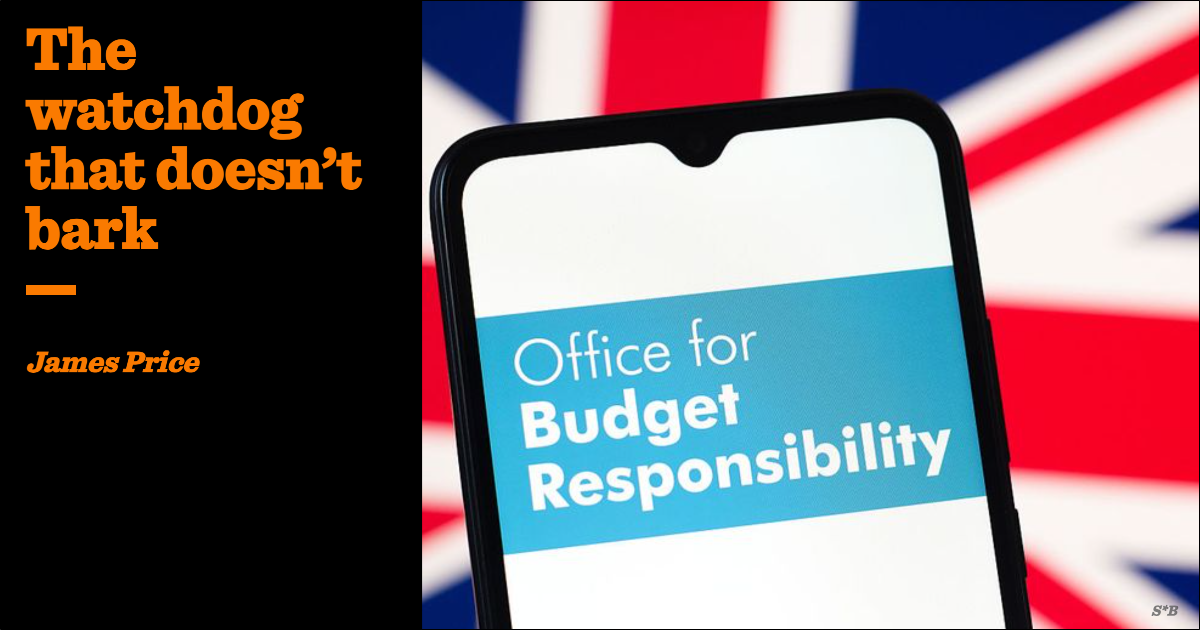
Quis custodiet ipsos custodes? Since 2010, the nation’s most influential watchman, or watchdog, has been the Office for Budget Responsibility (OBR), a QUANGO set up by George Osborne to provide independent analysis and forecasts based on the announcements made by Chancellors. But since then, Britain’s debt has continued to soar, we now pay a so-called moron premium to borrow money, and our fiscal position threatens the future of the nation itself. And so Nigel Farage, leader of Reform UK, has said that he is considering scrapping the OBR. I encourage him to consider this very strongly.
The argument for the OBR in the first place was that Gordon Brown had been able to fiddle the numbers by only looking backwards, using past surpluses to justify present deficits. And it is true that the Coalition inherited a deficit to GDP ratio of 10%, and bond markets were demanding action. And as Osborne’s excellent Chief of Staff, Rupert Harrison has warned OBR-sceptics: “Those Conservatives who have been suspicious of the OBR should note the way that it has skewered wishful thinking from the left just as effectively as from the right.” The OBR has indeed punctured Labour’s fantasy numbers from opposition days from leftist outfits that ought to be fiscally discredited — like the Resolution Foundation.
To be fair, there is a complicated paradox here. Similarly to the OBR, the Treasury is known as the only department that says “no” to spending in Whitehall, and thus acts as a much-needed block on all kinds of insane and evil spending from elsewhere. However it also suffers from what critics call “Treasury-brain”, and therefore also rejects spending on things that could, and indeed now do, provide a positive return to the nation.
The OBR is guilty of the same “Treasury-brain”, and the hard wiring of its rules now binds politicians into its own methodologies.
Cautious that the OBR’s strictures would prevent her from the radical change she thought necessary (understandable, given their forecasts have never been close to being right), Liz Truss tried to sidestep the OBR process entirely. This was clearly a disaster, but she and her Chancellor also failed to discuss her plans with her wider team, her parliamentary colleagues, the Bank of England, or, y’know, any of the outside world.
And even the Truss debacle hasn’t resulted in a better fiscal outlook for Britain. I don’t seek to defend Truss’ plan, merely to point out that it was, in the end, the markets and her colleagues who did for her, and would have done even if the OBR did not exist.
In fact, since the creation of the OBR, Britain’s budget has been anything but responsible. As a percentage of GDP, public sector net debt was around 70% in 2010 but climbed to approximately 95% by late last year (peaking at 98% during covid). The deficit was reduced, briefly, to almost nothing after years of mild spending restraint, but has shot back up again. Crucially, no one genuinely expects Labour to deliver the growth or austerity required to validate the OBR’s forecasts, which nonetheless assume that the deficit will obligingly decline.
But now the Adam Smith Institute has released a terrifying report, “Foreboding Fiscals”. The title is apt; it shows, with the OBR’s own forecasting, that Britain’s national debt is on course to hit 330% of GDP by 2075. Our debt will be more than three times the size of the economy.
Now complete the formula, and add to this spending and debt explosion the following; sluggish growth, expanding welfare payments, the “real debt” (shown by the TaxPayers’ Alliance of being many trillions higher because of unfunded public sector and state pension liabilities) plus the secret nuclear black hole that Dominic Cummings has warned about. Britain’s economic situation is nothing short of existential.
Obviously the OBR is not to be blamed for this; it is the fault of the politicians (and the voters). But the OBR has provided both a fig leaf of defence for wildly irresponsible chancellors, and an abnegation of responsibility from Parliament to hold such reckless spending to account.
In fact, this is not unique to economics; a trend 80 years in the making has seen governments, on both sides of the Atlantic & the English channel, push power away from themselves and towards QUANGOs and other bureaucratic bodies, in the hope of insulating themselves from blame when things go wrong. This is a doomed strategy.
Voters and journalists will always finger the politician, and said elected minister will then lack the administrative power to do anything about whatever problem arises.
I saw time and again this inside Government; something bad happens, but the blob surrounds the Minister and prevents them from taking decisive action. Whether you call this, the deep state, the administrative state, the stakeholder state, it all amounts to the same thing — politicians scared of power and people suffering as a result of inaction.
So both Farage and Kemi Badenoch are right to consider scrapping or changing any public body that does not have direct ministerial oversight. There are some public bodies for which there is a good argument to keep them independent of the Executive, but each of these should either be headed up by a member of the Lords (and therefore accountable to their fellow peers), or else select committee chairs should have much more legislative power to scrutinise them, much like in the US Senate.
If even a body as influential as the OBR, with the importance of the economy to our national survival, can fail so totally, isn’t it time we scrap it and try a different method of accountability?
Britain has left the European Union, and will leave the ECHR, because they inhibit the ability of our sovereign Parliament to effectively govern the country. But whilst these are necessary steps to fix our constitution and then our country, they are not sufficient. The Conservatives have learned through bitter experience, and Reform by watching both the Tories and now Labour, that power and legitimacy have been frittered away. It is those in office who ought to be ultimately responsible, not the quangos.