On January 3rd, those of us in European time zones awoke to the news that President Trump had authorised one of the most audacious special forces operations since the Germans whisked Mussolini from under the noses of the allies in 1943. In a spectacular feat of planning, logistics and daring, Delta Force had located and captured a hostile and heavily guarded Head of State, and successfully exfiltrated him from his own capital city and into American custody.
To mark the occasion, prominent commentators from Britain’s most reputable media outlets treated us to a display of some of the most masterful point-missing and artisanal parochialism ever witnessed in the history of social media. The Financial Times’ Gideon Rachman wondered whether the operation might give Vladimir Putin any ideas about making a similar move on Zelensky, or how the West would now possibly be able to parry a Chinese assault on Taiwan without the ability to say “hey, that’s illegal”. “Exactly,” commented The Guardian’s Will Hutton.
Meanwhile, ITV’s Robert Peston worried about America losing its ability to “lecture” nations of “the global south” convincingly, and thought that Keir Starmer might find himself in a tight spot if British intelligence couldn’t come up with evidence to corroborate White House claims about Maduro running a narco syndicate. Peston was well placed make such a prediction, given that he was the one who would be suggesting to the British public on the news a few days later that the Prime Minister was either failing to stand up for international law in order to avoid antagonising the Americans, or was antagonising the Americans by standing up for international law. In either case, the mysterious signifiers that show whether or not a British prime minister retains the favour of the gods were in flux.
We don’t necessarily expect regular columnists and presenters to be experts in absolutely everything. That Rachman was apparently unaware — or had just forgotten — that Putin has made at least one definite attempt to kill or capture Zelensky, might have been less forgivable in a war correspondent than in a generalist. Perhaps foreign policy specialists might have taken this as an opportunity to consider whether the concept of international law was still a meaningful principle in world affairs, given that each of the major powers with the ability to enforce it seems to have disregarded it. This might even have led a thoughtful pundit toward a more substantial consideration of where that left Keir Starmer, given that so much of the way he thinks about international relations seems to be based on law rather than power.
Rachman is the last of an older school of career foreign correspondent, as opposed to an international relations specialist, having served as a reporter in Washington before representing The Economist in various roles in Asia. He then went on to Brussels and cultivated a career-defining interest in the EU, and was among an influential cohort of British journalists who favoured a looser, larger Union. These hopes would be dashed by the 2016 referendum, and like many of those Brits who had previously devoted their time to criticism of the EU’s more self-destructive, power hoarding tendencies, he has gone on to spend the years that followed castigating the decision to leave as illogical and devoid of reason. In this latter role, he has benefitted from the aura of omniscience that has been lavished onto professional Brexit-scepticism in prestige media.
Following a PPE degree at Oxford, Robert Peston spent two years working as a junior stockbroker in the early 1980s, before going into journalism as a City correspondent. This led him to the Financial Times, where he transferred into political journalism. He later moved into broadcasting, becoming business editor of the BBC, and has made his name out of being someone who is thought to know a bit about finance and economics in the world of political reporting, and as someone who knows a bit about politics in the world of business reporting. There is something peculiar about modern Britain more generally in that the easiest way to enhance one’s reputation as a specialist in a particular field is to step into an adjacent one and talk about it.
I pick on Rachman and Peston not because they are especially egregious, but because they typify the career progression of journalists of their generation. They are both clearly intelligent men, and Peston in particular carries himself rather more lightly than members of the thin-skinned, status-obsessed and overwhelmingly female cohort that followed. But in both cases, their real expertise is in the workings of the news business itself, rather than in finance, politics or foreign relations. Peston gained a lot of his reputation due to his well-publicised fallings out with Alastair Campbell during the New Labour era, and it was during that period that the line between the news business and actual politics seemed to disappear entirely, at least as far as domestic British political reporting was concerned. Beyond anything that actually happened, the degree to which No.10 had the lobby transfixed was the story of the time.
The result of this is that we have a generation of commentators who struggle to think outside of the framework of comms and narrative as they analyse events. And we saw that very much on January 3rd, as Britain’s journalists fell over themselves to decide whether or not Trump’s coup in Venezuela was a good look, and whether it presented British politicians with a problem of “optics” insofar as they would have to comment one way or the other on what had happened. In particular, almost the entire media class seemed to be convinced that the real danger was that Putin and potentially the Chinese would be “emboldened”, and that the risk of appearing hypocritical would henceforth be the main restraining factor on America’s inability to contain its rivals.
There seemed little place in any of this analysis for consideration of hard power, or the economic conditions that might back it up. Nothing of America’s sprawling military industrial complex, nor China’s rapid strides toward matching it; less still anything about the increasing hollowness of Europe’s self-defence capacities or strategic autonomy. There also seemed to be either a lack of awareness of certain basic facts, or just an unwillingness to include them in the frame of reference. China doesn’t consider Taiwan to be a foreign country at all, so their view of “international law” doesn’t come into it. In any case, they flagrantly ignore all sorts of treaty obligations and international customs all the time. And even if our commentators weren’t aware of that, they are surely aware that Vladimir Putin has already invaded Ukraine. It almost seems as if they are only capable of computing a single variable at a time. The overall impression is of a style of analysis that would be more suited to the world of fashion or society gossip than statecraft.
If the standard of commentary that British audiences have come to expect on international affairs is poor, then things are even worse in domestic reporting. This became especially apparent at the government’s miserable “daily briefings” during the pandemic, when reporters were hostile to any attempt by ministers or officials to communicate uncertainty, or to explain the logic of their positions to the public. Instead, there was a reflexive and insistent impulse to enforce the principles of quotidian political reporting. That meant scourging any official statement for evidence that policy might be changing for any reason, in order to cast that as duplicity or weakness; demanding that decisions be confirmed today even when they depended on future variables, and a paranoia about hypocrisy. Their questioning reflected a view of decision-making based on the most reductive binaries, in which any consideration of trade-offs between conflicting priorities was regarded as inherently unethical. In their moral universe, each priority should have been considered in absolute terms, on its own.
Moments of absurdity lightened the mood (in particular Peston’s briefly being stumped about how mirrors work). However, like a moment of high drama in world affairs, the pandemic was an unusual event that exposed shortcomings in the way that events are reported to us by the media. It is easy to forget that all of the regular, day-to-day reporting and analysis we consume is fed to us through this same reductive prism, with the same inability to process the second order consequences of decision-making, and by the same set of individuals who don’t really know what they’re on about.
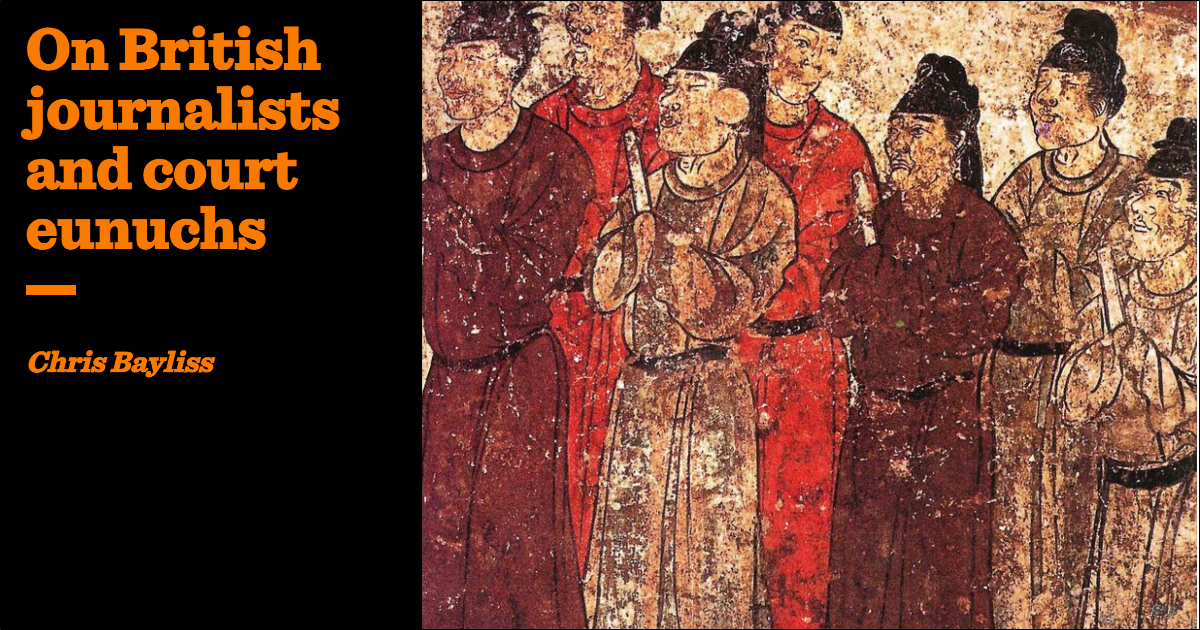
Consider them as the modern equivalents of court eunuchs in Imperial China
The role of regular British political reporting from mainstream outlets is easier to understand if you consider them as the modern equivalents of court eunuchs in Imperial China. Their primary interest is to ensure that protocol is followed, and is seen to be followed, correctly. Protocol being the formulaic aspects of Westminster government; holding together a cabinet and ensuring it presents a single face to the outside world; undertaking the weekly outing at PMQs in a confident and composed manner, and generally avoiding embarrassment. What matters most is projecting a sense of serenity, and maintaining the harmony, the hé (和) of the court at Westminster. If the harmony is disturbed, then the eunuchs will signal the prime minister’s failure by becoming excitable; this then irritates the public, and makes potential voters consider that it might be preferential if the prime minister was replaced, in order to placate the eunuchs and thus restore serenity to the Kingdom.
If the serenity deteriorates further and rigmarole ensues, then at some point, the eunuchs will take the most drastic step available to them; flying a helicopter over the Palace of Westminster, and broadcasting live, aerial footage of the unmoving building to the people, emphasising the shame that has been brought upon the court. But providing that protocol is followed and harmony is maintained, then the actual content of policy rarely attracts their interest. For example, there is currently legislation underway that will allow the state to kill people, and last year legislation was passed that allows babies to be “terminated” up until they are ready to be born. This legislation only bothered the eunuchs at the moments at which the specifics of the protocol became contested and rancor threatened to break out. The idea of ethical questions underscoring the rancour would be entirely beyond them, and they would consider it vulgar and borderline obscurantist even to bring them up.
Perhaps none of this is especially important, particularly if we consider news media for what it effectively is, which is a form of entertainment. Insofar as our eunuchs actually wield any real power at all, it is only to swap one prime minister for another interchangeable figure. The public don’t really allow them to influence their own views all that much, and they tend to make up their own minds about leaders based on gut feeling and whether or not they seem to have their own luck. People are aware that they oughtn’t trust too much what they hear on the television or read in the paper, but they have basically accepted the court eunuch style of reporting as being what news looks and sounds like. It’s only when something big happens on the world stage, especially in this era of social media, and journalists start trying to think aloud that we really get to see how limited their vision and understanding really is. Especially when Jon Sopel does it.
As people burrow down deeper into their own specific areas, it leaves a lack of shared comprehension of more general principles
But where we may have a more serious problem is in the transformation of the nature of expertise in modern society, and the fact that we no longer have a class of people left in public life who combine both relative depth and breadth of understanding. As the expanse of human knowledge and the complexity of the economy has grown, the increasing share of the population who make their living by what they know have been forced into deeper and deeper specialism in order to compete. The risk is that as people burrow down deeper into their own specific areas, it leaves a lack of shared comprehension of more general principles. In a democratic society, this is corrosive to the concept of decision-making, as there isn’t the check on specialists who have gone down particular paths of reasoning which laypeople might be alarmed by if they had a better understanding of what was going on.
One example of this might be a prime minister and an attorney general who, by virtue of their own professional backgrounds, took a highly legalistic approach to international relations, and used that as the basis to make questionable strategic decisions. One might hope that the preponderance of well-informed opinion would act as a counterweight. But if your elite class is made up of individuals with minute specialisms in financial derivatives or marine biology or tax law who are taking their cues from journalists who believed that “international law” was going to stop China invading Taiwan, your hypothetical prime minister and attorney general lack that constraint.
Another example is in energy policy, and the way in which zealots may be taking advantage of a glaring gap in the basic technical understanding of the policy-making class to lead the country down a catastrophic path. Though there is a substantial number of people among the relevant bit of “the elite” — which includes civil servants, ministers, regulators and people in the financial services sector — who do have the critical technical knowledge, there may be a sufficient mass of those who lacked that understanding for the elite to behave collectively as if it did not. Such being the herdlike nature of elite consensus.
It’s long been fashionable to worry about the ignorance of the general public, and how easily distracted they are by trivia and low-status rubbish. This is reinforced by the fact that even relatively high-brow news media seems to be pitched at roughly the level of an intelligent nine year old. But our actual problem might be that we no longer have a class of ten or fifteen percent of the population who are reasonably well informed about a broad range of subjects — from politics, to economics, science, foreign relations, or the arts. Instead, we have Financial Times man and woman — intelligent people with impressive specialisms in their own fields, but who are functional midwits when it comes to assessing broader questions about society.