Before my first visit to Senegal in October, I was warned that things don’t always function smoothly. The power goes out at a moment’s notice and ATMs often run out of money. Traffic gets so backed up on the highway that drivers have time to buy peanuts and candy from street vendors. When it rains, the sewers clog, making pedestrians hop through a maze of muddy puddles in an unchoreographed dance.
What struck me, though, was how much does work, thanks to people’s creativity in the face of these challenges.
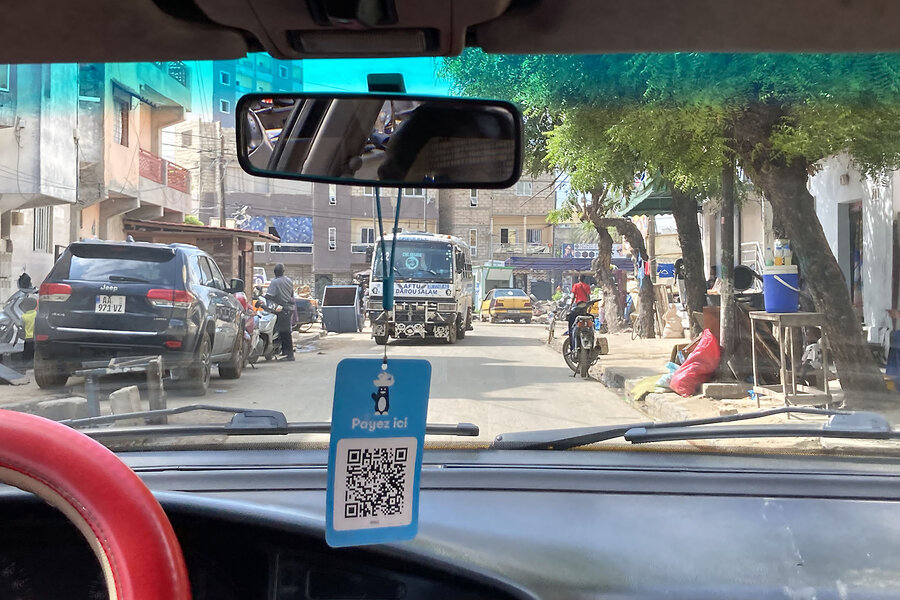
Take the clandos – the “clandestine” unregistered taxis that fill Senegal’s roads, plugging gaps in the public transportation system. These ancient, black-and-yellow Peugeots look as if they are held together with duct tape, sporting leather interiors covered in dust and exhaust pipes that belch black fumes into the atmosphere as they crawl down the street. These taxis are not registered anywhere.
Why We Wrote This
In Senegal, our reporter finds a nation powered by millions of tiny daily acts of entrepreneurship and creativity.
In one car that my colleague Essouly and I rode in, the doors were so bent out of shape that they needed to be body slammed shut from the outside. As our driver was performing this service, our taxi started rolling away. He jogged to catch up before nonchalantly driving us away.
The Senegalese have a word for a person like these clando drivers, who create their own opportunities from whatever they can hustle together – un débrouillard. It comes from the French verb se débrouiller – to get by, or to find a way.
Senegal is a nation of débrouillards. On street corners, hawkers sell tiny plastic pouches of drinking water they filter and fill at home. Women collect used plastic bottles coughed up on the beach and sell them to recycling centers. On city streets, teenage boys weave horse-driven carts through rush hour traffic, transporting hay, sacks of millet, or tires for some quick cash.
Taking practically nothing and making it into something is one of the engines of this society. Creative entrepreneurship, la débrouillardise, seems to be baked into the consciousness of everyone who grows up here.
But so is another notion: that things are better elsewhere.

Practically everyone in Senegal has been impacted by migration. Tens of thousands of young people leave in small wooden boats each year to seek a better life in Europe. Gleaming new multistory houses built with money they send home sit alongside crumbling, dilapidated apartment blocks in Dakar’s suffering suburbs. Everyone knows someone who has made it to Europe, or perished at sea.
Now the government is trying to create more opportunities for young people to stay and invest in their country. The education ministry launched its “Young Talents” program this summer to promote youth employment and innovation. Mentorship and coaching programs aim to build a new generation of entrepreneurs.
It’s a hefty challenge. Research shows that when underdeveloped societies become more prosperous, people’s horizons broaden. To begin with, they migrate more, not less. It could take more than a generation before Senegal sees the results of its efforts.
Still, a young server named Ibrahima in one of Dakar’s luxury hotels tells me he thinks it’s a good idea for the country to invest in the energy and potential of its young people so they don’t feel the need to take that risky, nearly 1,200-mile sea voyage.
He would know. He, too, boarded a wooden fishing boat three years ago, heading to Spain’s Canary Islands, hoping for a fresh start. But after a year, he was deported. Now Ibrahima says he just wants to make Senegal better.
“We need to build up our country,” he says, serving drinks as palm trees sway in the bay. “It has so much potential.”
For me, Senegal’s débrouillards are proof of that potential. After all, their countless improvisations already keep the country running. If la débrouillardise could be harnessed in a clear direction, wouldn’t that be an incredible thing?