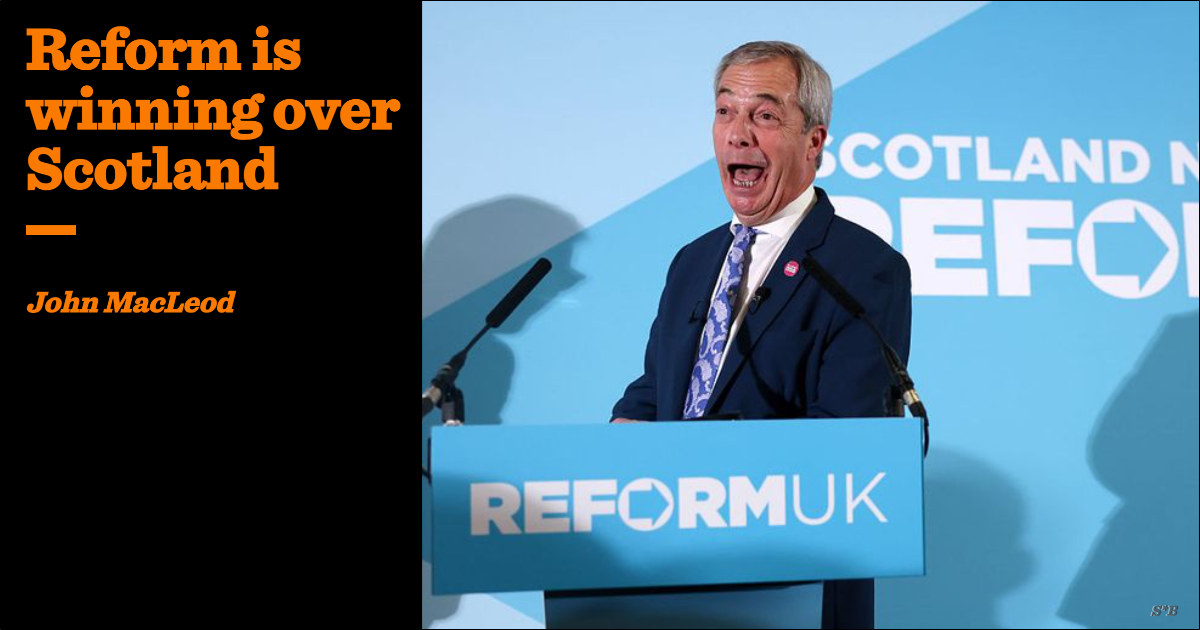
It barely registered in London’s press, but on Thursday 11 December Reform UK’s David McLennan won a local council by-election in West Lothian. In seizing this seat from Labour, it was Reform’s first ever electoral success in Scotland, and it was won under the alternative vote — a mechanism that had hitherto denied Reform in Clydebank, Stranraer and elsewhere, as a timid middle-of-the-road majority had always ultimately recoiled.
Despite eight rounds of transferred preferences, McLennan topped the Whitburn and Blackburn poll from the off and headed the count at every stage — and it was hardly the sort of electoral terrain in which, in normal times, one would have expected Nigel Farage’s candidate to prosper.
West Lothian has been a knock-down-drag-out fight between Labour and the Scottish National Party for as long as anyone can remember. Between them, the two parties — long the Rangers and Celtic of Scotland’s politics — hold twenty-six of the thirty-three council seats — and, three weeks ago, the Scottish Conservative and Unionist candidate earned just 129 votes.
A hard thing to swallow in an area, once a strong mining community, now increasingly the terrain of Legoland housing-developments, all unfenced lawns and double-garages, for Edinburgh commuters.
A century ago, in Labour’s first big Scottish breakthrough, what was then Linlithgowshire fell to Emanuel Shinwell — London-born, Glasgow-reared and of Jewish heritage; a central figure in “Red Clydeside” briefly imprisoned in 1919 as a suspected Bolshevik insurrectionist — despite such grotesque lines from opponents as “The Linlithgow Kid versus the Gorbals Yid”. (Shinwell, blessed with perky mien and length of years, would serve in the administrations of Ramsay MacDonald and Clement Attlee, and only quit the House of Commons in 1970.)
Of more immediate significance was the West Lothian Parliamentary by-election of 14th June 1962, won by Labour in the improbable person of Sir Tam Dalyell of the Binns, an Old Etonian who spoke as if his teeth were in the middle of his forehead. This was a sensation at the time because the Tories, by then in power since 1951, lost their deposit.
Of less metropolitan note was who had come second — Billy Wolfe of the SNP, as that emerging political force continued its quiet rise in Scottish politics, from a host of factors ranging from “Retreat from Empire” to Harold Macmillan ceding Washington the Holy Loch for a huge US naval base.
The Firth of Clyde inlet thus became assuredly the first Soviet missile-target in the event of nuclear war, which could have fried the mass of Scotland’s population at a stroke. Wolfe and Dalyell still share an entry in the Guinness Book of Records, as from 1962 to 1979 they fought each other in seven successive head-to-head elections.
The closest Wolfe ever came to winning West Lothian for the Nationalists was in October 1974 — Dalyell’s majority was 2,690 — and it is instructive that Dalyell to the last held every Nationalist challenger off with patrician ease on a platform of unpasteurised Unionism, refusing to have any truck with independence, federalism, Home Rule, devolution or “fiscal autonomy”.
Shaken by the electoral turn, three weeks ago, a pair of BBC Scotland reporters scampered to Whitburn and Blackburn with the air of conquistadores handing out strings of beads.
Save for the European Parliament elections of 2014 and 2019, Scotland had hitherto proved impervious to the be-Cuprinoled charms of our Nige. To their broadly veiled disappointment, David Wallace Lockhart and Morgan Spence did not find a community aboil with rage over immigration, in mass-mourning for Enoch Powell, or sick about all the people of colour in television commercials.
This is a moment nonetheless. So what has led a former mining town between Glasgow and Edinburgh to turn to the party of Nigel Farage? In the words of multiple people we spoke to, it’s all quite simple — they’re “fed up” …
Quite so. The concerns exercising the voters of Whitburn and Blackburn are, in fact, pretty well those exercising people the length of the realm.
A lamentable succession of failed Prime Ministers and hapless governments, the cost-of-living crisis, a British economy in a persistent vegetative state for some seventeen years, people pouring off small boats while pretty well laughing at us, courts that at every turn refuse to do anything about it, and the unvoiced but general dread of Islamic terror.
Our political class, clearly, is now the realm of ineptitude and idiocy. Take the reluctance of ministers either side of the Border to acknowledge biological reality and secure safe women-only spaces, or the latest twist in the Scottish Government ferry-farce.
Ordered in 2018 alongside a new Arran boat, the Glen Sannox, it will now be near another year before the Glen Rosa enters service in a double-procurement failure that has cost Scottish taxpayers millions and millions of pounds.
The Scottish ferry farce is not of immediate interest to the voters of Whitburn and Blackburn, amidst long-gone factories and historic pit-bings. But the sense of a political class playing us all for fools assuredly is.
If current polling trends continue — and assuming Scottish ministers do not figure out a way to cancel it — the next Scottish Parliament election, not now six months away, is likely to see the return of a significant tranche of Reform MSPs.
Not on account of racists, bigots and — and, as David Cameron once described them, until his ineptitude put him out of our misery — swivel-eyed loons. On account, rather, of quiet and patient people now terminally fed up.