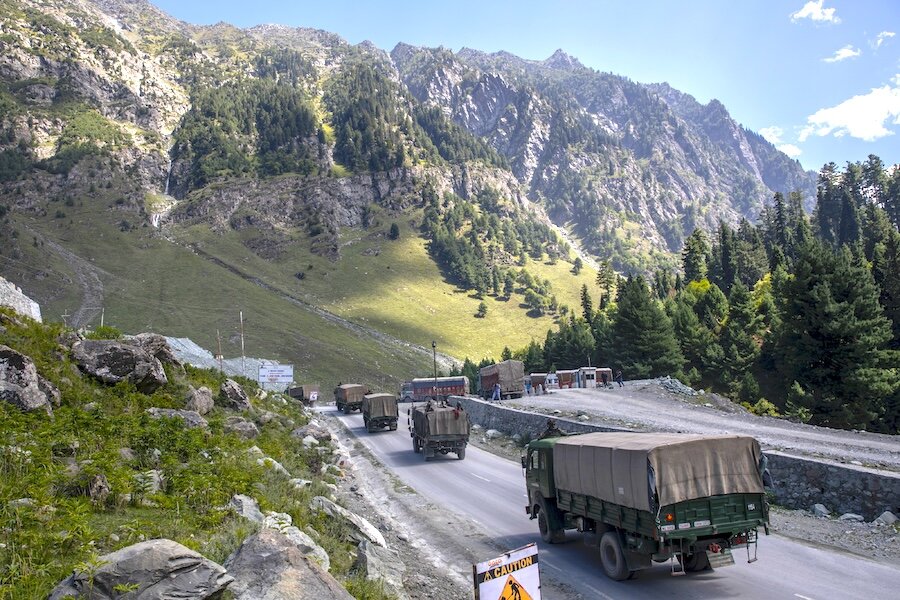
Relations between China and India – the world’s two most populous nations, which also rank among its top five economies – have been fraught and frosty for decades, starting with armed conflict in 1962 along their shared Himalayan border and, more recently, a serious clash in 2020. But going into this new year, there are encouraging signs of a gradual thaw between the two nuclear-armed Asian powers.
Even this slight warming – which one Indian diplomat described to a news magazine as a “state of armed coexistence” along disputed border areas – helps temper potential military flash points. On the political and economic fronts, the prospects are somewhat brighter. The leaders of both countries have met in recent months; flights and tourist travel are slowly resuming. And officials are exploring avenues for economic diversification and integration – moves that could boost regional growth as well as strengthen Global South economies jolted by the unexpectedly steep U.S. trade tariffs of 2025.
This year, India has taken over the rotating chairmanship of the BRICS group, named for its first five members – Brazil, Russia, India, China, and South Africa. Established in the wake of the global economic crisis of 2008, the alliance sought to better navigate and counter Western-dominated economic institutions and alliances. Today, it represents nearly 49% of the world’s population, 29% of global production, and 23% of international trade, according to the World Bank.
Economic pressures and unpredictability, Foreign Affairs magazine observed in November, have pushed BRICS nations closer: “All now have a clearer understanding that they are stronger together than apart.” However, achieving cohesion among countries from multiple continents and with differing domestic priorities takes time and negotiation. Some are concerned about becoming too beholden to China or alienating the United States further. Others cling to policies of protectionism or subsidized production. And China is expanding its geopolitical reach.
Nevertheless, the tentative overtures between BRICS’ two largest member nations hint at the benefits and lessons of even small steps in pursuit of diplomacy and civil dialogue. Given the widening rifts between the U.S. with both India and China, some “America First” proponents might view these closer ties as inimical to U.S. interests. But taking such a zero-sum view misses the larger picture.
“American national interests will be well served if the two Asian giants can ‘bury the hatchet,’” according to Lyle Goldstein, an analyst with the think tank Defense Priorities. Trade linkages between the two would boost prosperity – and thus, stability. And, more importantly, he wrote in The Hill, “The world will not have to watch nervously as two nuclear-armed powers engage in regular, violent skirmishing.”
Those would be big wins from a small thaw.