Butchery. Turgid. Period smut.
These are but some observations documented in the notes I took as I suffered through the new, five-part miniseries that is Joe Barton’s Amadeus (2025). For those who revere Sir Peter Shaffer’s great play, and Miloš Forman’s stunning adaptation of it, as well as music itself, this contemporary effort is about as frustrating as frustrations come. It falls well short of the high mark set by its antecedents, both dramatically and historically.
When viewing this Amadeus, it is impossible not to be influenced by Forman’s film. That adaptation, which in 1984 won eight Oscars and 32 other awards, is some of cinema’s finest escapism. It stars performances, sets and costumes that respect the style of Shaffer’s play; after all, there is much more in Amadeus that resembles commedia dell’arte than realism. It also treats the music of Mozart, Salieri and others miraculously.
Shaffer served as Forman’s screenwriter and this fact cannot be understated. In the film, crassness is effortlessly communicated through dialogue that, just as it is in the play, is in one moment absurd and then immediately biting. Tom Hulce’s infamous laughter shows Mozart’s obscenity. As Constanze Mozart, Elizabeth Berridge is wont to whine — sometimes innocently, other times with petulance. Jeffrey Jones’s aptitude for timing delivers a hilarious Emperor Joseph. These ridiculous characters are then perfectly balanced against F. Murray Abraham’s Salieri, whose icy resolve is broken only by his rival’s dying genius, the Requiem.
Conversely, this new Amadeus tries to be something that is seemingly unsupported by its precursors: a drama, but in the contemporary sense of that genre. Barton’s screenplay attempts to spin Shaffer’s text in original, serious directions. These are not convincing and are particularly undermined by the miniseries’ epilogue. Mozart did not abscond during the composition of Figaro, nor were there riots during the opera’s premiere, nor did Constanze Mozart miss that premiere because she was off in some church having an affair with Franz Xaver Süssmayr. Complementing this unsatisfying ahistoricism is lazy dialogue, delivered by dislikeable characters whose tumults the viewer never comes to empathise with.
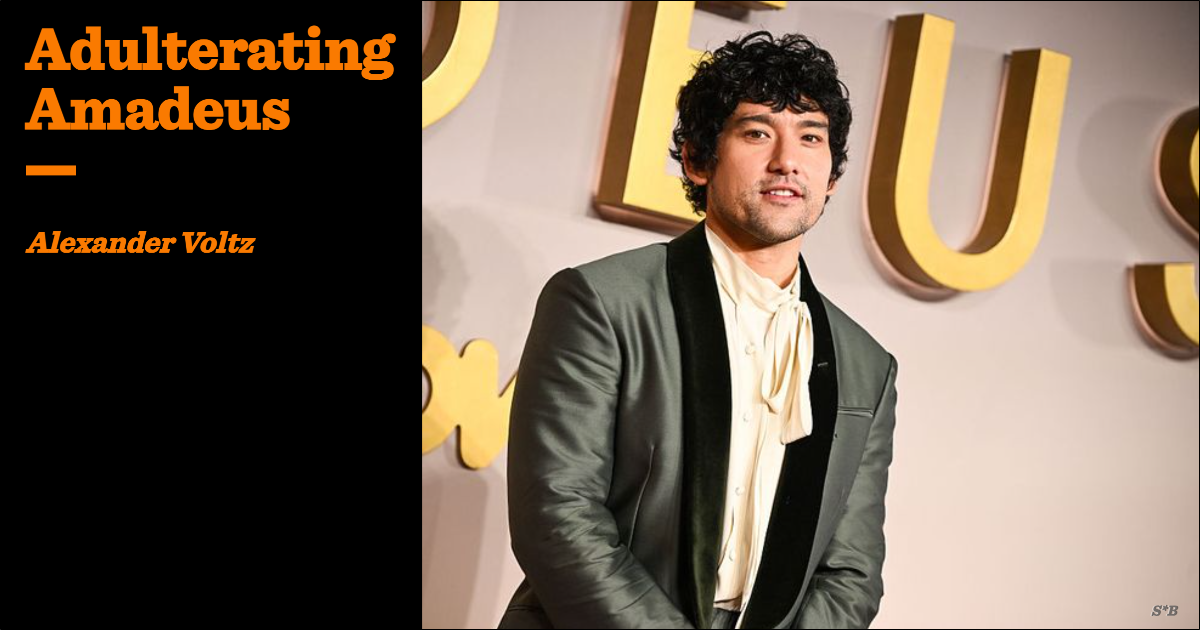
Also abundant is gratuitous hedonism. Salieri (Paul Bettany) masturbates, only to discover deviant urges which he sadistically embraces. Princess Elizabeth (Viola Prettejohn) is depicted as equally depraved. Mozart (Will Sharpe) even ejaculates onto a tray of meringues; the fruit of this labour is later shown, dripping. If you are confronted by these remarks, reader, I am only reporting the scenes that are there. If you think me too prudish, suffice it to say that these salacious inclusions barely advance the plot or its characters, if at all. Sex and swearing are no substitutes for good storytelling — something today’s filmmakers might benefit from remembering.
Then, there is the casting. Because this miniseries at times attempts sincerity, it is right to ask what dramatic purpose is served by the casting of female pit musicians. As the acolytes of Fanny Mendelssohn, Clara Schumann and Louise Farrenc can never let us forget, women did not occupy such orchestral posts. It was not until 1913 that, revolutionarily, the Queen’s Hall Orchestra under the stewardship of Sir Henry Wood hired six female violinists.
Moreover, what dramatic purpose is served by casting Jyuddah Jaymes as Süssmayr and Enyi Okoronkwo as Lorenzo Da Ponte, not to mention Sharpe as Mozart? There is no historical evidence of Mozart taking a pupil who was South Asian; why, then, is Sidhant Anand cast as a pupil of Mozart’s? This is supposed to be Amadeus, not Bridgerton. Mel Gibson would hardly be cast to play Yo-Yo Ma in a biopic of the cellist’s life; if Gibson were, his act would reasonably be dubbed an act of insensitive erasure. The inverse is equally true, even if it is unfashionable to argue.
The very worst transgressions included in Barton’s offering, however, are musical — and that is why they are so lamentable. In Shaffer’s play and then Forman’s film, music becomes plot, character and theme all at once. It is omniscient, the very voice of God, expressing those ecstasies that are unbeknownst to language and so cannot be conveyed through dialogue. The music in Forman’s Amadeus was specially recorded by Sir Neville Marriner and the Academy of St Martin in the Fields. Further luminaries like Simon Preston, Ivan Moravec and Dame Imogen Cooper, among others, contributed to the soundtrack, which remains one of the best-selling classical music recordings of all time.
With this artistry embossed in my mind, imagine my disappointment when, 13 seconds into this new Amadeus, I was met with music that belonged to neither Mozart nor Salieri. Alas, yes: an original score, one that paled considerably when interspersed between fragments of Don Giovanni and The Magic Flute.
A regrettable kind of artwork is one that is without authentic intention. That is exactly what this Amadeus is
The miniseries’ first episode is expressly set in 1781, when Mozart arrives in Vienna. There, he is depicted playing the Sixteenth Piano Sonata — a work that, in reality, does not appear in Mozart’s catalogue until 1788. We are also asked to believe that Mozart wrote Eine Kleine Nachtmusik in 1781 and was experimenting with the theme to the Twenty-Third Piano Concerto’s second movement by 1782; the former was completed in 1787 and the latter added to Mozart’s catalogue in 1786. These chronological faux pas strongly suggest that Barton and director Julian Farino have scant regard for the very music that gives power to Shaffer’s play. The conducting by Bettany and, particularly, Sharpe is just as damning.
A regrettable kind of artwork is one that is without authentic intention. That is exactly what this Amadeus is. It revisits a unique story that others have already told brilliantly; in that revisitation, it fails spectacularly. As the new year dawns, let us reject cinema’s present, yet tired, vogue: to adulterate classic tales in pursuit of profit and ideology.