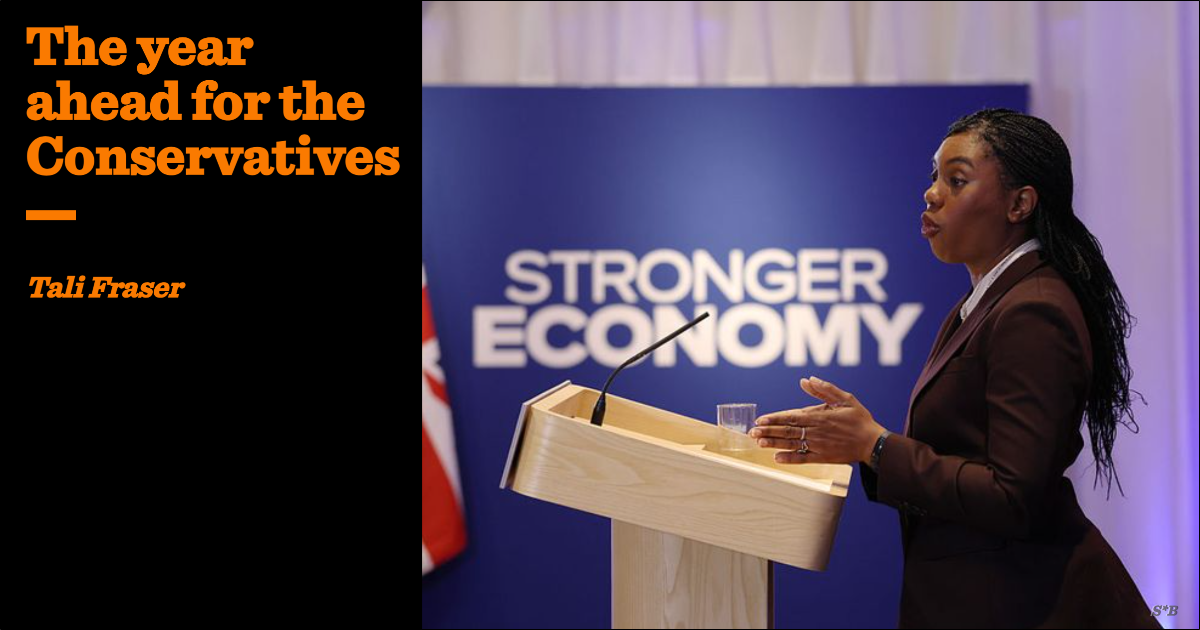
It is a strange thing to say of the oldest political party in the world, but for the Conservative Party, relevance is the prize on offer in 2026. “Next year won’t be easy,” Kemi Badenoch told MPs and peers before the Christmas break – that, at least, is incontestable – but, she added, “we can turn it around… and we will do it in one term”. What is unclear though is whether the party is finally prepared to define a new version of itself — one capable of presenting a united front, a narrative, a purpose.
It shouldn’t feel like too much to ask, but the party has struggled with this for a decade. Five Tory prime ministers in six years — and yet unity has repeatedly been treated as a reward for good polling, rather than its precondition. The past fourteen years suggest the opposite: without internal cohesion, political success never arrives. Even as they entered opposition, forging that unity has not been straightforward.
Badenoch’s leadership began — as seems customary now — with whispered rumours of imminent demise. A further slide in polling, alongside runner-up Robert Jenrick’s political cut through and viral videos, led many to whisper about a second chance for “the prince across the water” once November’s no-confidence window opened. Yet when the month arrived, nothing happened.
After changes in Conservative HQ, a policy blitz at conference, strong performances at PMQs, and a barnstormer of a budget response, Badenoch has steadied the ground. Her personal polling has seen a swift uplift. But the party’s numbers remain lower than when she took over from Rishi Sunak. Any suggestion she can rest easy is false.
If 2024 was reckoning, and 2025 stabilisation, then 2026 must be definition: the point at which Badenoch stops the party merely surviving and starts imprinting a Conservative story. So what comes next?
Within the parliamentary party, the mood is to “hit the ground running” — not, as Liz Truss once tweeted, simply “hit the ground.” MPs believe her internal LOTO reshuffle has materially improved her performance and, in turn, party morale and media coverage. That success has triggered whispers: should there be another reshuffle, a real one?
If Badenoch wants 2026 to be her year of definition, she could start by shaping it herself — a new look Tory party for a new year, with some fresh faces and a united team. A reshuffle before the May local elections — rather than after — would look proactive rather than panicked. “Move early,” one senior Tory told me. “You come at it from strength. You get the right people in the right jobs and it makes a mark.”
One role repeatedly raised in discussions is shadow chancellor, especially given the economy remains a core Tory offer – polling shows voters still seem to trust Tories on the issue. Quiet chatter, including from MPs inside the shadow cabinet, asks whether Badenoch should neutralise a rival and show unity by promoting her former leadership challenger, Robert Jenrick, to the job. “He would do well. It makes us look united, and he’s bound to her success then,” one LOTO source claims. “Stride would take it badly, but broader than that it could go down well.”
Beyond headline names, the 2024 intake is quietly becoming a proving ground: Katie Lam and Nick Timothy, spads turned MPs, already hold shadow roles. Others — Commons performers like PMQs favourites Lincoln Jopp and Andrew Snowden; media-tested newcomers Harriet Cross and Joe Robertson, both having survived the Question Time slot; or the party-integrated Bradley Thomas and Lewis Cocking, both of whom joined the 1922 committee recently — have a generational task, as much as political, at hand: to persuade voters the party can still look like the future.
Elevating more of their intake to shadow ministerial jobs would be wise. It offers new faces unscarred by government mistakes and gives time for development. It didn’t happen last reshuffle — it should at the next.
Meanwhile, the ideological tug-of-war still simmers: One Nation vs New Right; Old Guard vs New Generation; Builders vs Blockers. Badenoch’s phase two of renewal requires choosing a path. Perhaps the One Nation type gets fed up with the path Badenoch is going down, but they are much diminished in size from previous governments. Perhaps there is a way to convince the party into a new generational, aspirational offering – one that looks again at things like the triple lock. There are many within LOTO, the shadow cabinet and the shadow treasury team who think a relook is needed. But will the party have the confidence to define its route?
Hovering over all of this is Nigel Farage. Reform UK’s momentum seems to be stalling just as Badenoch glimpses the faintest flicker of her own — but it is unlikely he will let the dynamic settle. He needs to prove himself right after repeatedly declaring the Tory party “is finished”. And a fight is already booked for May: London, Wales, Scotland, and English councils – the trapdoor beneath Badenoch’s feet.
A fight is already booked for May: London, Wales, Scotland, and English councils – the trapdoor beneath Badenoch’s feet.
Scotland has suffered worrying byelections; Wales is increasingly Reform-curious and could leave the Tories without representation. In Westminster, few speak of “target gains” – only “survival targets”. Some optimists whisper that Barnet, Westminster, or Wandsworth could return after falling in 2022. But a serious bruising is likely. Every councillor lost weakens the party’s machinery – volunteers, organisers, door-knockers. Lose scores more, and MPs will start to panic in Westminster. There lies the risk for Badenoch.
It will also be bad for Labour, whose losses will attach to Starmer personally. Indeed, Starmer looks more likely to fall after May than Badenoch. And so far, the Conservatives have at least developed a competent Labour-attack unit for whomever may come next – taking down senior figures and building narrative discipline.
What remains unclear is the strategy against Reform. May’s results will almost certainly trigger renewed questions about a pact — a topic not completely shut down by the chairman and deputy chairman when pressed in interviews, though Badenoch is wise to deny it. MPs mutter — the strength of feeling against working with the party that so readily wants your extinction remains. And there is little evidence a pact could even be designed (how do you carve up seats?) and ideological reasons why it would collapse (economically, the two parties diverge).
The mission of 2026 becomes simple: kill the Farage narrative that the Conservatives are finished with a defining message of your own. If Badenoch pulls polling into the mid-twenties, Reform’s foundational argument weakens. In a multi-party landscape, relevance is a huge part of the battlefield. A strong 2026 could still position the Tories as the principal anti-Labour vehicle; a weak one may gift that identity to Farage.
Part of Badenoch’s task is clear, with a set of destructive locals on their way; rally the troops. Sir Iain Duncan Smith has urged her to spend early 2026 on the road, Maggie-style. There has been talk of “Kemi connects” — the idea she could tour local associations, like Cameron once did in opposition.
But still a narrative and message remain needed, aspirational voters don’t simply arrive. The stamp-duty cut at conference was a nod to the under-40s, but if the Conservatives want to govern again in the 2030s, they might want to start looking like a party with an average voting age of lower than 63-years-old.
If Badenoch does not define the Conservative Party in 2026, others will – Farage will. Starmer will. Scotland and Wales will. The electorate will. There is not much time, but enough.