In 2026, it will be a mistake for the British opposition to take its lead from the USA
The depth of midwinter feels like an appropriate time to consider Britain’s current position. Despite the bleak setting today, there are many who seem to feel that spring’s thaw may not be too far off. The latest humiliation, at the time of writing, is that the British government has seen fit to have an Egyptian far left agitator, Alaa Abd El-Fatteh, released from prison in his native land and brought to the UK. Like many of the markers on Britain’s path to degradation, this latest story has not been met with anger or sullen resignation, but with amusement. It seems like further confirmation, if any were needed, of the sheer absurdity of our current overlords.
This story really has it all — we have the FCDO in its ongoing transition to a campaigning NGO in the mould of “Amnesty”, and we have Number Ten failing to engage in the most basic due diligence to check whether the individual whose release they so joyfully celebrated hasn’t been rabidly anti-British and anti-Israeli. We have the haplessness of Keir Starmer as the guy immediately begins sharing content critical of the prime minister as soon as he is released. And inevitably, we find the Tories ultimately behind it all, having given in to the most reductive emotional blackmail to allow this individual citizenship, despite almost no connection to this country, while he was already in prison in Egypt in 2021.
Surely a regime so obviously out of step with reality cannot be much longer for this world? There doesn’t seem any point in wringing our hands about it all; we may as well just point and laugh along with the rest of the world, and make a note to reverse it When We Win, along with so much else. This calculation explains why most of us in Britain remain relatively cheerful, and are not rioting in the streets as so many Americans are convinced that they would be doing in our circumstances. We may be at rock bottom now, but we feel the stage is set for us to come springing back.
Looking back over 2025, it has been a good year for those who define themselves in opposition to the way that Britain has been governed for the last 30-odd years. Reform UK has cemented itself as the most potent political force in the country, and it now appears more likely than not that they will be leading the country after the next election. The local elections in May, followed by mass flying of the Cross of St George across the country over the summer, emphasised the restive mood of the public. But most importantly, a seismic shift took place in the terms of the national debate around identity, immigration and ethnicity, with progressive gatekeepers suddenly losing their ability to keep huge swathes of policy effectively off-limits for discussion in respectable circles. For the first time in many decades, elite consensus around immigration seems to be moving toward that of the general public.
For many on the right in British politics, there seems little to suggest that things will stop going their way in 2026. At the very least, there is almost no likelihood at all of Labour regaining popular support or momentum. There is none of the guile, or charisma, or operational competence that were behind the Blair governments, and literally a single week or so in power was enough to make that quite clear to the public. No matter how large the majority, it is to be a single-term government, and it could well be Labour’s last.
With so many taboos having been removed against discussion of the impacts of immigration, it is the progressive, multicultural establishment that is now on the defensive and being forced to justify positions that have been assumed sacrosanct for a generation. The fibres which hold together the orthodoxy of a “values-based” conception of a multi-ethnic national identity are being unpicked, and those insisting on a universalist, non-exclusionary framework are poorly placed to construct what will replace it. It should follow, then, that 2026 will be a year in which the forces of change continue to set the agenda and disrupt the status quo. And to some extent it will be, albeit with new and challenging dynamics coming into play which will disrupt the disruptors, and which potentially may crack the opposition coalition. The origin of these new dynamics will be the United States.
2026 will be the year in which the next US presidential election will go from being a future event to a current one. By the end of the year, Donald Trump will be starting to look like a lame duck in a way that he very much does not currently. The field for the Republican nomination is likely to be testy and aggressive, as various factions seek to prevent a coronation for J.D. Vance. In particular, there is already an emergent purity spiral swirling as Vance seeks to shore up his right flank from those seeking to cast him as closeted globalist; primarily by virtue of his American-born but Indian-originated wife, but also as a result of some of his political stances.
This is going to mean questions around the relationship between nationality, ethnicity, citizenship, ancestry and belonging are going to become highly salient in the ultra-tribal atmosphere of American presidential politics, at the same time as the opposition in Britain will be attempting to curate a debate on similar themes. This will be further complicated by the relationship that has emerged between the British opposition and figures on the American Right, in which attention from the latter has the potential to boost the status and in some cases the earnings of the former far more quickly and drastically than anything they do on the domestic scene. Furthermore, many British populists have started to look to Washington to act as a political counterweight to the Government’s overwhelming majority in parliament; a role that the White House is periodically happy to play. As a result, there is a huge temptation for those seeking influence on the British Right to play up to audiences in America.
It goes without saying that there are similarities in the debates that are currently going on around nationality and belonging in both America and Britain. The emergence in late 2025 of the Somali fraud scandal in Minnesota holds striking parallels with England’s Pakistani grooming gang scandal — albeit without the rape and torture. We see the same trend of a high trust society with an individualistic social structure being taken advantage of by an alliance of cynical leftist machine politicians, and a clan-based immigrant community with an alien conception of morality. And we have seen the same pattern of official institutions and the media either unable to recognise the issue or unwilling to bring it up, either for a fear of appearing racist, or of lending credibility to racist arguments. And there is the same huge underlying reluctance to consider group-level behaviours in a society where the individual is the primary point of reference.
However, there are substantial differences, and we must be very wary of these given how many of Britain’s mistakes on migration and integration have been the result of our mistaking ourselves for the United States. Most notably, America has a jus soli conception of nationality, and a robust civic-republican notion of citizenship, with its roots as a propositional New World settler society. This is going to mean a far more painful redrawing of the idea of what it is to be an American if they are going to try to stabilise the country’s demographics.
Whereas the British can reasonably point at absurd examples such as El-Fatteh that expose the concept of “British Citizenship” as an ersatz administrative bauble, the Americans are going to have to be far more explicit about the redrawing of identity. There is no need for the British opposition to wallow in any of this, but I suspect that the temptation will be too great for some. This is going to be enormously off-putting to many middle-of-the-road types in Britain, and will cause the leadership of Reform UK to run a mile in the opposite direction.
More menacingly, there is the issue of diaspora influence in foreign and immigration policy, which has a far longer and more established history in America than it does in Britain. From the Northern Irish troubles to Turkish-Armenian relations, modern history is littered with examples of conflicts that were perpetuated and exacerbated by an activist diaspora group wielding influence over US politicians. However today, it is the Arab-Israeli conflict that looms largest, and there is a vehement movement on the American Right that is insistent that America’s sentimental relationship with Israel has been a diversion and a cost for far too long. A substantial number of these generally relatively young people believe that this is a result of an undue degree of Jewish influence in and over Washington. Inevitably, much of this discourse has quickly descended beyond an objective analysis of the role of Jewish people in American public life, and into tawdry and predictable antisemitism, usually steeped in layers of mocking irony. This is exemplified by online commentator Nick Fuentes, and his followers.
If your version of being “terminally online” means Twitter, then your first exposure to this phenomenon spilling over into British political discourse is likely to have been a drawn-out argument surrounding the Tory peer Lord Finkelstein. This came in the wake of an appearance by Finkelstein in a boring and unedifying interview of Fuentes by Piers Morgan. Whether or not it was the idea of the Talk TV producers to do so, Finkelstein’s appearance seemed to have been deliberately set up to conform to Fuentes’ description of the way in which the memory of the Holocaust is used as a sacred political artefact — the invocation of which is supposed to induce hushed solemnity. For younger right-wing audiences however, this sort of stuff has been all over TikTok for some time now, with British teenagers consuming the same reductive slop as their American equivalents, and becoming increasingly politically indistinguishable from American kids.
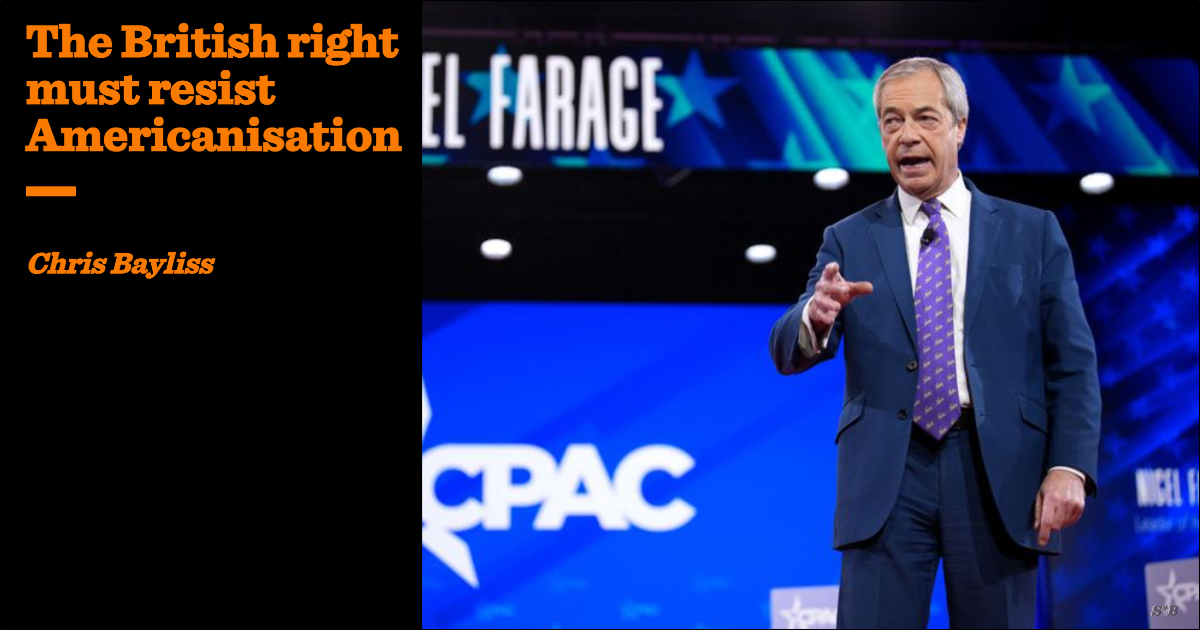
All of this I think points to Nigel Farage and his colleagues logging off for a while
The debate that followed, I fear, was merely a taste of what 2026 is likely to be like on the British Right; a thin-skinned and rather self-important generation of Conservatives who came of age toward the end of the Cold War and drank deeply of unipolar moment, arguing past a set of commentators in their late twenties and thirties who are looking for attention from Americans and Americanised-teenagers. Whilst somebody with a greater degree of self-awareness and a more natural humility might have handled it better than Lord Finkelstein, it has to be conceded that what he ended up facing was devoid of reason. For all his Cameroon liberalism, Finkelstein has been a critic of mass immigration over many years, yet his interlocutors were too often either unwilling or unable to see past his Judaism, and insisted on arguing with him as if he were a cipher for George Soros himself. But their audience are too young, too American or just too antisemitic to care about that.
All of this I think points to Nigel Farage and his colleagues logging off for a while. The territory is simply too risky while they have a poll lead to defend (or even to extend) made up of the middle-aged and middle-class and middle-of-the-road. But while this may seem the safer course, there is the danger of a gulf opening up between themselves and those who are desperate to overturn the existing consensus and establish the legitimacy of an ancestry-based national identity while the political wind is in their sails. In the wake of the implosion of the Tory Party, it will be all too easy for those who want to go further and faster to claim that Reform UK is inflicted with the same weak-knees and superannuated leadership as the Conservatives.
Beyond the online relationship with the American Right, there is the very real-world issue of the White House taking a far more assertive line with European governments, including Britain, that is seen to align with the positions of the British opposition. The issuing of travel bans against various figures associated with the Online Safety Act and campaigns against “online harms” has been greeted as a well-deserved slapping down of a deeply sinister bunch of people. So far, there seems to have been little notice of this taken by much of the British public, and the Americans have been cautious to couch their reasoning in terms of the attempt to apply British law extra-territorially against US citizens and businesses practicing their rights of free speech.
The British opposition, and especially the leadership of Reform, will need to handle this especially cautiously over the year ahead. The Online Safety Act is a profoundly flawed piece of legislation, and in practice it does require technology platforms, most of which are American, to impose heavy-handed and crass censorship onto users with UK IP addresses. However the idea of trying to stop children accessing things like pornography and all manner of other things that people fear is lurking on the internet is generally popular in principle with the British public, and folk will take an exceptionally dim view of it if they discover that the Americans are effectively insisting that the British government cannot do anything about it without Washington’s approval.
There are moments when they talk as if they have forgotten that the current government isn’t the entire country
Deeper than this is the rather strident tone that some figures around the White House, including some of the Vice President’s circle, are talking about Britain in general. Yes, we don’t like our government any more than they do, and some of them seem keen to help us fix things. But there are moments when they talk as if they have forgotten that the current government isn’t the entire country, and that the opposition and the public exist as separate bodies of people. Even those of them who are favourable and supportive sometimes give the impression that our being here at all is a bit of a waste of American time, and that it’s only at their forbearance that we’re allowed to continue our cringeworthy existence.
There’s some truth to what they say, of course. We are weaker, relatively, than we have been at any point since the sixteenth century, and we only have ourselves and successive governments to blame. Moreover, we have lost any sense of national confidence and purpose — our current situation is genuinely cringeworthy. Restoring ourselves to our rightful place as a country that is admired and envied by others, and regarded as a junior but valued peer by the Americans, is the project of what is currently the opposition over the next decade. This is fundamentally a nationalist project, and the political moment we inhabit is a nationalist one. There is a fine line to tread between accepting and taking advantage of American support when it is offered, and appearing to delight in watching the government being pushed around by the larger power. If nothing else, it establishes precedents that will be hard to break when the balance of power is reversed, either in London or in Washington.