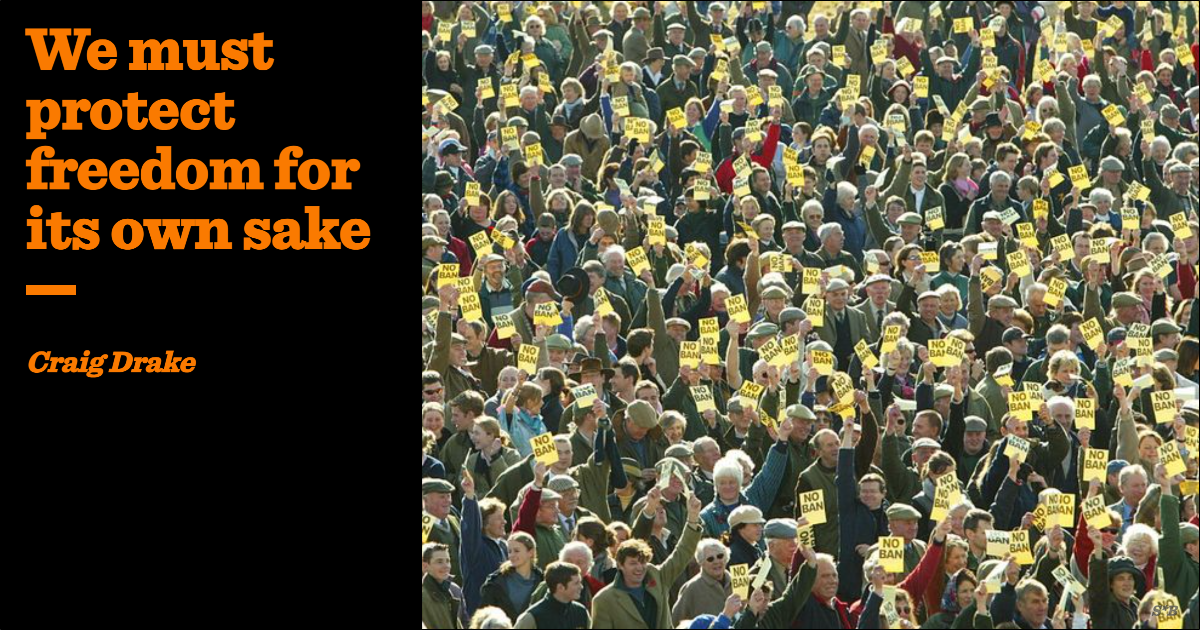
Hunting with hounds was banned in England and Wales more than 20 years ago as part of Tony Blair’s Hunting Act — aimed at giving red meat to his urban and suburban supporters and to shore up support from militant backbenchers.
It took up more than 700 hours of parliamentary time to debate — more than the decision to Invade Iraq. Protests saw hundreds of thousands people take to the streets of Westminster to defend their civil liberties. Blair may have described the ban as “one of the domestic legislative measures I most regret”, but that provided little comfort to those whose lives and liberties were trodden upon.
Now, a ban on trail hunting represents a fundamentally more pernicious move to ban the practice of following a trail laid for dogs to follow rather than a real animal, while a group of hunters follows the pack on horseback.The intention is to replicate the pursuit of a fox across the countryside, without the need to kill anything. The justification from the government for the persecution of law-abiding members of the public freely assembling is that: “There are concerns that trail hunting is being used as a smokescreen for the hunting of wild animals, and that’s not acceptable.” However, it is hard not to see this as an attempt to salt the earth.
Whether or not you think that people wearing pink tailcoats to chase an artificial scent is silly should not detract from the fact that this is a clear attack on some fairly basic civil liberties. Some are bemused by the fact that grown men dress up in the knitted knee high stockings and the collared shirts of the games kits of Victorian public schools to play for the Dog and Duck on a Sunday, but that does not mean that football should be banned on the grounds that there are rare and localised incidences of violence at matches.
Indeed, I remember when Umbro replaced the traditional collar buttons of their football shirts with a zip for the 1998 season and the furore made complaints about turning up to a driven shoot with an over and under seem akin to arguing about the colour of a nosecone on a spaceship. It is okay to have odd customs and traditions, and much like the heavy handed treatment of football fans that would not be tolerated for other groups, we should recognise that these attacks on free assembly in the countryside are motivated in the majority of cases by a distaste for the manners and dress of their supporters, rather than for the activity itself. This is very poor grounds for abrogating liberty.
In response to the proposed ban on trail hunting, the pages of The Critic and other publications have been filled with stories about the beauty and the importance of rural life.
It is right to give thanks and praise and to share stories about the joys of the countryside. It is our duty and our joy. For many, it is what binds us, and is perhaps the most tangible manifestation of what it is to be British. I happen to have lived the majority of my life outside of Britain, but when I discuss angling or hunting or shooting with somebody abroad, I know that I am inescapably English in how I see the world. It is important to remember why these things are so important to us.
We should, however, remember that the battle should not be fought over romance, or because things have been done for a long time (Mrs Brown’s Boys is about to celebrate 15 years of being on television and I don’t think that we should be sentimental about its longevity). There is also very limited mileage in the argument that doing away with some pursuits would cause unhappiness or loss of income. We already know that there are people that outright despise what we love. As the former deputy Prime Minister John Prescott put it: “Every time I see the Countryside Alliance’s contorted faces I redouble my determination to abolish fox hunting,”. But perhaps a bigger challenge is the ambivalent — these things matter a great deal to those of us that spend our time in the countryside, but simply do not really matter to a great many people when evaluating the political mathematics of the pursuit of their own interests. Your beloved pastime and fabric of life is another person’s mere hobby.
We should focus on the indivisible, inalienable, and uniting principle of liberty
There is also no unquestioning political tribalism. Conservatives have been incredibly wrong in thinking that they have a God-given right to the support of rural communities, but it flows both ways. Those of us that value rural pursuits should also bear in mind that the view of “a bunch of ruddy-faced toffee-nosed twits” is as likely to be shared by a Thatcherite free-marketeer in the City as it is was by the late John Prescott.
Instead, we should focus on the indivisible, inalienable, and uniting principle of liberty — in town and country, for the master of hounds and for the protester on Oxford Street.
There was a pleasant article from Patrick Galbraith published by The Critic recently on the joys of rough shooting. It’s a pursuit very close to my heart. My small rural village works on a system whereby resident hunters of small and large game are given almost free range across the land, provided that they take the management seriously. There is a large population of deer and wild boar that needs to be kept down or there will be disastrous consequences for crops and livestock. Pigeons need to be controlled, foxes and other vermin need to be killed, but we also release a very small number of pheasant to help the population — there has been a healthy increase in raptors over the last year, which is good news for many things, but not great for the native partridge and the wild and semi-wild pheasant.
Just over a year ago my faithful dog died out of nowhere and it broke my heart, but I knew I couldn’t be without a dog so I trawled the local shelters, and adopted another companion. She had been abandoned, was underweight, and was terrified at the mere sound of a car door slamming. A neighbour took one look at her and said that she would never hunt, which is why it is a particular joy to walk across the fields with my now happy, healthy, and confident dog, and for her to enjoy the sport and the challenge together. As much as I do it to make my dog happy, I hunt for largely selfish reasons —- because I enjoy the sport and I get joy from being connected out of necessity to the cycles of the seasons; observing the health of insect populations that my quarry will rely on for protein, the roosting habits of woodpigeon, the evolution of cover crops through the months. Even the most self-interested city slicker buying a day’s shooting on a commercial estate is a greater force for conservation than Ed Milliband. His cold hard cash pays for strips of fields to be left for the benefit of gamebirds, otherwise unprofitable wildflower mixes help provide life for insects, and the estate owner and gamekeepers are motivated to ensure that the biosphere is healthy and sympathetically managed so that paying guns will return and bring their friends.
Despite this, I do not feel the need to justify hunting and fishing and shooting any more than I feel the need to justify mowing the lawn or weeding the herb garden. We do not live in the wilderness, we live in a managed environment and it is an objective fact that whether you consume meat or carrots or use highways or public transport, there needs to be a large amount of management of animal populations. But I take great pleasure in shooting in the autumn and winter months, and trying to outsmart trout in the summer months, and my life would be much poorer if those things were taken from me.
I don’t have any particular interest in riding to hounds. To me, the idea of using a horse to pursue a fox evokes thoughts of riding your bicycle into town to pick up some shopping. You spend the ride in enjoying the challenges of dodging obstacles, the speed that allows you to take everything in while getting to where you’re going faster than on foot, then you get there and you have to faff around with this cumbersome thing that needs tethering up somewhere, but instead of a bicycle that needs an unobtrusive place to be locked up safe from thieves, you have a capricious animal that has a habit of doing anything but what you want.
However, I understand that in those countries where it has not been suppressed by the state, a great many people get lots of joy from hunting foxes on horseback. Roger Scruton famously embraced it later in life, though perhaps shared some of my scepticism at the wisdom of using a fickle beast over a more dependable Polaris ATV:
…the moment in October when the fields refuse to absorb more rain and the cows begin to churn up the pasture. It is the moment when the animals take their revenge, remaking the landscape as a warm bath, friendly to four-legged creatures, hostile to man. The faces of the horses, as they watch you slither towards them, express their sudden bliss: ‘four legs good, two legs bad’, and a laugh of triumph sounds somewhere under the hillside.
I’m not alone in enjoying these things. There have been dozens and dozens of pieces published defending the traditions, the husbandry, the romance, and the importance of these ways of life. This article is one of those. We should, however, reflect on the fact that this is the same defence that has been mounted for decades and it has not yielded a single blade of grass in recaptured freedoms.
Under David Cameron, the Conservative manifesto promised a free vote on whether to repeal the foxhunting ban — but no vote was held. In 2017 during her successful general election campaign, Theresa May stated: “As it happens, personally, I’ve always been in favour of fox hunting and we maintain our commitment — we had a commitment previously — as a Conservative Party to allow a free vote and that would allow Parliament to take a decision on this.” No vote was held. This was a betrayal that should not be merely dismissed as savvy political calculation, but as a lesson to both supporters of country sports and to future governments. Liberty matters.
I do believe that there is such a thing as political capital. However, many people have been conditioned to believe that you enter parliament with a set amount of political capital, mostly defined in proportion to the size of your majority in the general election, and that you then spend your political capital tokens until you can’t afford to do any more politics and then you starve and die.
There is also a tacit idea that liberty is an asset that is divisible, portable, durable, fungible, verifiable, and, above all, scarce. If you spend it defending the right to freely assemble then you will run down stocks of liberty needed to defend speech. If you defend the notion of fox hunting then you won’t have enough to share with the guys that want to oppose football banning orders.
The Conservative Party failed and will likely never see power again because it ultimately had nothing that united it besides a belief that it was the natural party of government. It is why it felt as comfortable ignoring the freedoms of rural life as it did taxing and regulating and generally picking away at the lives of the citizens. A future government seeking to reform the erosion of freedom in Britain should instead not see liberty as a finite resource or as coins to be run down, but as a lodestar guiding everything. It should revoke the ban on foxhunting not just because it is the right thing to do, but as a demonstration to the faithful that it is prepared to fight difficult battles in the pursuit of British liberty. Political capital can go up by demonstrating that you have the courage of your convictions, as it can go down. As passionate as the enemies of freedom for the horse-mounted wildlife management worker are, there are enemies just as passionate for every other freedom that must be reclaimed.
A reforming government should sound the horn to let people know that they are not afraid of what is to come, and we that support the liberty of the countryside should make it clear that it is on those terms that they will be judged.