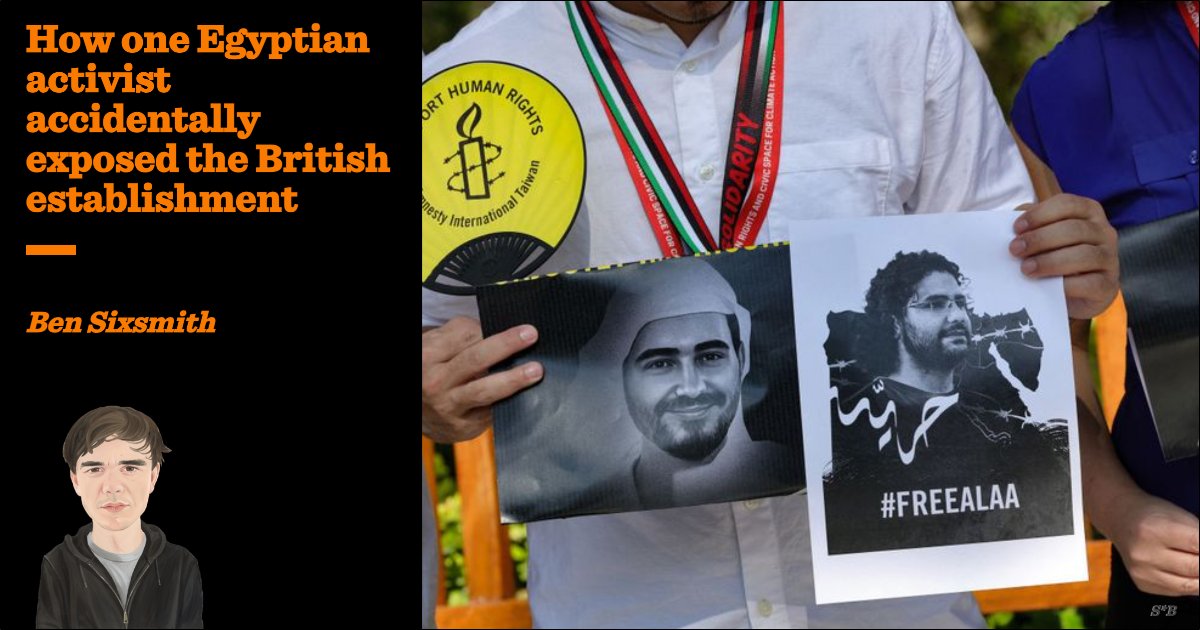

I try to avoid judging people by their worst tweets. Twitter, as a medium, encourages us to be at our most provocative and uncompromising. (Except me, of course — my tweets are always nuanced and sensitive. Except for that one from 2019 which is liable to be exhumed in the future. Apologies for that.)
When it comes to judging people for their worst tweets, meanwhile, I would rather not be judging someone who has spent years in prison. It seems like bad form when there are so many people posting bad tweets who will never face greater discomfort than a sore back.
I’ll go further. Some of the tweets that people are bashing the Egyptian dissident — for are clearly being misinterpreted. When he wrote that “us terrorists” were going to “take over your town and rape ur women”, it seems obvious that he was sarcastically mocking stereotypes of Islamic extremists (actual terrorists don’t call themselves “us terrorists”). When he claimed that Thomas Friedman columns made him want to join Al Qaeda he was patently joking (and, frankly, as a longtime reader of Mr Friedman, I can see where he was coming from).
So, I don’t think we are dealing with some sort of frothing militant jihadist here. Abd El-Fattah seems like the sort of secular leftist who might appear on Novara Media and vote for Your Party. Alas, this can coexist with the fact that he has expressed a deep grudge against white people (“fucking hate white people … a blight on the earth”), British people (“dogs and monkeys”), and Jewish Israelis (“it is possible to kick them all out”), and has supported indiscriminate violence against Israel (“I consider killing any colonialists and especially zionists heroic”).
That this sort of toxic third worldism has held such an uncontroversial place in Western Europe and the US does not make it any less hostile and obnoxious. It is a symptom of the insulting accommodation of vehement anti-European thought and speech that even as El-Fattah’s supporters were courting international sympathy, they never felt compelled to erase his old tweets.
I don’t really blame Mr El-Fattah for his views. Is it surprising that someone who was raised in the cultural and political environment of Egypt is temperamentally anti-European? I’m as surprised as if I heard that a Liverpudlian dislikes Manchester United. I certainly don’t think — on the basis of what is in the public domain — that Abd El-Fattah should have been in jail. But the fact remains that he has no substantive personal connections with Britain and, indeed, appears to have held a hot resentment against it (another tweet, during the London riots: “go burn the city or Downing Street or hunt police”.)
Victims of injustice can support different forms of injustice
There are two tendencies worth addressing here. The first is the idealisation of foreign dissidents. Liberal attachments to anti-communism and left-wing attachments to anti-colonialism mean that foreign activists being repressed by authoritarian regimes are likely to receive knee-jerk support.
It’s important to be clear that I am not suggesting that such activists deserve their repression. Not in the least. But we should also remember that victims of injustice can support different forms of injustice. Left-wing anti-colonialists are liable not to care if the activists they support have unpleasant views (having unpleasant views being pretty much essential to a Fanon-flavoured weltanschauung). Liberals for whom the end of the Soviet Union was just a step towards the expansive and utopic universalisation of a maximal system of “human rights”, meanwhile, are delusionally Manichean. Yes, someone fleeing an authoritarian regime might be the next Leszek Kołakowski. But they might also be the next Abu Qatada. (I am not suggesting that Mr El-Fattah is the next Abu Qatada. But nor is he the next Kołakowski.)
This case illuminates the degraded nature of official conceptions of Britishness
Secondly, this case illuminates the degraded nature of official conceptions of Britishness. Abd El-Fattah is “British”, despite being born abroad and never visiting Britain, because his mother was born in Britain while her mother was studying there. This is about as technical a technicality as technicalities can be.
This underlines the preposterousness of recent attitudes towards migration. The British Nationality Act 1981, which institutionalised this approach to citizenship, made more sense in a world of demographic edge cases. Now, though, millions of people from nations with cultures that are deeply different to Britain’s have become “British” despite many of them — though, of course, not all of them — having hostile biases against their new homeland as well as deep allegiances to foreign causes. (Let us recall that almost 1000 British citizens left the country to support the Islamic State.) If we dislike the idea of withdrawing citizenship — and I do — it should never been given away so cheaply.
Again, I feel a bit bad for piling onto Alaa Abd El-Fattah. He has said horrific things, yes, but I doubt that he has more extreme beliefs than, say, at least half of the people teaching or studying at SOAS, and very few of them have had to experience anything more unpleasant than the London Underground. So, it seems a bit unfair that his circumstances have left him to be singled out.
Yet his case does show why Britain has to change course. If one foreign student giving birth in 1956 could involve the British state in such a complex diplomatic dispute in the 2020s, entirely against its own interests, imagine what the future might hold.