Implemented on October 10, 2025, the Gaza ceasefire remains in effect. It is, however, under considerable strain due to repeated Israeli violations that so far have killed at least 414 Palestinians but have at least stopped short of triggering a return to full-scale hostilities. Clearly, the “ceasefire” is a mere deescalation arrangement, though one that powerful actors in the region would like to strengthen into a real foundation for peace.
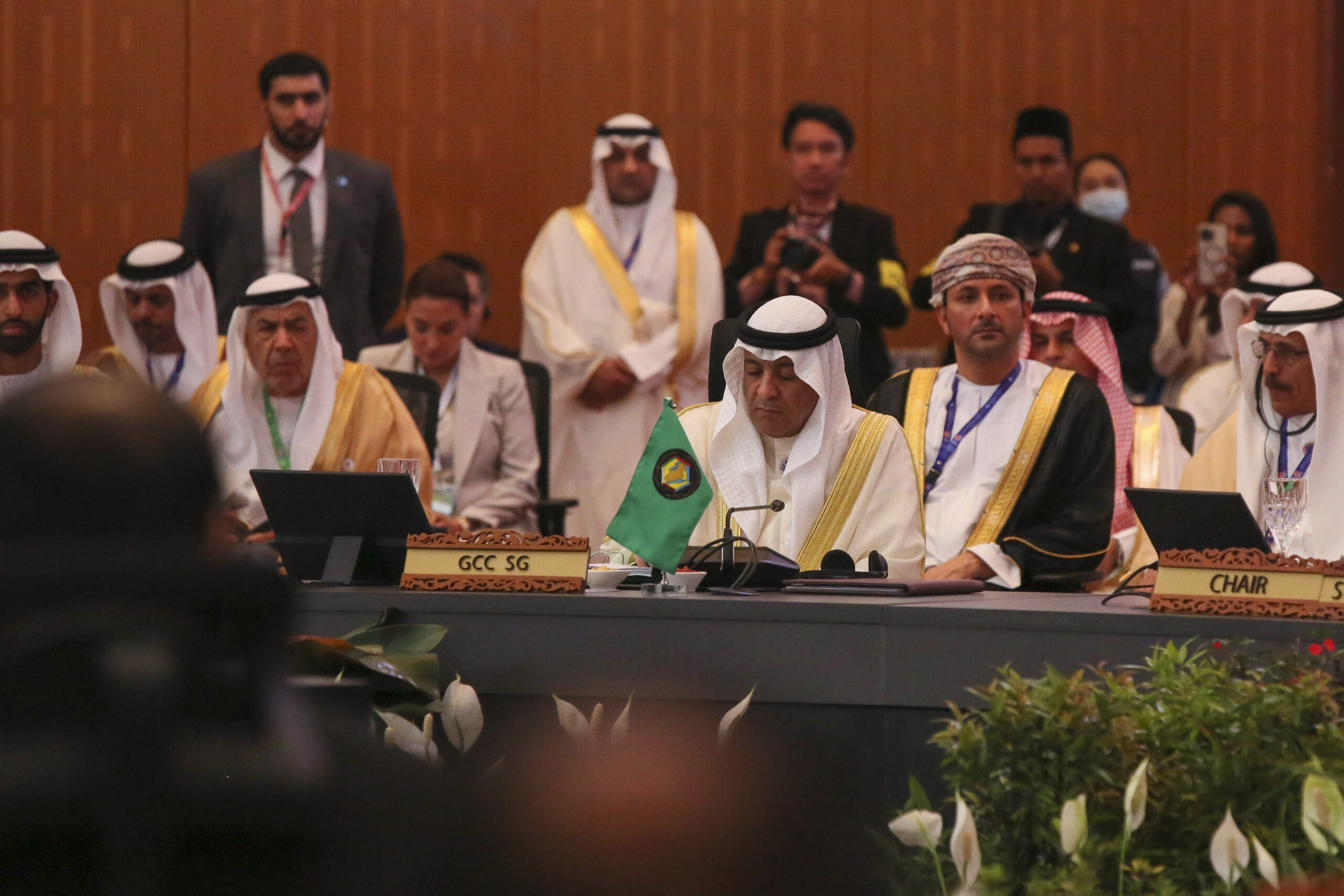
Persistent doubts regarding the truce’s durability have fostered a measure of alignment among the six Gulf Cooperation Council (GCC) members—Bahrain, Kuwait, Oman, Qatar, Saudi Arabia, and the United Arab Emirates (UAE)—with each urging the Trump administration to pressure Prime Minister Benjamin Netanyahu’s government to adhere to the ceasefire and to engage constructively in the subsequent phases of the 20-point peace initiative.
Although the long-term viability of the ceasefire remains uncertain, Gulf leaders will likely seek to capitalize on their personal relationships with President Donald Trump and their ability to operate within the transactional mode of diplomacy that he favors. They hope to coax him into pressuring Israel not to sabotage the current ceasefire, as it did in March 2025 by unilaterally ending the first ceasefire negotiated by Trump’s team just prior to his inauguration in January.
or GCC members, Israel’s war on Gaza has posed a complex set of strategic and political challenges. The Gulf states remain dependent on Washington as their principal security guarantor. At the same time, they are acutely aware of public sentiment at home and across the wider Arab world, where solidarity with Palestinians and anger toward Israel and the United States have surged since the war began in October 2023. These competing political pressures have forced Gulf leaders to navigate a series of delicate balancing acts.
Moreover, the Gaza conflict’s spillover into the Red Sea, coupled with the 12-day Israel–Iran war in June, underscored the extent to which Israeli military actions have contributed to broader regional instability, heightening the GCC members’ sense of vulnerability. Against this backdrop, Oman’s foreign minister remarked at the Manama Dialogue conference this November that, from the perspective of the Gulf monarchies, Israel, not Iran, has long been regarded as a primary source of regional unrest and insecurity. Such threat perceptions of Israel have heightened after the country carried out an unprecedented military strike against Doha in September, bringing Israel’s borderless aggression into the GCC for the first time.
That strike, and the increasing tensions more broadly, have created a political challenge for Trump, who supports strong ties with both Israel and the GCC. The latter nations hold at least one key advantage over Israel when dealing diplomatically with the U.S. president: He has sought to cultivate an image as a “peacemaker” and “dealmaker” intent on resolving conflicts inherited from his predecessor. Central to this effort is his aspiration to be remembered as the American leader who ended the Gaza war.
Within this context, Gulf leaders—most notably, Qatar’s Emir Tamim bin Hamad Al Thani, Saudi Arabia’s Crown Prince Mohammed bin Salman, and the UAE’s President Mohammed bin Zayed—have recognized an opportunity to influence Washington’s regional approach. The success of MbS, alongside Turkish president Recep Tayyip Erdogan, in persuading the Trump administration to lift sanctions on Syria in May 2025 underscored the ability of Gulf leaders to influence U.S. policy. That intervention ran counter to the goals of Israel and America’s pro-Israel lobby while advancing the Gulf states’ strategic interests. Trump’s purported determination to help resolve the nearly three-year conflict in Sudan also resulted from a persuasion campaign by MbS this November and speaks to these same dynamics.
On the question of Gaza and other regional issues, the GCC states and Israel, together with their respective advocates in Washington, are likely to continue exerting competing pressures on the Trump administration, with the two factions steering U.S. policy in divergent directions. This marks a contrast from 2017–2018, when Saudi Arabia, the UAE, Bahrain, and Israel were largely on the same page when it came to lobbying the first Trump administration to impose “maximum pressure” on Iran. Back then, Gulf Arab–Israeli alignment against Iran was, to a notable degree, reshaping important aspects of the Middle East’s geopolitical order. In the current period, while Israel continues pursuing its maximalist aims in its grander quest to further degrade what remains of the Iran-led “Axis of Resistance,” the GCC members are prioritizing regional stability in the interest of advancing their own ambitious visions for economic development and diversification. Thus, the Gulf states welcome détente with Tehran even as they remain suspicious of Iranian intentions in the Arab world.
As Trump faces mounting domestic calls to condition American support for Israel and to avoid deeper entanglement in protracted Middle Eastern conflicts, GCC members perceive an expanding opportunity to position themselves as Washington’s most pragmatic and capable partners in advancing U.S. interests across the region. This effort aligns with Trump’s core objectives of fostering economic growth at home, promoting stability in key conflict zones abroad, and maintaining U.S. competitiveness in emerging technologies such as artificial intelligence.
For now, the GCC states are aligning themselves with Trump’s 20-point Gaza peace initiative. The plan gained further international backing, and with that greater legitimacy, once the UN Security Council adopted Resolution 2803 in November.
The fact that Qatar, Saudi Arabia, and the UAE—joined by other major players in the Arab-Islamic world, including Egypt, Indonesia, Jordan, Pakistan, and Turkey—endorsed the U.S. draft through a formal joint statement, reaffirming the support they had signaled during their meeting with Trump on the sidelines of this year’s UN General Assembly in New York, proved instrumental in advancing the resolution through a divided Council and persuading several hesitant members to support the text. Russia, rather than casting a veto, ultimately abstained, reflecting Moscow’s desire to avoid alienating its Arab-Muslim partners.
The resolution’s reference to a “credible pathway towards Palestinian self-determination and statehood,” and its insistence that responsibility for day-to-day governance in the nearly devastated enclave be entrusted to a purely Palestinian technocratic body, rather than one comprising non-Palestinian experts as envisioned in the White House plan, clearly reflect the influence of the Arab-Muslim states.
Ultimately, GCC states regard Trump’s Gaza initiative as burdened by significant shortcomings. Still, there is a broad recognition in the Gulf that the ceasefire, which was secured through sustained U.S. pressure on Israel, has dramatically reduced the scale of death and destruction in Gaza. In this sense, the prevailing attitude among GCC members might best be described as one of pragmatic acceptance: taking what can be gained, even from a flawed arrangement.
This shared view among Gulf leaders was reinforced at the 46th GCC summit, held in Manama earlier this month, where Bahrain’s King Hamad bin Isa Al Khalifa called for Trump’s plan to be fully implemented and described it as “a positive step toward reducing escalation.” A few days later, speaking at the Doha Forum, Qatari Prime Minister-cum-Foreign Minister Mohammed bin Abdulrahman Al Thani pushed back against claims that a ceasefire is even in effect in Gaza, arguing that such a designation would require Israel’s complete withdrawal from the enclave. “What we have just done is a pause,” he told attendees. Doha’s top diplomat further emphasized that “it’s not enough” to address Gaza alone without confronting the “root” causes of the conflict and guaranteeing rights for Palestinians, not just in the Strip but also in the West Bank.
Subscribe Today
Get daily emails in your inbox
Looking ahead, the Gulf states are likely to encourage the Trump administration to intensify pressure on Israel, with the second phase of the ceasefire set to begin in the first two weeks of 2026. Their goal is not only to preserve the fragile ceasefire in Gaza but also to convince Washington to use its considerable leverage to pressure Israel into a full withdrawal from Gaza while preventing ethnic cleansing in the West Bank. They also want Washington to restrain Israeli military operations elsewhere in the region, including in Lebanon, Syria, Yemen, Iran, and, above all, the Gulf itself. In pursuing this objective, the Gulf monarchies will likely seek to deepen their coordination with China, Europe, and Russia to broaden international support for their position.
By maintaining tight Gulf unity, leveraging their unique access to Trump, and meaningfully engaging various global powers, the GCC members seek not only to prevent a descent back into catastrophic violence in Gaza, but also to steer Washington toward a more sustainable strategy in the broader region. Whether this moment of tentative alignment between Gulf interests and the Trump administration’s political incentives can be translated into real peace in Gaza—let alone lasting stability in the Middle East—remains highly uncertain.
At least for now, however, the Gulf states appear determined to seize narrow diplomatic openings to shape, rather than merely react to, Trump’s approach to the region.