There is a dangerous fatalism in the air, in public discussion around Russia, its belligerent ruler Vladimir Putin and the future. Fatalism, simply put, is a belief that a thing is inevitable. This belief has consequences. As an attitude to the future, it can lead decision-makers to high-risk anticipatory action and trigger the very crisis they fearfully expect. This is not a new point, of course. It is woven into Greek tragedies. Yet despite its antiquity, too many of our public defence and security officials are forgetting it.
Thus, NATO’s Secretary General warns the alliance to prepare for large-scale war in Europe in the next half decade, at a magnitude comparable to World War Two. He didn’t explicitly say that war with Russia was bound to come. But he didn’t take care to emphasise that point, either. Amidst the language of war readiness and alarm, the process of deterrence, the effort to dissuade others from attacking us in the first place, takes a back seat. Dire warnings about inevitable war are now frequent — indeed, fashionable.
To his credit, Britain’s Armed Forces Minister Al Carns claimed, when sounding a similar warning, that “The shadow of war is knocking on Europe’s door once more. That’s the reality. We’ve got to be prepared to deter it.” But deterrence isn’t just a matter of preparedness to fight a war, in order to dissuade aggressors. If it was, there would have been fewer wars in history. Well-armed states seeking to deter others from attacking have a mixed record, historically. The United States in 1941 had a large navy, but a determined and desperate Imperial Japan under economic sanctions decided it must strike, and regarded the Pearl Harbor naval base as a target, not as a deterrent. Iran and Hezbollah’s missile arsenals were supposed to deter Israel from striking, but their unremitting death threats and attacks provoked the target to strike in devastating fashion. As well as capability, deterrence also flows from diplomacy and cool heads. It requires a commitment to stability and a degree of self-restraint. Raising the temperature of international affairs can induce others’ fears and inject a terrible haste into their calculations, while bringing on crises that we need time to prepare for.
Even predatory states can be deterred with capability and diplomacy
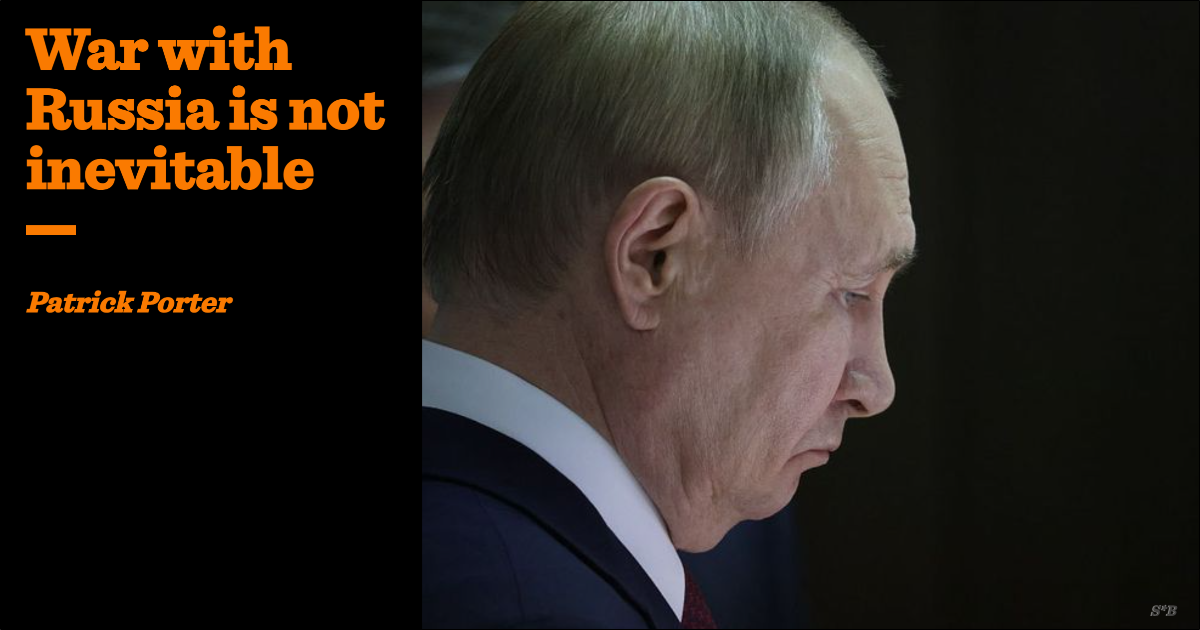
There is some good news that our leaders should hold on to, and remind others of, even as they deliberate how to prepare the country’s defences. It is this: that war with Russia is not inevitable. We know this because NATO and Russia have deterred one another, thus far, even while NATO arms and supports Ukraine to bleed Putin’s invading forces, and even as Russia spies, hacks and molests NATO countries below the level of all-out conflict. That is not to suggest that Russia is innocent of imperial designs. Rather, it is to suggest that even predatory states can be deterred with capability and diplomacy. If that were not so, there would have been a hot war against a larger, more heavily armed Soviet Union under Stalin or his heirs, generations ago. Historically, regimes that have decided a clash is inevitable — the Kaiserreich, say — have entered into a state of cognitive closure, ceasing to ask whether war is wise, and obsessing with how and when.
Speaking of our time and place, there is also a dangerous unreality to the Starmer government’s strident rhetoric and its modest actions. Calling for a “whole of society” mobilisation plan across industry, the population and the military for a scenario akin to the Blitz is not matched by our own policies or behaviour. The fact is, we are not acting as though we regard Vladimir Putin as today’s expansionist equivalent of Adolf Hitler or Joseph Stalin. In terms of the sheer ability to overrun territory at bearable cost, Russia can threaten Europe but it is not a super-threat on their level, not even close, and such conquests are harder in the nuclear age. As the fascist menace worsened in the late 1930s, Neville Chamberlain increased British defence spending to the point that half its revenues went to defence by 1939, and only after heavy increases in borrowing and an economic dislocation that aggravated a balance of payments problem. By contrast, Starmer is raising defence by 0.2 per cent of GDP by 2027, and at present, disability benefits alone exceed spending on the armed forces. Sure, Starmer has also signalled an increase to 5 per cent in the more distant future. But even if that were real and earnest, it would take time and considerable reallocations of resources. A rhetoric organised around memories of mid-century is married awkwardly to incremental budget increases and an avoidance of hard trade-offs. The net effect is not to put the citizenry in a state of patriotic alert or psychological mobilisation, but to attract mirthful disdain.
We in the West tend to overstate the threats of other states, while understating what will be required to counter them effectively
Treating Russia seriously, without triumphalism or panic, is one of the hardest challenges for statecraft today. We are in uncomfortable intermediate terrain: Russia is neither a fifteen-foot giant nor an unthreatening mosquito. It is deterrable, if not from everything, from striking NATO territory. And that deterrence requires NATO Europe to take more charge of its own defence, without inadvertently signalling war enthusiasm, and preparing also for the event of fractures within NATO and the formation of other coalitions. As the Australian strategic mind Hugh White recently warned, we in the West tend to overstate the threats of other states, while understating what will be required to counter them effectively.
Conversely, having a grown-up conversation with our own people about what is at stake, and what must be done, also seems beyond us. If we are to rearm in greater earnest, the capability must be bought, and it must come at the expense of other investments and other sacrifices. The state cannot pursue economic growth, large increases to the welfare state, demanding “net zero” schemes and heavy civilian infrastructure investment and tax ceilings simultaneously. In turn, that will throw up political risks to a government evidently more preoccupied with the threat from its back bench.
Ironically, the government is keen to emphasise the near-term threat of Moscow at almost every turn, but not in the case where its actions most raise the risks of precipitating a showdown. The same Starmer government that preaches war-readiness also proposes to lead a multinational deterrence/reassurance force in Ukraine if and when an armistice is agreed. But all of a sudden, in that discussion, talk of war and escalation and dire threat recedes to the background, and Starmer takes comfort in the more antiseptic and pleasing language of “guarantees” and “mechanisms”, assuming a war-prone, pathologically aggressive Russia will then be deterred after all. What if it isn’t? What if Russia notices that it has the balance of resolve in its favour in Ukraine, and that countries like Britain are not at a state of readiness for sustained combat operations, and then tests the force? In that possible scenario, some consideration of actual war is worthwhile. Instead, we are treated to legalistic-moralistic language, and assured it will be all right on the night.
Russia is not a super-threat and it can be deterred; that deterrence must be paid for and carefully built; and we need time to put this all into an effect. Speaking less loudly, while building a bigger stick, is not as attention-grabbing as war talk. But it is a more prudent and responsible course. It is time, surely, for a little sobriety.