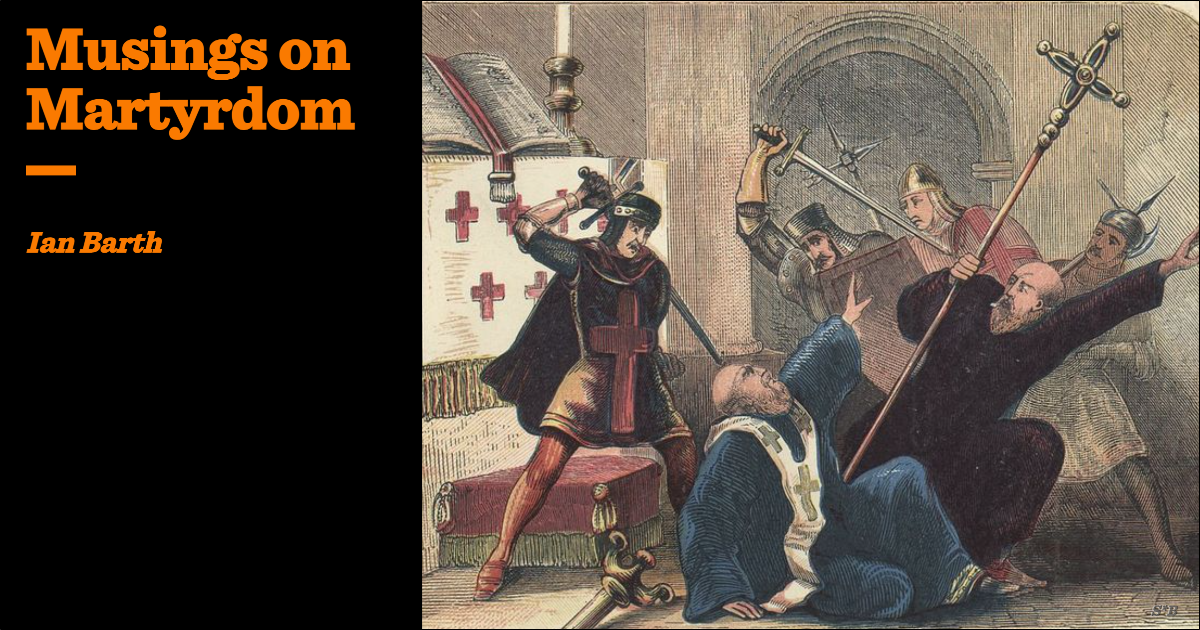
On the evening of 29 December each year, Canterbury Cathedral holds a special service to commemorate the murder of Thomas Becket, famously hacked to death in 1170 near the high altar by four knights acting on the implicit orders of Henry II. The ceremony is a well-attended event. As the choir sings at the climax of the service, the congregation, holding unlit candles, walks to the site of the martyrdom. They file through the chancel, between the opposing benches of the choir and wait at the top of the stairs. Then all the lights go out. In total darkness, characters read out the scene from the T.S. Eliot play Murder in the Cathedral; the knights banging on the door and bellowing for Becket, the priests desperate to keep them out, the voice of Becket commanding the priests to let them in. The door opens and slams, echoing through that vast space. There is a minute of silence that seems to last a lot longer. Finally, someone lights a candle from which the congregation all light theirs, the flames passing from hand to hand. It’s an incredibly dramatic moment.
Every religion and denomination, every cause has its martyrs
Martyrdom is the ultimate personal sacrifice to a greater cause or a higher power. For Christians, it is an expression of complete participation in the death of Christ. It has the power to unite people in a common conviction, a common resolve. The courage and faith demonstrated by Becket in his death reverberated through England and Europe. In the resultant outcry, Henry II made a barefoot pilgrimage to Canterbury in penance, where he allowed himself to be whipped by monks. Becket himself was made a saint by Pope Alexander III within 3 years. The cathedral became a hugely popular pilgrimage site and remains so to this day. It’s striking to notice the wear on the stones of the floor.
Every religion and denomination, every cause has its martyrs. They provide a unique affirmation of conviction, proof that people are willing to die for a particular set of beliefs. In death, the life of the martyr becomes indelibly tied to a particular cause. Something changes in the public perception of both the martyr and the cause for which they died. Consider Martin Luther King and the Civil Rights movement, Gandhi and Indian independence, the 21 Coptic Christians killed by ISIS.
In my own Anabaptist church there is a strong tradition of martyrs. Two of the first three anabaptists were killed within the first couple years of the movement; Felix Manz, drowned in Zurich in 1527, and Jorg Blaurock, burned at the stake in Innsbruck in 1529. Of the thousands killed for their faith in the predominantly Catholic persecution of the 16th century there are some particularly striking accounts. Michael Sattler was gruesomely tortured before being burned at the stake as was Jakob Hutter. Hans Bret was burned with a clamp screwed to his tongue to prevent him from testifying as he died. Dirk Willems, fleeing across a frozen moat, turned back to rescue his pursuer when he broke through the ice; as a result, he was captured and killed. The most recent anabaptist martyrs to my knowledge are Joseph and Michael Hofer, who died of mistreatment in Alcatraz during World War I after refusing to serve in the military. I grew up with these stories and they provided not only challenge and inspiration but also a sense of identity; essentially that my church is made up of people like this, that having this sort of conviction is part of what it means to be a Christian. I’ve read the stories to my own children. I recognise, though, that the celebration of martyrs has a strong potential to lead to the demonization of the perpetrators. Many Anabaptists to this day retain a deep suspicion of Catholics due at least in part to the fostering of the collective memory of persecution.
A more extreme example can be seen in the continuing enmity between the Muslim Shia and Sunni sects tracing back to the death of Muhammad’s grandson, Husayn, at the Battle of Karbala. In fact, in many of the most violent examples of sectarian violence of the last century, martyrs have been used to inflame tensions, justify atrocities, and entrench positions. Human beings do not seem to be easily capable of celebrating the witness of a martyr without demonising a group that they hold responsible. It’s easy to dismiss the idea that militants killed in violent conflict are martyrs, but even some of the stories that tell of unequivocal Christian witness have a sting in the tail. Polycarp was an Early Christian elder who was burned at the stake for refusing to burn incense to the Roman Emperor. His courageous testimony to the Roman officials in the face of death remains a powerful witness to this day. There is a jarring note, though, in the Early Christian account of his death. After Polycarp has been condemned to death the account continues: “Now everything happened much faster than can be told. The mob rushed to collect logs and brushwood from the workshops and the public baths; the Jews as usual were especially zealous in this work.”
What does it mean to be a martyr in the Christian context? Anabaptists do not keep an official list of martyrs or have a set of criteria for deciding particular cases but perhaps unsurprisingly, the Catholic Church, with millennia of Christian thought and doctrine behind it does. According to my understanding of Catholic doctrine, a martyr is a person whose witness to their faith resulted in their death. The motives of both the perpetrator and the martyr are key in making a distinction. But establishing motives is tricky. Things are never quite as clear cut as they seem. The 16th century Anabaptists, for example, with their refusal to join the state church, pay taxes, or participate in military service presented a direct challenge to the authority of the state.
Michael Sattler seems to have been killed primarily for preaching non-resistance to the Turkish invasion of Austria in the 1520s and others were tied to the violent insurrection led by Thomas Müntzer in what is now Germany in the same violent decade. Records of torture and interrogation clearly demonstrate anabaptist anger at the abuses of government and Church authority as a motivating factor in their refusal to recant. To return to Becket, it remains unclear to what extent his death had to do with a clear witness to Christ and how much it had to do with asserting the power of the Church over the State. Perhaps human analysis and judgement is not the important thing here. There is an undeniable power in the witness of a person who chooses to die rather than yield on an aspect of their faith. Countless reports testify to the effect of this on bystanders, even on the perpetrators themselves. It’s a power evident in itself, a divine power. Almost all Christians will experience a not quite definable tingle in reading the words of Jesus from Matthew 24: “Then you will be handed over to be persecuted and put to death, and you will be hated by all nations because of me. At that time many will turn away from the faith and will betray and hate each other, and many false prophets will appear and deceive many people. Because of the increase of wickedness, the love of most will grow cold, but the one who stands firm to the end will be saved. And this gospel of the kingdom will be preached in the whole world as a testimony to all nations, and then the end will come.”
For Christians, then, Martyrdom is a promise rather than a command. It’s an extremely personal thing. Jesus is simply making a bald statement that being a disciple is going to demand enormous personal sacrifice, right up to death. It’s a hazard sign on the road, if you will; go this way and nasty stuff will happen to you. As Christians we stumble along with all of our frailty, vices, ambitions, and self-will in the expectation of both sacrifice and ultimate redemption, not only for ourselves but for the whole world. The death of Jesus Christ is the one perfect example of martyrdom. For us, as his followers, this is not something to seek or to aspire to, but it is promised nevertheless. God help us, I hope we’re ready.