Among the many practices developed in the Cold War and brought together under the so-called Moscow Rules is to blend in and go with the flow as much as possible.
But scientists in spy agencies across the world seem to have taken that to heart over the years.
Though many have toyed with the idea of using animals in intelligence gathering, the first time they are believed to have been used was after German pharmacist Julius Neubronner developed the pigeon photograph method in 1907.
This involved strapping lightweight cameras with timers to homing pigeons, which were sent out to take photographs from the skies.
Battlefield tests of the technology during the First World War were promising, though it doesn’t appear the idea took purchase during the Second World War.
But the idea of using creatures in espionage, coupled with major technological advancements made throughout the 20th century, sparked an animals arms race among spooks across the world.
To this day, they continue to compete to figure out how denizens of the animal kingdom can be used to gain an information edge over their opponents.
Putin’s spy whale: How Beluga Hvaldimir appeared off Norwegian coast with straps to carry surveillance kit
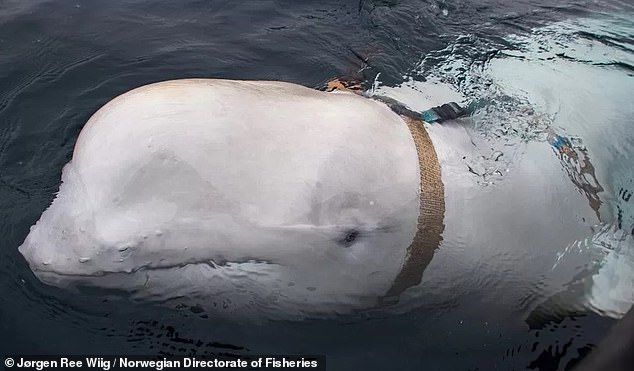
The harness and camera mount sparked allegations that the beluga was ‘a spy whale’. It has now been revealed the beluga was likely guarding something
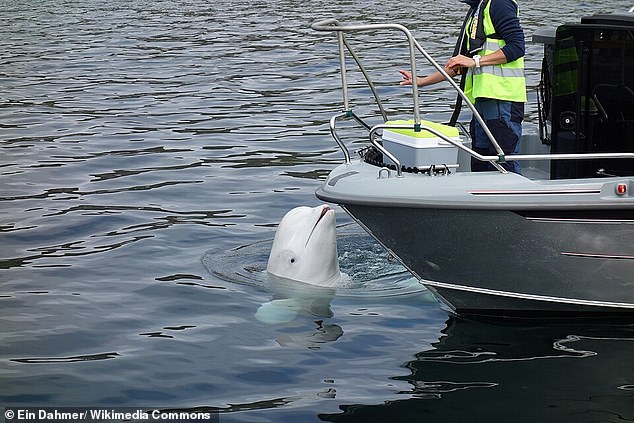
Hvaldimir (pictured) was first seen in Norwegian waters in 2019

Hvaldimir was sadly found dead in August 2024
First appearing off the coast of Norway in 2019, local fishermen reported Hvaldmir the friendly whale was wearing a camera harness.
Fishermen found a drawing of a carved fish hook, as well as the words ‘Equipment St. Petersburg’ written in English.
This, coupled with the knowledge that Russia has a sea mammal espionage training programme, led many to believe that Hvaldimir, whose name is a portmanteau of ‘hval’, the Norwegian word for whale, and Vladimir, the first name of the Russian dictator Vladimir Putin, was being used by Russian intelligence.
To top it off, after he was freed from his bonds, he apparently stuck around and seemed used to being near humans, an unusual trait for wild belugas that further suggested he had long been in contact with people.
Russia made attempts to distance itself from Hvaldimir, though it did not explicitly deny it was using him for intelligence gathering.
A Russian military spokesman, Colonel Viktor, reportedly said at the time: ‘If we were using this animal for spying do you think we would attach a mobile phone number with the message ‘please call this number”.
But investigations by local media revealed that the Russian naval base at Olenya Guba, just a couple hundred miles east of Hammerfest, had pens that could easily accommodate belugas and other marine mammals.
Hvaldimir was sadly found dead in August 2024. Though local activists initially claimed he had sustained multiple gunshot wounds, a necropsy found he had likely died from a bacterial infection.
Join the debate
How do you feel about using animals as secret agents in wartime or intelligence operations?
US plan to turn millions of bats into bombs

Bat bombs were developed by the American military during the Second World War, and held in enclosures (pictured) across the US

The plan had the approval of then-President Franklin D. Roosevelt, and the weapons were tested across the US, including at sites in New Mexico (pictured)
Dentist Lytle Adams had a very dim view of bats.
Describing them as ‘the lowest form of animal life’, the American dentist said of the winged mammal: ‘Reasons for its creation have remained unexplained’.
But Adams eventually saw purpose in these creatures. Inspired by a trip to a national park in Mexico and enraged by the Japanese attack on Pearl Harbour in December 1941, he used his connection to then-First Lady Eleanor Roosevelt to pitch his crazy idea.
Despite his misgivings about bats, he knew they were remarkably strong, capable of carrying significant loads while flying.
He also knew they roosted before dawn. These characteristics, coupled with the knowledge that many of the buildings in Tokyo, Japan’s capital city, were made from wood, led him to come up with the bat bomb.
Adams’ theory was that bats released over Japanese cities during the night would naturally try and find eaves to roost on.
If these bats had tiny incendiary bombs strapped to them, they would essentially become living time bombs capable of burning down entire cities.
As far-fetched as the plan sounded, it had the approval of then-president Franklin D. Roosevelt, who told the head of the Office of Strategic Services: ‘This man is not a nut. It sounds like a perfectly wild idea but is worth your time looking into’.
After acquiring ‘a few million’ Mexican free-tailed bats, a team of crack scientists set about figuring out how best to store, transport, and deploy the bats before detonating the explosives.
They cooled the animals in ice cube trays and glued small amounts of napalm to them before stuffing roughly 1,040 into sheet metal tubes.
The plan was that bomber planes would fly down to an altitude of just 4,000ft before deploying the bombs, whose sides would fall away and allow the bats to spread across cities.
Initial tests were positives. One scientist wrote following an experiment in Utah: ‘A reasonable number of destructive fires can be started in spite of the extremely small size of the units.
‘The main advantage of the units would seem to be their placement within the enemy structures without the knowledge of the householder or fire watchers, thus allowing the fire to establish itself before being discovered’.
But the bat bombs never got their day in the sun. Testing began too late in the Second World War, and would have taken too much time before they were ready to deploy.
On top of this, the American military was already focused on developing the nuclear bomb – which would end up devastating two Japanese cities in a way the bats could never hope to achieve.
Russian ‘controllable spy pigeons fitted with brain implants and cameras’
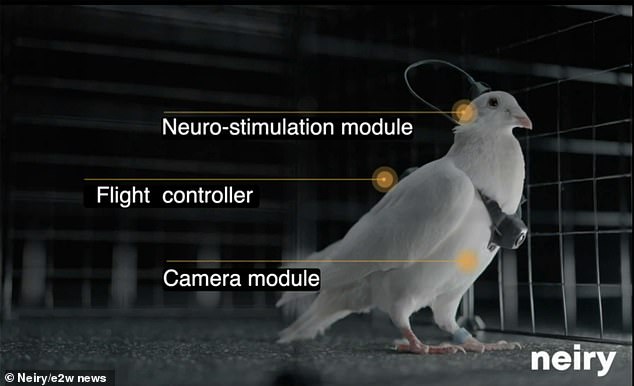
The birds can be steered remotely in real time, with operators able to upload flight commands by stimulating targeted regions of the brain
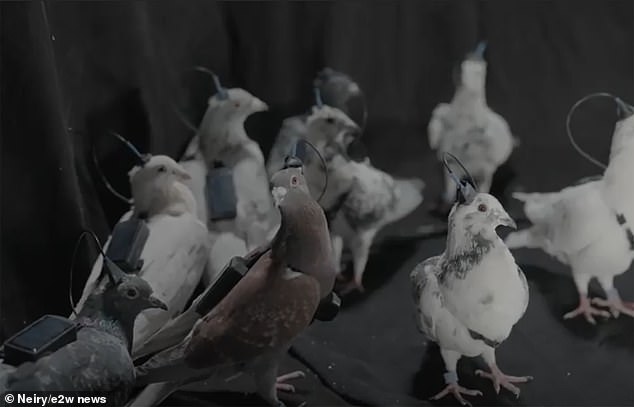
Neiry insists that ‘no training is required’, declaring that any animal becomes ‘remotely controllable after the operation’
Russia recently revealed it was pioneering remote controlled spy pigeons fitted with brain implants.
A state-linked Moscowneurotechnology firm boasts its operators can steer flocks of the flying pests across the sky at will.
Researchers have launched field tests of so-called ‘bird-biodrones’ known as PJN-1, ordinary pigeons surgically implanted with neural chips that allow technicians to direct their flight routes.
The birds can be steered remotely in real time, with operators able to upload flight commands by stimulating targeted regions of the brain.
The pigeon then ‘believes it wants to fly’ in the instructed direction, claim sources at Neiry, which has deep ties to the Kremlin’s hi-tech innovation machine.
Surgery is carried out in which electrodes are inserted into the brain with millimetre precision.
The birds wear tiny solar-powered backpacks containing onboard electronics, GPS tracking, and the receiver that transmits signals into the neural implant.
Chillingly, Neiry insists that ‘no training is required’, declaring that any animal becomes ‘remotely controllable after the operation’ – with pigeons capable of covering 310 miles a day, or more than 1,850 miles in a week.
‘Right now, the solution works on pigeons, but any bird can be used as the carrier,’ said Alexander Panov, company founder.
‘For transporting heavier payloads we plan to use ravens, for coastal monitoring — seagulls, and for large marine territories — albatrosses.’
How a taxi stopped a CIA plan to use cats to spy on Soviet embassies

The CIA’s plan was to get vets to surgically implant microphones in a cat’s ears, a small radio transmitter in its skull and push a thin wire through its fire (File image)
Launched in the 1960s by the CIA’s Directorate of Science and Technology with the intention of releasing them near Kremlin and Soviet embassies, the project to stick microphones in cats to use them in espionage is perhaps one of the agency’s more embarrassing failures.
The CIA’s plan was to get vets to surgically implant microphones in a cat’s ears, a small radio transmitter in its skull and push a thin wire through its fire.
In theory, this would allows the furry animals to become the ultimate infiltrators, recording top-secret conversations while sat in the laps of feline-loving diplomats.
The first mission for Operation Acoustic Kitty was to send a cat to eavesdrop on two men in a park outside the Soviet embassy in Washington DC.
But, as the legend goes, the feline James Bond was immediately killed by an oncoming car.
Further tests also failed. Combined with the problem of safely removing the equipment from the cat, as well as the extortionate price of the whole project, it was written off as a total failure in 1967.
CIA researchers claimed in a final memo that while they believed it was possible to train cats to move short distances, ‘the environmental and security factors in using this technique in a real foreign situation force us to conclude that for our (intelligence) purposes, it would not be practical’.
The vultures suspected of espionage
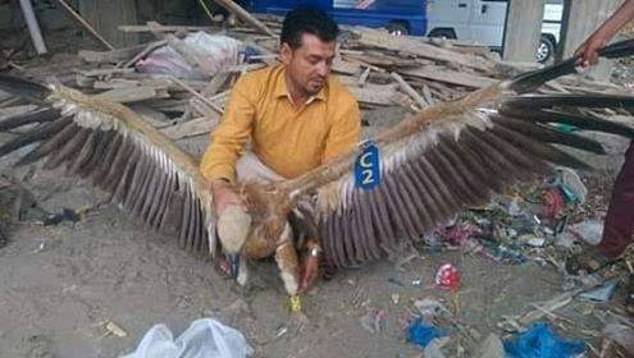
In 2018, a Bulgarian vulture (pictured) that flew into Yemen was captured after officials believed it was being used to spy on the army
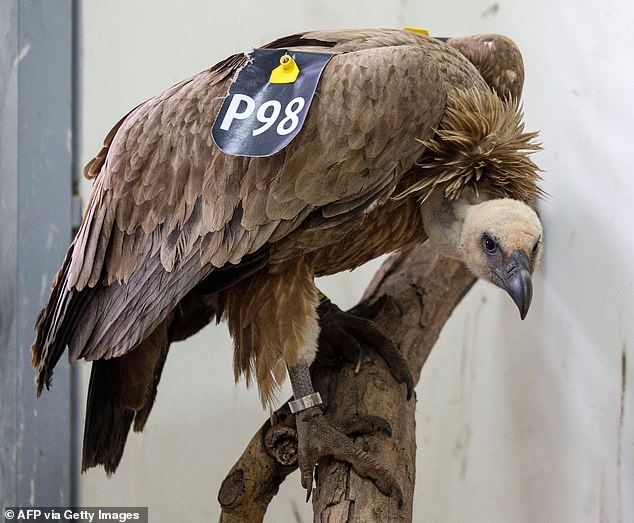
In 2016, a vulture (pictured) as detained in Lebanon on suspicion of spying for Israel
There have been multiple instances of security services detaining vultures on suspicion of espionage.
In 2018, a Bulgarian vulture that flew into Yemen was captured after officials believed it was being used to spy on the army.
It was found with a transmitter by locals in the Middle Eastern country. While the army said at the time they believed this was being used to communicate with its handlers, scientists said it was tagged as it was being studied.
It then took several months of negotiations between Bulgarian and Yemeni officials to mediate the release of the animal.
And in 2016, another vulture was detained in Lebanon on suspicion of spying for Israel.
The bird, which was a 6ft and 5in wingspan, flew over Lebanon’s southern border from an Israeli game reserve.
Lebanese villagers became suspicious of it, as it had a tracking device on its tail.
Wildlife officials said at the time that the vulture hailed from Spain, and was set free in the Gamla Nature Reserve in the occupied Golan Heights.
The bird was released after a week after villagers realised it wasn’t actually a spy.
Upon its release, officials found it was weak and was being treated for minor injuries.
Iranian intelligence agents capture over a dozen squirrels suspected of spying for the West
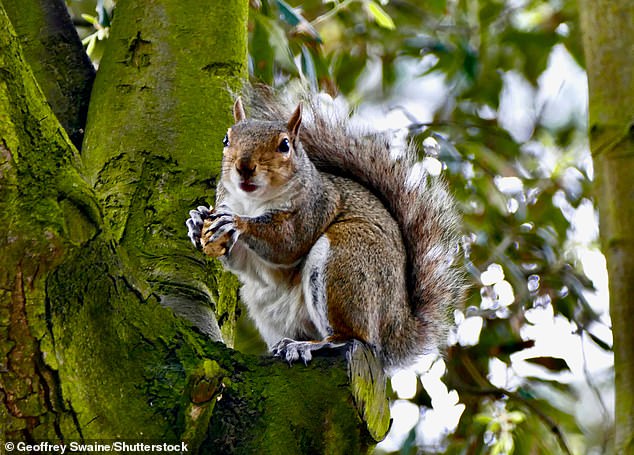
In 2007, Iranian intelligence operatives arrested a group of 14 squirrels, claiming they were Western spies
The cat-and-mouse game of international espionage requires spooks to think like their enemies, to predict how they may use advanced technology and come up with strategies to defeat them.
But these mind games can, in some instances, result in overzealous action against the wrong people or, in this case, squirrels.
In 2007, Iranian intelligence operatives arrested a group of 14 of the critters, claiming they were Western spies.
The state sponsored IRNA news agency said at the time: ‘The squirrels were carrying spy gear of foreign agencies, and were stopped before they could act, thanks to the alertness of our intelligence services’.
Iranian police commander Esmaeil Ahmadi-Moqadam confirmed the report, saying that a number of squirrels had been caught bearing foreign spy gear within Iran’s borders.
‘I heard of this but I have no specific knowledge on the subject,’ he said. He refused to give further details.
Just a year later, Iran’s security forces apprehended a pair of pigeons they claimed were spies looking into the country’s nuclear processing systems.
One was captured near a rosewater production plant in Kashan, which is only up the road from the Natanz uraniam enrichment facility.
Reports at the time claimed it has a ‘wired rod’ and ‘invisible threads… fixed to its body’.
Another one had been detained earlier in the month. The fate of the two pigeons and 14 squirrels is not known.
China reveals miniature robots modelled after mosquitoes
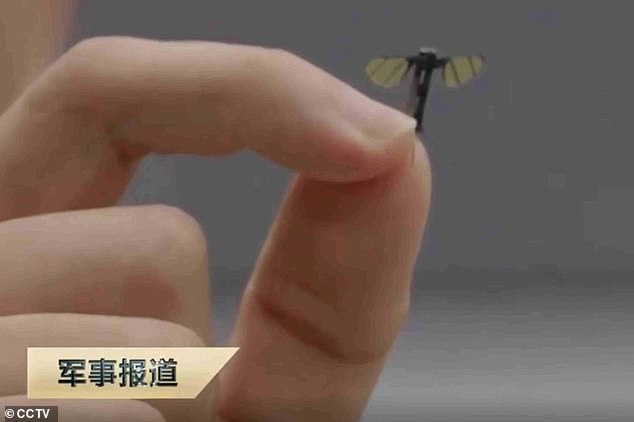
The mosquito-sized nanorobots measure just 1.3cm in width
Perhaps the most successful example of animals being co-opted into the security services comes in the form of so-called listening bugs.
Technically, the Chinese-made drone isn’t an animal. Rather, they’re miniature robots designed to look and behave like flies.
The mosquito-sized nanorobots measure just 1.3cm in width and are made up of two tiny wings and three legs attached to a miniature body.
With such a small size, they are nearly undetectable to unsuspecting human beings.
Researchers at the National University of Defense Technology, China’s top militar R&D academy, said in 2024: ‘Miniature bionic robots like this one are especially suited to information reconnaissance and special missions on the battlefield’.
The technology is far from complete, with scientists still figuring out how to attach sensors, power storage and control circuits to them without overwhelming the small wings.
As a result, it’s not clear exactly what capabilities the robotic flies have, nor is it known how long they can stay in air.
But the pace at which Chinese scientists are developing the technology is worrying, to say the least.