The Flemish excel at two things: blocking multinational agreements and cycling. Last weekend, the region’s newspapers heralded Belgian Prime Minister Bart De Wever’s obstinacy in EU negotiations over financing Ukraine. Exciting as the EU Council may be, I was in Antwerp for a different reason—cyclocross. Veldrijden, as they say in Flemish, is the cycling-mad nation’s favourite winter pastime, and Britain could do with it.
Cyclocross, veldrijden, CX or just cross is at first a rather bizarre sight. It involves dozens of lycra-clad cyclists racing what look like road bikes over an eclectic mix of mud, sand, and obstacles. To add to the glamour, it usually takes place in the vicinity of a minor Belgian leisure centre. Across the Scheldt from the port of Antwerp, the riders were huddled in a scout hut while they waited for doping control. Yet beneath this rustic shell is incredible physical performance.
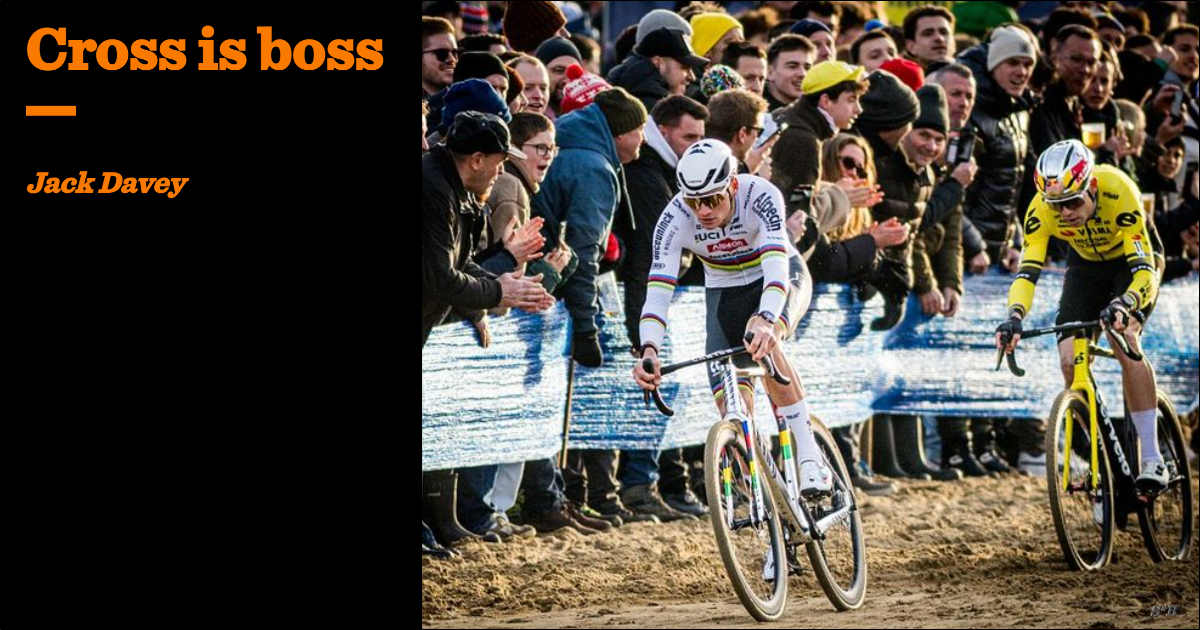
Tens of thousands had descended on Antwerp because two giants of modern cycling, Mathieu van der Poel and Wout van Aert, were returning to the dirt tracks they grew riding. The Dutchman, Van der Poel, is probably the best cyclist outside of Tadej Pogačar (covered in these pages a few months ago). Van Aert—his rival, having raced together since they were kids—is Flanders’ most popular man. He is what the French would call an éternel second, a nickname first given to Raymond Poulidor, van der Poel’s grandfather. His victories, often despite bad luck, and his small-town Flemish outlook have made him the region’s talisman. As he passed me, the crowd roared—although this didn’t help Van Aert, who punctured soon after.
Such stardom seemed incongruent with what, over the afternoon, became an extremely cold, drunk-filled park. van Aert’s starship-like team bus was wedged next to a smaller team’s preparation area, which doubled as a caravan showroom for those passing by. Yet this is part of the magic of a sport that shapes the Belgian Christmas calendar. From 20 December through to 4 January—the kerstperiode—there is a major race almost every day. Despite the global stars’ presence, the event’s sponsors—Maes Beer (I promised their PR rep I would mention them), Pauze Mayonnaise, and a local letting agent, among others—are all uniquely Flemish.
Coming from across the Channel, where even our traditional Boxing Day schedule of Premier League football has died at the altar of global commerce and the scramble for more TV rights, you feel the difference here. Unlike in Britain, Flanders’ petit-bourgeoisie still controls its sport, although that is not to say the event is an all-Flemish affair. The crowd was admittedly what a post-woke professor would call ‘intellectually diverse’ and besides the masses of Dutch and Belgians, there were plenty of foreigners. Europe’s Basque and Breton cycling-mad minorities were present in large numbers, and a few Mamil holdouts from England had made the same journey as me across het Kanaal.
Cyclocross remains distinctly Flemish in a way English sports no longer are: our sporting culture rode the waves of global success and drowned in them
This was officially the latest round of the UCI Cyclocross World Cup; despite this branding, only four of the eleven races in the series are outside Belgium and the Netherlands, and none are outside Europe. Cyclocross remains distinctly Flemish in a way English sports no longer are: our sporting culture rode the waves of global success and drowned in them. Such a mixture of high performance and so powerful a local culture is unthinkable in a Britain of global pastimes. As the heavenly vapour of Scheldt mist and frituur smoke rose and revealed Antwerp’s cranes and warehouses, it occurred to me that even in sport we can now only import what we used to export. Britain would do well to have a Cyclocross World Cup race, but even then, with its Maes Beer (they gave me free merch) and mayonnaise, it would still be a bit of Flanders in Britain—but perhaps that is precisely why we need it.
As for the race, Van Aert slid to seventh after his puncture, and Van der Poel slaughtered the field as usual, going off into the distance with half the race to go. This season will probably be the final battle between this pair of two-wheeled legends. For this reason, a cyclocross-mad Japanese couple I spoke to had come all the way to Belgium for the first time. They were also there to support the newly crowned Japanese cyclocross champion, Hijiri Oda. Tragically for Oda, he had a mechanical in the first lap and had to carry his bike over his shoulder for half a lap to the pits. As he ran, he was followed by his compatriots, sprinting through the Flemish mud to support their countryman. I realised there would always be some corner of Japan that was forever Flanders.