Sir Keir Starmer is facing fresh embarrassment over his pledge to ‘smash the gangs’, after French police refused to stop small–boat migrants from crossing the Channel by incapacitating their vessels.
Unions representing the officers have blocked plans for police to stop the dinghies by using tactics such as jamming the propellers, on the grounds that they could face prosecution if any migrants died as a result.
This comes despite year–long negotiations between Sir Keir and French president Emmanuel Macron over the interceptions – and the payment of £500 million by the Government to France. In return for the money, which covers a three–year period, Paris is meant to act to prevent migrants from reaching British shores.
In a letter written by Sir Keir to Mr Macron last month, the Prime Minister said: ‘It is essential that we deploy these tactics this month,’ adding: ‘We do not have an effective deterrent in the Channel.’
But now Alliance, the largest police union in France, has said it is too dangerous for its members to carry out arrests at sea while trying to force a boat to change course.
A source at the French interior ministry told The Mail on Sunday: ‘The police want guarantees that there will be no prosecutions in case of death or injury, but prosecutors say that is impossible. Meetings between lawyers and police chiefs have taken place over the past month, but the judicial authorities remain firm – there will be no waiving of criminal liability if things go wrong.
‘Any interceptions at sea are extremely dangerous, and the risk has to be accepted by those involved in policing immigrant boats.’
Last night the Home Office tried to put a brave face on the latest setback, with a source insisting the Government was still ‘committed to working in partnership’ with the French to ‘drive down small–boat crossings and break the model of the criminal smuggling gangs’.

Unions representing the officers have blocked plans for police to stop the dinghies by using tactics such as jamming the propellers

Sir Keir Starmer is facing fresh embarrassment over his pledge to ‘smash the gangs’, after French police refused to stop small–boat migrants from crossing the Channel by incapacitating their vessels (Pictured with French President Emmanuel Macron earlier this month)
But the Conservatives said the revelation demonstrated that it was a serious mistake for Labour to cancel Rishi Sunak’s plan to deter migrants by threatening to deport them to Rwanda.
Shadow Home Secretary Chris Philp said: ‘Keir Starmer promised interceptions at sea near the French coast, and that’s proved to be another gimmick that won’t happen – just like his claim to smash the gangs and return many illegal immigrants.
‘Starmer himself has admitted there is no deterrent. It was a huge mistake to cancel Rwanda just before it started, and illegal immigrants have flooded over the channel since the election as a result.
‘The Conservative plan is to exit the European Convention on Human Rights, which will enable us to deport all illegal immigrants within a week of arrival. Then the crossings would soon stop.’
The move by the officers – who have arranged emergency meetings with the legislative – comes despite orders being given by the French local authorities in key sections of the Channel and North Sea coast last month for tougher intercept measures to start.
These included stopping boats off the Calais and Dunkirk beaches, from where thousands of migrants head off to England each week.
The plans were at the centre of negotiations between London and Paris over the past year, during which time more than 40,000 migrants crossed the Channel by small boat. Most were asylum seekers from countries such as Iran, Afghanistan, Iraq, Syria, Eritrea and Sudan.
France’s Maritime Gendarmerie was set to start the new operations, focusing initially on ports and rivers which lead into the sea.
During interceptions, police were to ‘order the boats to stop’ before ‘immobilising them, diverting them back to France, and then handing those on board to the authorities,’ said the interior ministry source.
But a senior source at Alliance said: ‘People don’t seem to realise how dangerous it is to try and carry out arrests at sea, while trying to force a boat to change course. If there are 80 people on an overcrowded boat, including women and children, then it is extremely dangerous to try and stop them.’
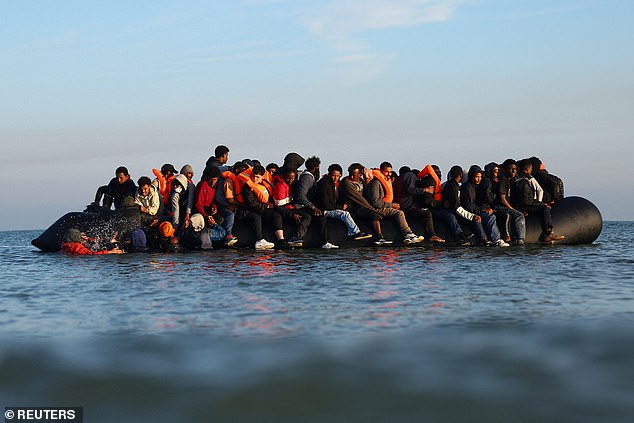
A group of migrants on an inflatable dinghy leave the beach of Petit–Fort–Philippe in northern France in an attempt to cross the English Channel to reach Britain in September 2025
The French Navy also objected to intervening at sea. One senior officer said: ‘Disaster, including drownings, can easily happen.’
France’s previous interior minister, Bruno Retailleau, approved a plan to allow sea interventions in certain circumstances, including shallow water, but these appear to have been put on ice.
His successor, Laurent Nunez, a former Paris police prefect, is understood to be concerned about the dangers the new tactics pose to serving officers. ‘He agrees that intervening in boats at sea is incredibly dangerous and should be avoided at all costs,’ said a French National Police source.
Martin Hewitt, who is in charge of border security in the UK, has expressed ‘frustration’ at French delays in implementing a new ‘maritime doctrine’ which would see patrol boats attempt to intercept inflatable boats at sea.
A Home Office spokesman said: ‘Independent operational matters are for the French authorities. France remains a critical partner in securing our borders and our joint work has prevented over 22,000 small–boat crossing attempts this year.
‘The Home Secretary has set out the most sweeping reforms to tackle illegal migration in modern times. These new reforms will restore order and control to our border, removing the incentives which draw people to the UK illegally and increasing removals of those with no right to be on British soil.’
A Home Office source said: ‘This government has transformed the UK’s illegal migration relationship with France. Our historic one–in–one–out scheme means we can now send those who arrive on small boats back to France and we are working to ramp this up.’