As we prepare to flip the calendar into another year of war, unpunished wrongdoing, public lying and monstrous taxation, can anyone tell me what is so good about optimism?
I was lucky enough to be born a pessimist, a view of the world which millions take decades to learn. And I am amazed by how totally most people misunderstand what we pessimists think. Above all, they fail to notice how cheerful we all are.
Last week we marked the centenary of AA Milne’s famous bear, Winnie-the-Pooh, so much more entertaining and witty than the infuriating, drippy Paddington and his wretched marmalade sandwiches.
Now, I am old enough and English enough to have much enjoyed the Pooh books as a child. Pooh bear is a great master of understatement, as was the superb illustrator of the original stories, EH Shepard, a real artist who won the Military Cross in the Great War. But I think they are probably beyond most modern children. I fear they only survive thanks to the horrible Disney version, which I cannot bear to watch.
But the greatest character in those books is the old grey donkey Eeyore, one of the most important figures in English literature.
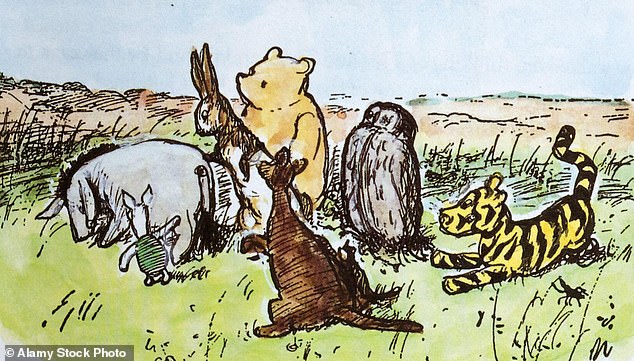
The old grey donkey Eeyore (left) is one of the most important figures in English literature, writes Peter Hitchens. AA Milne’s character is a thinker and a master of logic, with a very good grasp of the true nature of the universe
I am not joking about this. In a few short episodes, author AA Milne invented a personality so memorable that it will survive as long as there is anyone English left alive (I’m not sure about the other nations of our Kingdom, who laugh differently).
We all know him. Some of us (the lucky ones) are him. Some years ago, old friends of mine gave me my own personal Eeyore (with detachable tail) for Christmas, and I treasure him to this day. Eeyore is a thinker and a master of logic, with a very good grasp of the true nature of the universe. He never wastes a word. He is full of dry humour, if only you pay attention.
When he has shown, through pure reason, that his tail has been stolen, Eeyore concludes ‘Somebody must have taken it’, adding – after a long silence – ‘How Very Like Them’. Yet when his tail is found, he frisks happily about the forest, rejoicing, a detail people tend to forget, just as they forget the happy outcome of his seemingly dismal birthday, during which he receives an empty honey jar and the shreds of a burst balloon, and is wonderfully content with them.
To all you optimists, doomed as you are to disappointments piled one on top of the other, and who will seldom be pleasantly surprised, I say this. Please stop going on about how you are a ‘glass half-full person’, as if this was a good thing. It is obvious that a glass which contains 50 per cent air is on the way to being empty. This is because someone is drinking from it and will drink more until it is all gone. It is therefore half-empty.
It will only be half-full if it is in the process of being filled. And this is why pessimists (among many other virtues) can always be relied upon to get the next round before everyone else is parched with thirst.
I wish you all a pessimistic new year. It may have its bad aspects, but you will be ready for them.
The brutal reality of war
Boxing Day always had a special significance for my late father, sharply set apart from the cosiness of the post-Christmas interlude. On that day in 1943, he was on the Royal Navy cruiser HMS Jamaica, when she was part of the fleet which chased, caught and ultimately sank the German battlecruiser Scharnhorst, at the Battle of the North Cape.
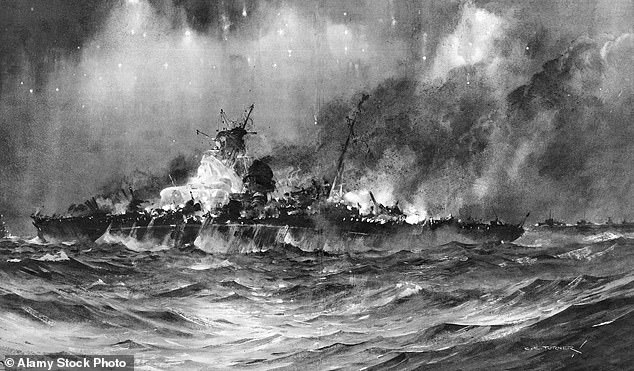
The sinking of the German battlecruiser Scharnhorst in 1943… my father never hid from the terrible number of German seamen who went down with their ship, writes Peter Hitchens
This was during his time on the convoys between the Orkneys and north Russia, a gruelling part of the Second World War which has never really had the attention it deserves. Hugh Sebag-Montefiore has written an excellent, if horrifying, new book The Battle Of The Arctic about this.
My father recalled seeing Scharnhorst, illuminated by starshell and plainly taken by surprise. Her sinking was a rare moment of success in constantly dangerous combat, about which he otherwise seldom spoke. Yet he never hid from himself or from us the terrible number of German seamen who went down with their ship or froze to death. If it had been the other way round, the same thing would have happened to him.
His view of the war was hard and unsentimental, and I think he would have been surprised by the national religion of incessant war reminiscence which has sprung up as the conflicts of the 20th century have receded into the past.
People who now lightly say we should be preparing for new wars should make more effort to find out what the old wars were like. They wouldn’t be quite so keen.
Stop being coy about prayers
Curiosity about every aspect of our civilisation took me last week to Bicester Village, a hugely crowded ‘designer outlet’ on the edge of a handsome Oxfordshire town. Amid the throng, among modish shops with those diamond-bright lights which make the merchandise glow, I saw a sign directing me to a ‘Contemplation Room’. How could I resist? What would I find there? I found a multi-faith prayer room. I quite like these, and often make use of them. I am increasingly sure that there is too little prayer in our lives. I admire those who take it seriously in the midst of commerce and bustle. So why the coy name?
For much of last year I and many others worked as hard as we could to reopen the case of Lucy Letby, whose conviction for allegedly killing and harming babies at the Countess of Chester Hospital now seems less and less convincing. In the coming year, we hope that the courts, too ready to close their minds to criticism, will at last recognise that a terrible error may have been made.