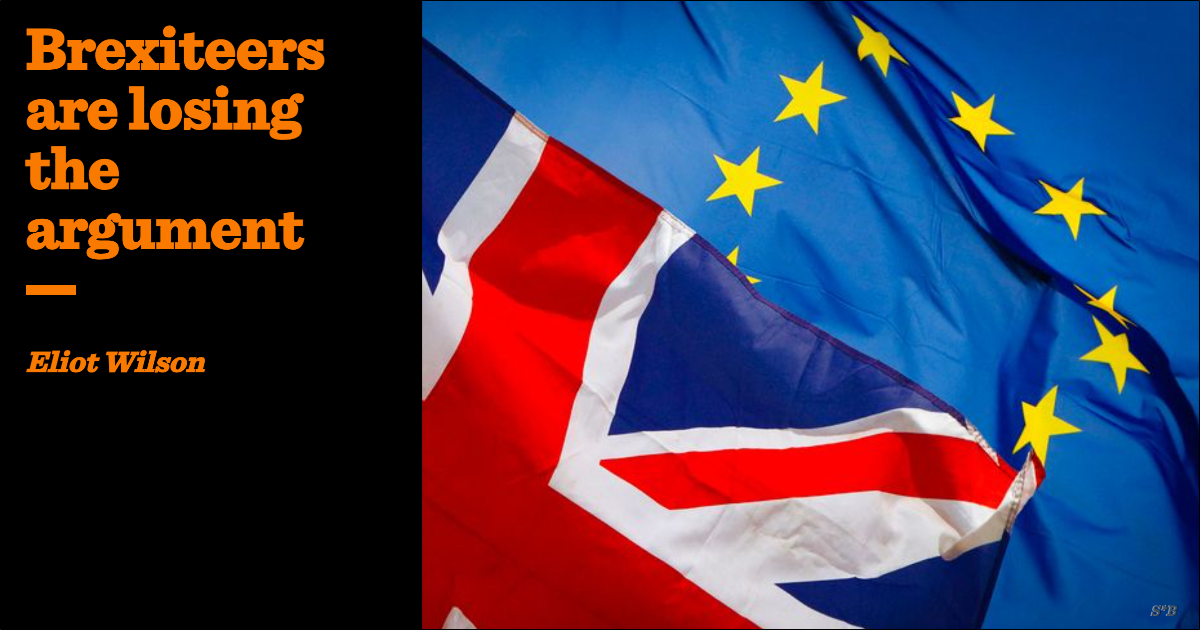
We must make a rational and cool-headed case for why Britain is better off outside the EU
In mid-December the government finalised an agreement with the EU and Spain over border arrangements in Gibraltar. In return for keeping the border with Spain open, the Policía Nacional will be part of dual passport checks at the port and airport.
The framing was clear in The Daily Telegraph’s headline: “Starmer hands Gibraltar border controls to EU in ‘Brexit betrayal’”. Former Conservative leader Sir Iain Duncan Smith called it a “ridiculous disaster” and “cowardly posturing”, but also part of a pattern.
Labour’s 2024 election manifesto pledged to “reset the relationship and seek to deepen ties with our European friends, neighbours and allies”, and Sir Keir Starmer has worked hard on that relationship.
At a summit in London in May, the UK and the EU agreed a Joint Statement outlining a new strategic partnership, a Common Understanding identifying areas for negotiation and a security and defence partnership. (People in Brussels and those who want to impress them really do talk like this.)
The “reset” of UK/EU relations has not always brought the benefits anticipated. Despite the security partnership, the UK was unable to participate fully in the Security Action for Europe defence loan scheme; access to UK waters for EU fishing vessels has been extended for another 12 years; and business groups have warned that trade friction with the EU is getting worse, not better.
For the most devoted Brexiteers, there is an obvious plan. As Duncan Smith put it:
They’re using Gibraltar as a lever to get themselves back closer to Europe. He wants to undo Brexit. The whole plan of this Labour Government, who hated Brexit, is that over a period of time it will become impossible for us not to rejoin.
A conspiracy to undo Brexit by a left-wing elite which has never reconciled itself to the result of the 2016 referendum is central to some Brexiteers’ critique of Labour. It is not utterly baseless: although the party’s manifesto explicitly promised “no return to the single market, the customs union, or freedom of movement”, it has demonstrated slipperiness on other manifesto commitments.
There is little reassurance when Deputy Prime Minister David Lammy praises the “self-evident benefit” of a customs union, and the ambitious Health Secretary, Wes Streeting, advocates a customs union and rejoining the single market. It is very easy to believe that, in their hearts, Labour ministers would like the UK to rejoin the European Union. But this is not a winning argument for Brexit.
Before some Brexiteers are afflicted by the Commissioner Dreyfus twitch and book my seat on the next tumbril, let me be clear: I voted to leave the EU and I would vote to remain out if there were another referendum. I concluded as an undergraduate in the mid-1990s, when it was still a belief confined to the fringes, that the structures and ambitions of the EU were incompatible with my idea of a sovereign Parliament and nation. At Oxford I listened to a frail but razor-sharp Enoch Powell demolish the case for integration. I have been here for a while.
Yet we have to move away from accusations of betrayal and conspiracy precisely in order to defend the decision taken in 2016 and our future outside the EU. The argument, of which Duncan Smith is only the most recent exponent, comes in two parts. The first construes Brexit as a phenomenon, an act of God which came upon us in 2016 and must not now be questioned. The turpitude of the government’s actions require no elaboration: it is “betraying” Brexit.
The second part presents Brexit as a settled element of the constitution taken for granted by a contented but quiescent electorate. Brexit’s unreconciled opponents therefore scheme to unpick or reverse it by stealth. Conservative front bencher Mark Francois said of the Gibraltar deal, “Starmer remains a Remainer at heart, but now he’s not even bothering to hide it — he’s going to try and take us back in”.
These arguments are unsustainable because they rest on false propositions. I derive no pleasure from the fact that a poll in the summer showed 56 per cent of respondents now think it was a mistake to leave the EU and only 31 per cent believe it was the correct decision. Those are bad numbers, but they are the numbers we have.
Leaving the EU was not a single knockout victory but the first step into a different future
That draining away of support makes the cry of betrayal pointless or counterproductive. Brexit was a political decision, and it could be reversed. If polling indicates that more than half the electorate is now against it, there is little mileage in accusing them of betrayal or howling down anyone who questions a decision against which people are turning.
Leaving the EU was not a single knockout victory but the first step into a different future. Brexiteers, in whose ranks I number, cannot keep fighting the battles of the late 2010s. We need to look ahead: certainly, we should keep pointing out why we no longer belonged in a sclerotic, protectionist, centripetal institution like the EU.
We cannot be dragged back into the EU; if we return it will be by consent. For those of us who think that would be a mistake, we have to develop a clear and credible alternative. We are a sovereign nation and Parliament but we must also exploit our unique combination of advantages — language, commercial culture, global networks, geography, strength in financial services, education and research — to remake a prosperous economy built on free trade, innovation and self-confidence.
Fifty years ago, the new leader of the Conservative Party said “you don’t win by just being against things, you only win by being for things and making your message perfectly clear”. Margaret Thatcher was right. Brexit was a gateway. If we don’t want people to turn around and go back through it, the challenge is obvious: show them what’s on the other side. Everything else is just noise, and voters know that.