A man with confusion and signs of a brain injury actually had an extremely rare condition diagnosed in just 50 people over the past century.
The unidentified 76-year-old was rushed to his local emergency room in Waterford, Ireland, in January 2024 after caregivers found him lying on the floor beside his bed.
Doctors noted he seemed confused and agitated, insisting he felt his right arm levitating and moving involuntarily, sometimes hitting him in the head. He told doctors he hallucinated visions of animals.
The man had also been suffering from a long list of chronic conditions, including heart failure, diabetes, ulcerative colitis, high blood pressure and a pulmonary embolism, a blockage in the artery.
Caregivers reported he often seemed disoriented and that he would try to grab at his bed and move his arm sporadically, which left him distressed. Within 24 hours in the hospital, the patient also started involuntarily lifting his left arm, in addition to his right, in the air as he claimed it was ‘acting on its own.’
The arm tightly grasped at the man’s clothing and torso, causing the arm and hand to become swollen from the force and activity.
A CT scan showed the man had suffered severe brain damage from what doctors believe was a stroke in his left temporal lobe, which controls language comprehension and word storage, and occipital lobe, which helps the brain interpret colors, shapes and motion from vision.
The damage extended into his corpus callosum, a C-shaped bundle of nerve fibers in the brain that connects the left and right hemispheres. This structure is essential for coordinating motor skills, sensory processing and cognition.
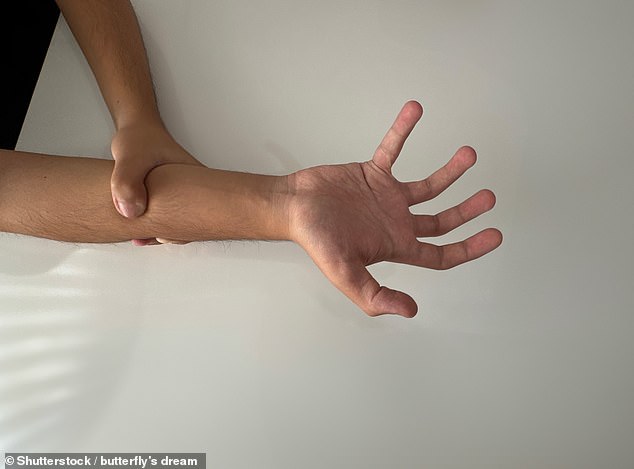
A man in Ireland was diagnosed with alien hand syndrome, an extremely rare condition in which a person’s hand moves on its own uncontrollably. Only 50 cases have been identified (stock image)
Doctors writing about his case in the Journal of Medical Case Reports believe the brain damage was a sign of a stroke, which had triggered alien hand syndrome (AHS), an extremely rare condition in which a person’s hand moves on its own uncontrollably.
Also referred to as Dr Strangelove syndrome, the hand in question often performs actions or movements without a person’s consent or knowledge, as if it has a mind of its own.
It may grab items, try to unbutton clothing or harm the patient or others.
The affected hand, usually the left one, also doesn’t have sensation and cannot feel anything it touches.
Only about 50 cases have been recorded since AHS was first identified in 1909.
For many patients, the disease causes the hand to act inappropriately or violently.
One patient in a case report told doctors her alien hand tried to intermittently choke her and the hands of some study subjects fondled them or reached out to the study examiner without the patient being aware.
The exact cause of AHS is unknown, but one study suggested it could occur just before or during a stroke, much like in the case of the unidentified man.
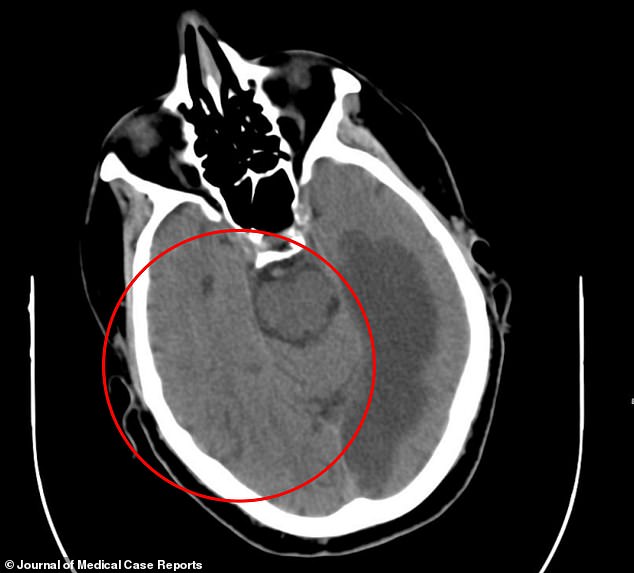
The above CT scan image shows damage to the man’s brain tissue, likely due to a stroke. A healthy brain would have distinct gray and white brain tissues, but in this case, the tissue gray and white colors have blended together, signaling a potential lack of oxygen
The syndrome has been reported after surgery on the corpus callosum and in patients with brain tumors, aneurysms and degenerative brain diseases.
The man in the new case report also had a history of alcoholism, which has been shown to raise the risk of Marchiafava-Bignami disease (MBD), a rare neurological condition that causes damage to the corpus callosum.
Doctors believe AHS may be a manifestation of this condition.
Only around 300 to 400 cases of MBD have been reported in medical literature.
There are no standard treatments for AHS because it is so rare, though some studies suggest cognitive behavioral therapy and distraction techniques can minimize symptoms.
The case study authors also pointed toward Clonazepam (Klonopin), which is used to treat seizures and panic disorder, and Botox, as it may temporarily block nerve signals in overactive muscles.
Doctors treating the man gave him the anti-anxiety drug lorazepam to manage his agitation and delirium, which also controlled his hand levitation episodes. He also started a program to manage signs of alcohol withdrawal.
The patient was discharged after several days and continues to be monitored with brain scans and blood thinners to reduce the risk of another stroke. It’s unclear if the AHS has been fully resolved.