The last time I invited some people round for a lobster lunch, one of the more squeamish members of the party took one look at the two antennae-waving beauties I’d lined up for the pot and christened them Nippy and Pinchy.
We are a nation of animal lovers and, even if no crustacean has ever responded to the call of a pet name, many of us still quail at the idea of thrusting a living thing into a pan of boiling water.
And this week, the Government declared that ‘live boiling is not an acceptable killing method’ for crustaceans and pledged to publish guidance on the appropriate way to despatch them at some point in the future.
As this raises the spectre of restaurants being forced to invest in expensive and cumbersome electrical stunning devices, the announcement sparked an immediate outcry from the hospitality sector.
Bars and restaurants have already been clobbered by rises in everything from National Insurance and business rates to hikes in the minimum wage and alcohol duty. So the idea that any lobster-serving establishment might also have to, er, shell out for a £3,500 stunning machine has gone down like a bowl of cold bisque.
The Government’s move follows on from a law passed by the Tories in 2022 that ruled decapods, which include lobsters, crabs and prawns, and cephalopods, such as squid and octopuses, are sentient. Quite how home cooks and restaurants alike are expected to abide by the new rule is questionable. Is every Morecambe Bay shrimp to be sent to meet its maker by electrical prod? Enforcement is another issue.
With the country in the grip of an epidemic of burglary and shoplifting, are the police really going to devote much time to arresting murderous crayfish boilers?
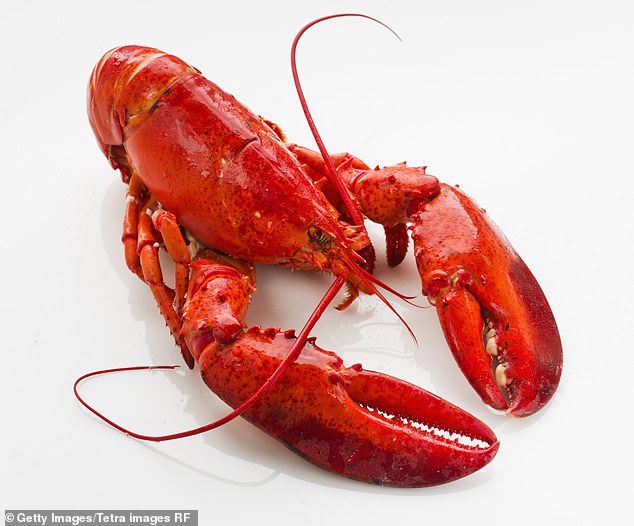
The idea that any lobster-serving establishment might also have to, er, shell out for a £3,500 stunning machine in order to have the antennae-waving beauties on the menu has gone down like a bowl of cold bisque

With the country in the grip of an epidemic of burglary and shoplifting, asks Dominic Midgeley, are the police really going to devote much time to arresting murderous crayfish boilers?
That said, as someone with a fondness for entertaining, I am no stranger to the sensitivities of guests when it comes to dreaming up a menu.
I vividly recall offending one particular luncher who came round when I was going through my Italian phase soon after returning from a stint in Rome some years ago. At the time, I considered Saltimbocca alla Romana – veal fried in marsala and topped with ham and sage – the height of sophistication. But I had reckoned without the emerging concerns over the plight of veal calves.
Foie gras is also probably not worth bothering with as it leads to the inevitable debate over the ethics of massaging the necks of geese to force down yet more corn in a bid to create the perfect liver.
And so, when I decided to experiment by cooking lobster live, mindful of the political incorrectness of the exercise, I decided to invite only family members who could be relied upon not to go ballistic as the wriggling creature was plunged into a pot of boiling water.
The first signs that I was entering hostile territory came when I called a branch of Waitrose to ask if they sold live lobsters. The reaction of the young woman at the other end varied from cold to glacial and I put down the phone having been made to feel like an axe murderer.
After a number of other fruitless calls, I eventually struck gold with a fishmonger in the fashionable London enclave of South Kensington. The next step was to come up with a recipe, and what better than lobster thermidor, the famed dish named in honour of a play that took its title from the eleventh month of the French Revolutionary calendar?
This involves mixing the cooked crustacean in a rich sauce consisting of cheese, egg yolks and brandy and browning it in the shell under a grill. Unfortunately, the version I found on the internet outlined a laborious six-phase process and conceded that making thermidor was ‘so time-consuming, complex and expensive that few restaurants serve it today’.
So I opted for a recipe for curried lobster with lime and cucumber from Rick Stein. But the $64,000 question remained: How was I to cook Nippy and Pinchy?
There’s no avoiding the fact that it’s a moral minefield.
Fans of the boiling alive method take solace from the fact that lobsters don’t have a brain in the conventional sense and possess 100,000 neurons – or nerve cells – compared to a human’s 100billion. Speak to the neuropsychologist Nicholas Humphrey and he will tell you that, as a result, lobsters are so lacking in conscious feelings that cooking them alive is arguably no more offensive than boiling an alarm clock.
But others take a very different view. As I wrestled with the issue, my brother David arrived, unhelpfully armed with an article culled from the website of the Shellfish Network – the League Against Cruel Sports of the crustacean world.
As well as outlining the group’s campaign to ban the ‘cruel’ practice of boiling lobsters alive and its plan to boycott restaurants that did so, it pointed out that, when animals suffer pain during slaughter, stress hormones are released that affect the taste of the meat.
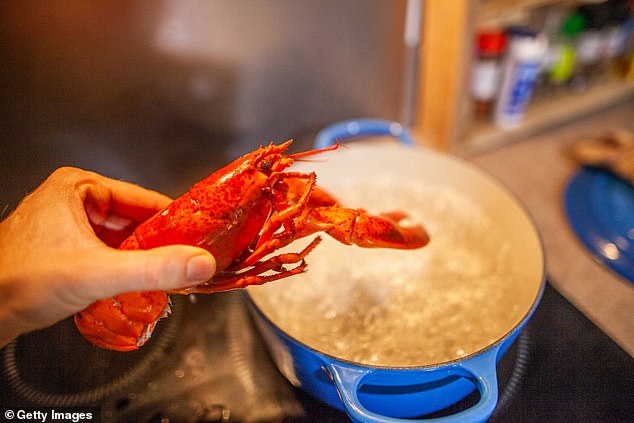
Fans of the boiling alive method take solace from the fact that lobsters don’t have a brain in the conventional sense and possess 100,000 neurons – or nerve cells – compared to a human’s 100billion

Neuropsychologist Nicholas Humphrey says lobsters are so lacking in conscious feelings that cooking them alive is no more offensive than boiling an alarm clock
There is something in that. But the accepted wisdom is that a lobster thrust into ‘ferociously boiling’ water will die within 15 seconds. That’s what makes it such an attractive cooking method.
The only alternative that comes close is to plunge a knife between the eyes but this requires such skill that in inexperienced hands the lobster is likely to die of lengthy asphyxiation.
Some advocate massaging a lobster’s head or back and folding its tail to induce a ‘sleep-like’ state before cooking.
Others recommend storing the crustacean in the freezer for a couple of hours to kill it before boiling, or putting it in a pot of cold water which is then brought to the boil (the idea being that it goes to sleep at some point and dies painlessly).
But the need for the cooking process to begin at, or soon after, the point of death rules out the freezing and gentle heating methods. The nuclear option it would have to be.
By this time, the rest of my guests had arrived.
And it was shortly afterwards that I was forced to admonish the backslider who had dubbed my lobsters Nippy and Pinchy (Pinchy, incidentally, being the name Homer Simpson gave to the lobster he – initially – couldn’t bring himself to cook). I did this by telling them the story of the food writer who, when he discovered that his children were becoming attached to two young pigs he was fattening up in the back yard, informed them they were called Lunch and Dinner.
The moment of truth arrived. As a metropolitan sap who has never shot a rabbit, let alone a pheasant or a deer, I was beginning to feel slightly nervous. A friend who had cooked a live lobster told me he had been utterly traumatised by the experience.
After first putting his brace of crustaceans in the fridge to ‘calm them down’, he thrust them into a cauldron of boiling water, only to see them make frantic attempts to crawl out. In a panic, he whacked the lid on. ‘Never again,’ he said.
And so it was with some trepidation that I removed Pinchy from the fridge and prepared to do the deed. My mood was not helped by the fact that everyone seemed to be convinced that, the moment that Pinchy hit the water, he would begin to emit a fearsome screaming.
By now an expert, I knew this to be an old wives’ tale: Any noise would be the sound of air escaping under pressure from the carcass – but that knowledge didn’t help much.
As I held Pinchy over the steaming pot, was it my imagination or was he behaving like a desperate man approaching the scaffold, his claws – still tied tightly shut – waving more agitatedly than before?
I steeled myself and plunged him into the ‘ferociously boiling’ water. All signs of life departed within seconds, there was no unearthly squeal and a perceptible feeling of relief spread among everyone gathered around the hob.
Oh, and Pinchy was delicious.