This article is taken from the December-January 2026 issue of The Critic. To get the full magazine why not subscribe? Get five issues for just £25.
A couple of miles inland from the north Norfolk coast, there is a small patch of water meadow with a stand of old beeches on its northern edge. The woodland understory beneath the trees is so dense that most spaniels look at it and decide to turn back. Any that do push through on cold January mornings put up extraordinary numbers of woodcock.
For the past two years, I’ve rented that little meadow and have shot over it three or four times a year. There are hares, there are lapwings, and a small herd of native cattle graze in the summer months. It isn’t much more than 40 acres, but it’s where three farms come together.
A couple of days ago, I set out with a few neighbours and their dogs for the first walkabout of the season. We only have enough ground for an afternoon of sport so we met at midday, just as the rain was coming on.
Over the years, as shooting has become commercialised, days have started to be sold by the bag. A person might buy a 150-bird day or a day twice that size — the going rate is currently around £50 per bird. Recently, whilst writing about an American billionaire who has bought a smart shoot in Wiltshire, his people tried to assure me that their boss’s 500-bird days are pretty standard fare in the Home Counties. They’re not entirely wrong, but I’m not sure it makes it any less gluttonous just because other people do it.
On the ground I rent, I think we once shot 25 birds (including ducks and woodcock), but most outings see us end up with about half that. The difference I think is that there is almost no expectation. Anything that ends up in the bag and subsequently in someone’s oven is toasted as a great success.
The first “manoeuvre” last week consisted of one of the team and my spaniel pushing through a strip of wild bird cover into a strong northerly. It was my young dog’s first time out after a good two years’ training. As she worked away, pheasants in their twos and threes, broke ahead of her and curled round on the wind. Remarkably, almost every time a bird got up, she paused at the peep of my whistle and watched it disappear towards the rest of the team, who were walking through a field of sugar beet. A dog that chases birds is no good and, happily, Jessie was keeping it together.
When we made it to the end of the strip, we turned into the field where the team had seemingly shot five birds — our first manoeuvre had just about come off. We then dropped down into the meadow, formed a vaguely straight line, and the dogs got back to it, hunting away just ahead of us.
Anyone going rough shooting is really only as good as their dog
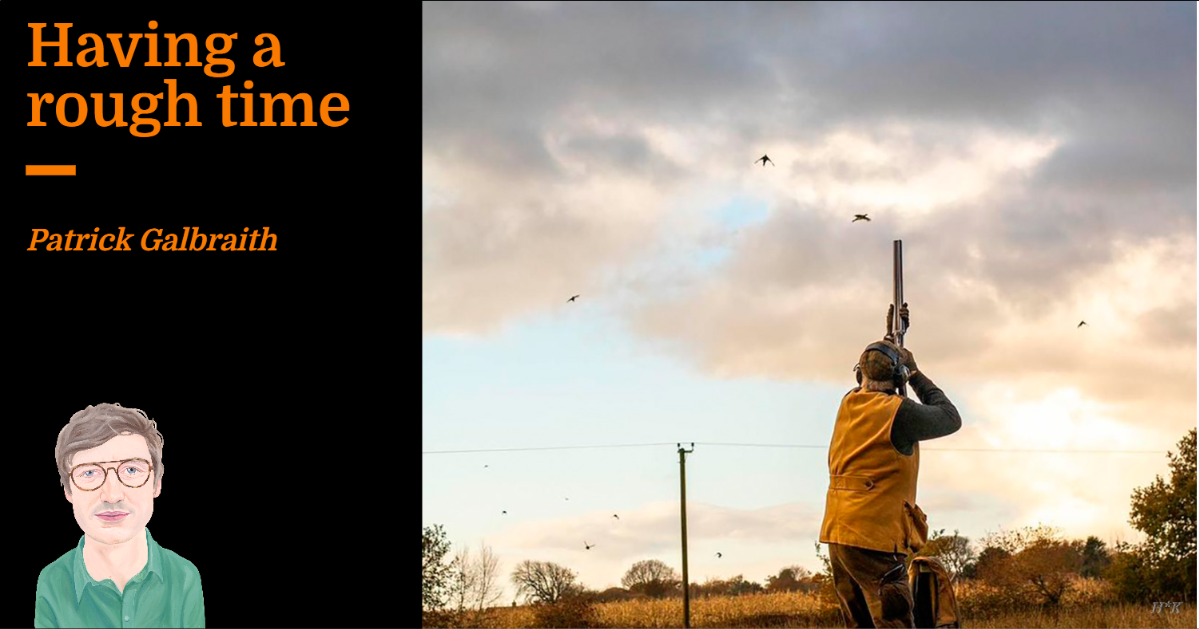
On the face of it, standing on a peg to take on driven pheasants and heading out for “a rough day” perhaps don’t seem so different — it’s game shooting versus another sort of game shooting. But they are hardly the same thing at all. Clearly, driven birds are flushed towards you. Whereas on a rough day you are flushing the birds yourself. But there is complexity in that distinction.
Anyone going rough shooting is really only as good as their dog. A wayward spaniel working 200 yards ahead renders the whole thing pointless, and anybody who can’t read the landscape tends to go home empty-handed. A good rough shot knows that woodcock like to be beneath holly bushes, they know where the snipe will be, and they’ve learned how to use the wind to their advantage. Somebody who is good at taking on driven birds can get on fine without knowing any of those things. If hunting is about communing with nature, rough shooting is a far better medium.
The little meadow sits not far from some of the country’s smartest shoots, where people spend huge amounts of money to take days. Some of them would understand the delight of watching a well-trained spaniel flush a bird, then stop, then wait patiently to be told to retrieve it. The rest simply wouldn’t understand all that work for half-a-dozen birds. That, I’m afraid, is partly where shooting has gone wrong. Big days aren’t necessarily bad, but when hunting becomes a numbers game, something is amiss.