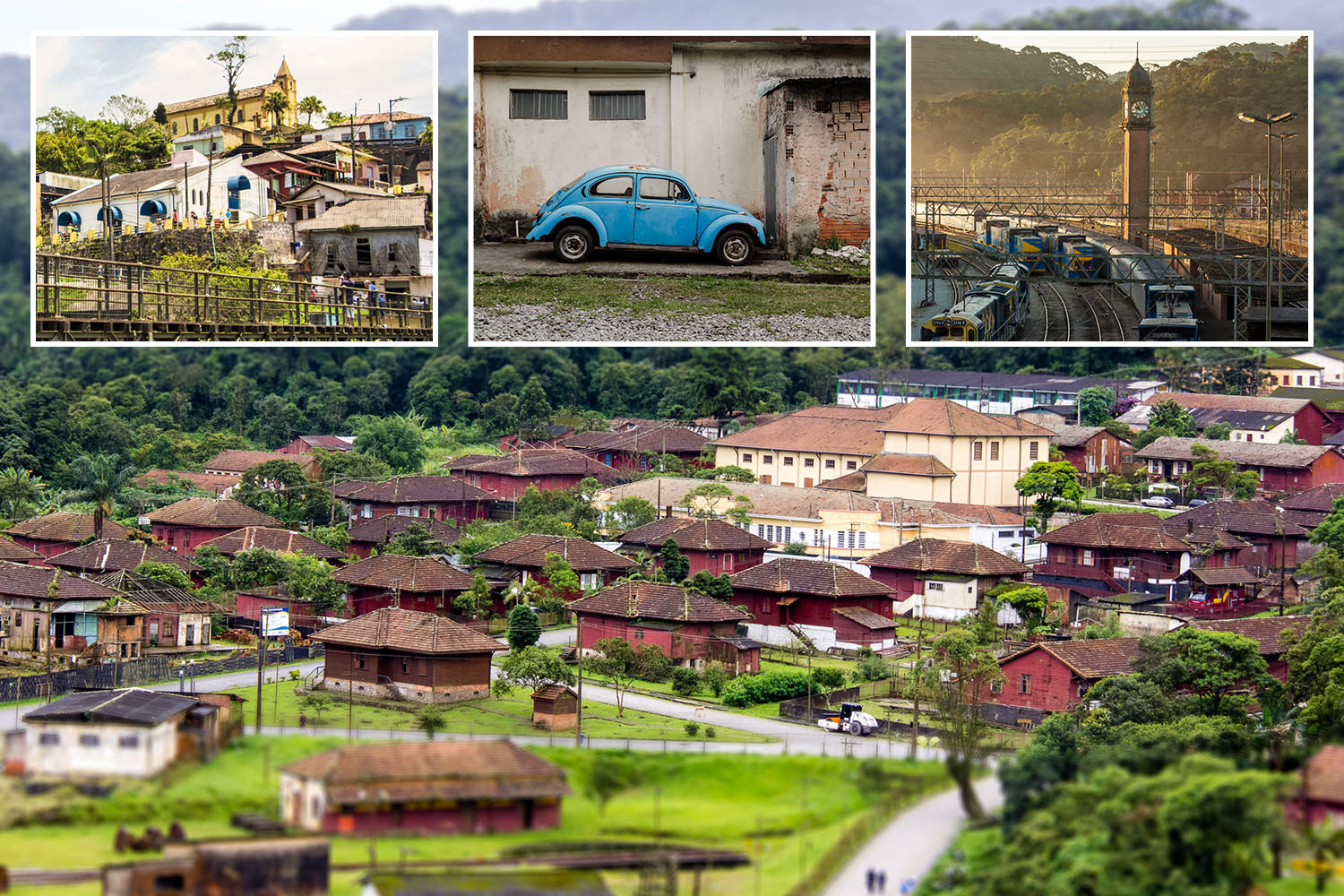
DEEP in the Atlantic Forest in Brazil lies a British-built railway village where clocks freeze at 11:47, and thick fog smothers the streets.
Paranapiacaba was founded in 1860 as a model of Victorian precision – brick houses in regimented rows, a funicular engineered to haul coffee down the coast, and a clock tower shipped from Manchester.
But the quiet mountain village has become one of Brazil’s most haunted districts, a place where the past insists on replaying itself.
The town’s neat geometry has long been overtaken by tropical decay.
Paranapiacaba was built by the British in 1867 for practical, economic reasons, not mystery.
In the mid-19th century, Britain had strong commercial interests in Brazil, especially in the export of coffee, which was Brazil’s most valuable commodity.
Read more on haunted places

The challenge was geography: the Serra do Mar mountain range made it extremely difficult to transport goods from São Paulo’s interior down to the port of Santos.
To solve this, the British-owned São Paulo Railway Company was contracted to build and operate a modern railway system, bringing British engineering expertise, technology, and management to Brazil.
Paranapiacaba was created as a company town to support that railway.
It housed British engineers, administrators, and skilled workers, along with Brazilian laborers, providing homes, schools, clubs, and infrastructure close to the rail line.
The British left after the railway declined in the 1950s, leaving behind tunnels, workshops, and a clock tower that never recovered from the night its keeper died.
Paranapiacaba has preserved much of its Victorian character, with wooden houses, narrow streets, and original railway structures dating back to British control.
Its iconic clock tower, inspired by London’s Big Ben, overlooks the village, reinforcing the strong English influence that still defines the town’s appearance today.
Today only 1,000 people remain, living among derelict houses, permanent mist, and stories that have become part of the landscape itself.
To understand Paranapiacaba, you follow its ghosts.
The woman who rings 19 times
The mansion on the hill is where it starts. In 1902, Lídia Makinson Fox sealed herself and her children in the attic during a yellow fever outbreak.
By the time help arrived, all three were dead, her brass handbell still in her grip.
Weeks later, villagers spoke of a lone figure pacing the widow’s walk at exactly the same hour the family was found, the bell ringing in a slow, steady pattern.
The bell, now kept under glass, has been recorded sounding on its own in the early hours, always with the same 19 strokes, from the same narrow window before dawn.
According to locals, thermal cameras have traced a cold silhouette around the balcony where she once walked.
The funicular car that still falls at 2:14
Below the mansion, Plane 3 of the old funicular remains frozen in its own loop of time.
In October 1921, a steel cable snapped and Car No. 7 plunged into a ravine, killing eight workers.
Residents say the accident still replays to the minute each year: the pressure spike on the gauge, the whistle rising from the valley, the metallic wrench of a falling car.
In 2018, CCTV captured an empty cable moving uphill at the exact speed and timing logged on the night of the disaster.
Engineers continue to report voices in century-old railway slang drifting from the slope before falling suddenly silent.
The bride of the mist
Another long-standing Paranapiacaba legend is known as the Bride of the Mist, a story tied directly to the village’s near-constant fog.
The tale centres on a relationship between the son of an English railway engineer and the daughter of a worker.
Their families opposed the match, but the couple arranged to marry.
On the wedding day, the groom was confined in the basement of his family home, preventing him from reaching the ceremony.
And the bride, still in her gown, left the chapel and boarded a train toward the coast.
When it crossed the historic Grota Funda Bridge, she jumped to her death.
Since then, the mist rolling down from the forest has been described by locals as the bride’s veil moving through the village in search of the man she was meant to marry.
Hikers camping near the Fourth Level, above Grota Funda, sometimes report seeing a figure fall from the bridge or watching the fog rise in a concentrated column before spreading across the village.
‘Soul Tunnel’
Further down the slope, the 1.2-kilometre Túnel da Alma (Soul Tunnel) still bears the scars of a 1954 derailment that killed a dozen workers after trapping them for 36 hours.
Visitors walking through at night report finding kerosene lanterns burning midway inside, trimmed and filled exactly as the 1950s crew kept them.
Drivers crossing the tunnel’s length sometimes encounter men in denim overalls pushing a handcar that dissolves into dust as headlights hit.
Locals say dashcams have recorded apparitions that vanish frame by frame, leaving only static and faint, distorted voices.
The clock that refuses to strike noon
And at the village centre stands the clock tower, its four faces locked at 11:47.
The tower has resisted every mechanical overhaul, digital replacement, and satellite sync attempted since 1932, the year its keeper, Alistair McBride, died by suicide after losing his family in a landslide.
Guards patrolling the museum at night describe a tall man in tartan calmly tending gears that no longer exist.
He vanishes when approached, locals say, leaving behind only traces of metallic dust or damp footprints that do not match any soil found on the mountain.
These stories persist not because locals romanticise them, but because the environment conspires in their favour.
Residents tell of the fog funnelling sound unpredictably, carrying voices across empty streets.
Landslides and epidemics also left unmarked graves beneath modern paths, and abandoned houses warp in the mist.
Descendant families – British, Afro-Brazilian, and those who speak the old railway pidgin – keep the memories alive.
Locals say the episodes occasionally overlap.
On 17 October 2021, the centenary of the funicular crash, the village experienced a convergence: the bell sounded its pattern; the cable on Plane 3 moved; children’s voices rose from the school gym; lanterns glowed inside the tunnel; and the frozen clock tower released a single chime at 11:47 that no mechanism inside it could have produced.
Moments later the entire grid failed.
Every timepiece in the village – including phones, microwaves, and digital dashboards – displayed 11:47 for one full minute before the correct time returned.
Modern Paranapiacaba still welcomes visitors, especially during its winter festival, but locals warn that the village keeps its own schedule, so come at your own risk.