The European Union and its most powerful member states hit back angrily last night after the US imposed visa bans on five Europeans accused of policing online speech, in a dramatic escalation of transatlantic tensions under President Donald Trump.
France, Germany and Brussels condemned the move as an unprecedented attack on allies, after Washington barred several prominent figures involved in efforts to combat online hate and disinformation.
Among those targeted is former French EU commissioner Thierry Breton, one of the architects of Europe’s controversial digital crackdown on Big Tech.
The bans were imposed on Tuesday, with US officials accusing the five Europeans of censoring free speech or unfairly targeting American technology firms through burdensome regulation.
The decision marks the latest swipe by the Trump administration at long-standing allies across the Atlantic, as relations deteriorate over defence, immigration, technology and political values.
Washington has increasingly portrayed Europe as a declining force, arguing the continent is being hollowed out by weak defences, uncontrolled migration, excessive bureaucracy and what it claims is the ‘censorship’ of far-right and nationalist voices to keep them from power.
The visa bans follow closely on the heels of a stark US National Security Strategy document warning that Europe faces ‘civilisational erasure’ unless it changes course and proves itself a reliable ally.
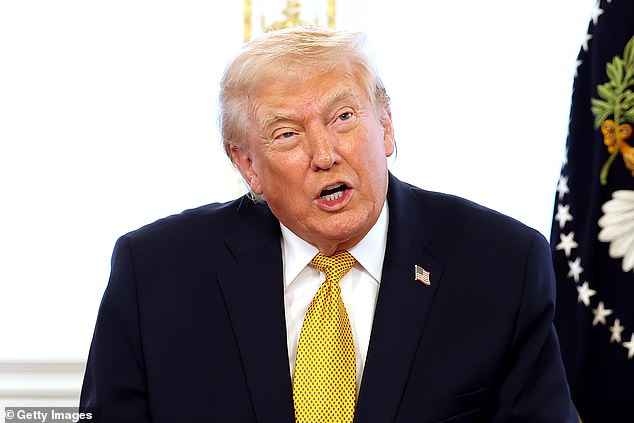
The decision marks the latest swipe by the Trump administration at long-standing allies across the Atlantic, as relations deteriorate over defence, immigration, technology and political values
That warning – alongside a series of provocative remarks from senior Trump officials – has shaken European capitals and challenged decades of assumptions about the strength of the transatlantic alliance.
Chief among those moments was a bombshell speech delivered in Munich in February by Vice President JD Vance, which forced European leaders to confront the possibility of a future less dependent on American technology and military protection.
Officials in Brussels, Paris and Berlin reacted furiously, defending Europe’s right to set its own laws governing how foreign companies operate.
A European Commission spokesperson said it ‘strongly condemns the US decision’, adding: ‘Freedom of expression is a fundamental right in Europe and a shared core value with the United States across the democratic world.’
The spokesperson said the EU would demand answers from Washington but warned it could ‘respond swiftly and decisively’ to the ‘unjustified measures’.
French President Emmanuel Macron also entered the row, confirming he had spoken with Breton and praised his work.
‘We will not give up, and we will protect Europe’s independence and the freedom of Europeans,’ Macron said on X.
Breton, who served as European commissioner for the internal market from 2019 to 2024, played a central role in shaping the Digital Services Act – a landmark law designed to force tech giants to crack down on illegal content such as hate speech and child sexual abuse material.
The legislation has enraged the Trump administration, which claims the EU has imposed ‘undue’ restrictions on free expression while unfairly targeting US companies and citizens.
Tensions intensified earlier this month when Brussels fined Elon Musk’s X platform €120million for breaching online content rules.
Musk and Breton have repeatedly clashed online over EU regulation, with Musk branding him the ‘tyrant of Europe’.
Breton, the most high-profile individual targeted, later responded defiantly, writing on X: ‘Is McCarthy’s witch hunt back?’
According to US Under Secretary for Public Diplomacy Sarah Rogers, the bans also apply to Imran Ahmed, the British chief executive of the US-based Center for Countering Digital Hate; Anna-Lena von Hodenberg and Josephine Ballon of the German non-profit HateAid; and Clare Melford, co-founder of the Global Disinformation Index.
Germany’s justice ministry said the two German activists had the government’s ‘support and solidarity’ and described the visa bans as unacceptable.
It said HateAid supports people affected by unlawful digital hate speech, adding: ‘Anyone who describes this as censorship is misrepresenting our constitutional system.’
‘The rules by which we want to live in the digital space in Germany and in Europe are not decided in Washington.’
Britain also weighed in, saying it remained committed to defending free speech.
‘While every country has the right to set its own visa rules, we support the laws and institutions which are working to keep the internet free from the most harmful content,’ a British government spokesperson said.

Among those targeted is former French EU commissioner Thierry Breton, one of the architects of Europe’s controversial digital crackdown on Big Tech
A spokesperson for the Global Disinformation Index condemned the move in stark terms, calling the visa bans ‘an authoritarian attack on free speech and an egregious act of government censorship’.
‘The Trump Administration is, once again, using the full weight of the federal government to intimidate, censor, and silence voices they disagree with,’ they said.
‘Their actions today are immoral, unlawful, and un-American.’
Breton is not the first French citizen to be sanctioned by the Trump administration.
In August, Washington imposed sanctions on French judge Nicolas Yann Guillou, a member of the International Criminal Court, over the tribunal’s pursuit of Israeli leaders and a previous decision to investigate US officials.