From 18 trips to rehab and stints of homelessness to making a film with his father about getting clean, Nick Reiner’s life has been defined by addiction and turmoil.
The middle child of Hollywood royalty, Rob Reiner and Michele Singer Reiner, he allegedly began experimenting with opioids at just 14 years old. By age 18, he had reportedly taken heroin, LSD, cocaine and cannabis.
Reiner, 32, has been charged with murdering his parents after they were found with their throats slit at their Los Angeles home, just hours after attending a Christmas party together.
Now, doctors who have not treated Reiner and are opining based on general medicine, warn that his drug-taking teenage years may have done more than cloud his judgment; they may have permanently rewired his brain.
Drug use ‘can transform [a person’s] personality,’ an addiction expert told Daily Mail, possibly even making someone violent.
Using drugs in adolescence, at a time when the brain is particularly vulnerable and still developing, could have left him with such a strong addiction that he would be prepared to do anything to get high again.
Dr Ziv Cohen, a forensic psychiatrist in California who works with young drug addicts but has not treated Reiner, told Daily Mail that every time someone has a healthy achievement, such as academic success or making friends, the brain releases a small shot of feel-good hormones, such as dopamine.
But, when someone takes a drug such as cocaine, the brain is flooded with feel-good hormones on a scale not seen naturally.
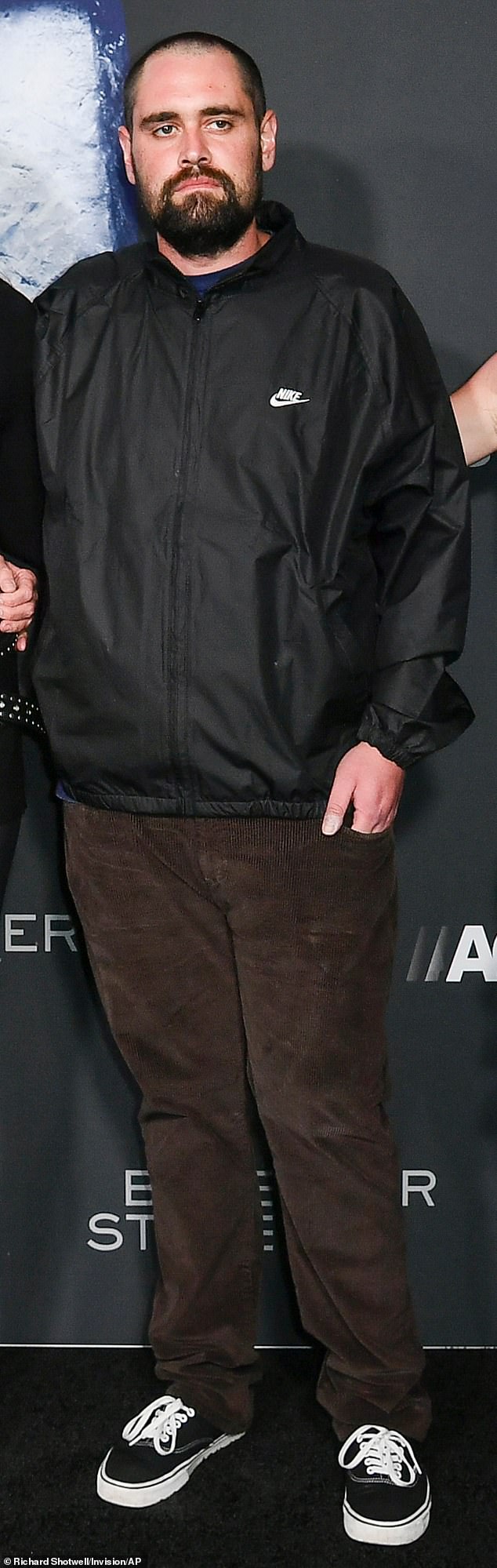
Nick Reiner is shown above in September this year at a movie premiere in Hollywood, Los Angeles
This causes the brain to build reward circuits that reward drug taking and, over time, come to expect the surge of chemicals from the drug to feel ‘normal’, while those for healthy achievements are likely to dwindle.
Adolescent brains are particularly vulnerable to this because they are hyper-sensitive to rewards.
At this time, the brain is also going through a cycle of ‘synaptic pruning’, removing reward-circuits that are rarely used, and myelination, strengthening reward circuits that are regularly used, which can increase the preference for drugs.
Cohen said: ‘[Taking drugs] really floods your brain [with reward chemicals] and makes you much less able to access healthy rewards from your environment.
‘Healthy rewards give much more subtle hits. But drugs like cocaine prompt such a massive discharge [of feel-good hormones] that this completely overwhelms your reward circuits and, for your brain, this becomes an incomparable experience that you must seek again.’
In interviews on the podcast Dopey, which investigates addiction, Reiner revealed that at 14 he took Xanax and Percocet to a party because he was using them at the time. After his parents found out, he was sent to rehab, but this did not stop his drug use.
On the same podcast, Reiner claimed that at rehab he shared a room with a heroin addict for 126 days, who kept telling him how good heroin was. Three or four years later, he said that he went to try the drug.
He also told listeners that at 15, he smoked crack at an Alcoholics Anonymous event in Atlanta, Georgia. At some points before his 18th birthday, he slipped into homelessness. He added that being surrounded by people prepared to stop at nothing to take the drugs ‘desensitized’ him to the risks.
In 2015, at 22 years old, Reiner made the movie ‘Being Charlie’ with his father, about a father running for political office who had a son that was battling drug addiction.
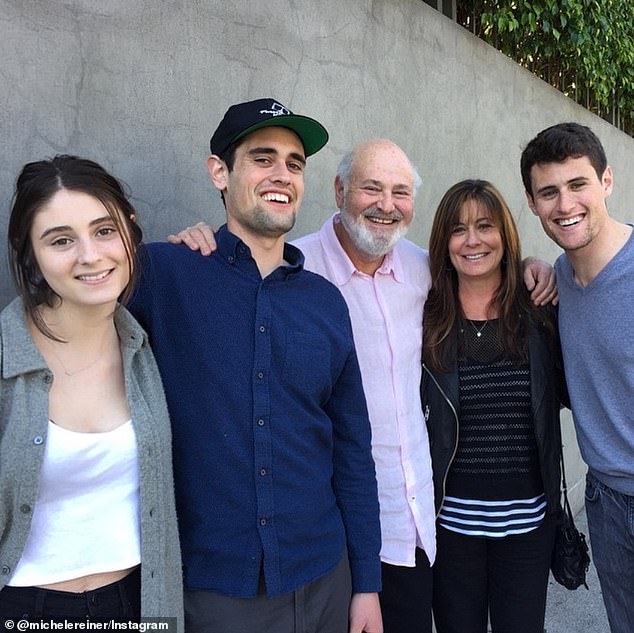
Nick Reiner is shown second left next to his sister Romy. Behind him is his father Rob and mother Michele Singer Reiner. On the right is his older brother Jake
In 2017, he said he ‘totally spun out on uppers’ and ‘smashed up’ his parents’ guesthouse, destroying devices and furniture.
Speaking about it a year later on Dopey, he said: ‘I think it was coke and something else, and I was up for days on end. I started punching out different things in my guesthouse.’
It was only this year that his father said Reiner had been sober for ‘more than six years’.
However, Daily Mail reporting revealed his father allegedly said to a guest at Conan O’Brien’s holiday party, where the Reiners were last seen: ‘I’m petrified of him [Nick]. I can’t believe I’m going to say this, but I’m afraid of my son. I think my own son can hurt me.’
Adolescents are more vulnerable to using illicit substances because the prefrontal cortex, the rational and decision-making area of the brain, is still maturing.
This is an evolutionary adaptation, Dr Cohen said, because adolescents need to take risks to learn independence and understand their environment. But it also means adolescents may be more likely to try drugs, and then find it harder to stop.
In the brain, if neurons get used to the high from drugs but stop receiving it, they can signal displeasure to the individual.
This causes someone to feel unhappy, while, in response to the lack of the flood of feel-good hormones, the body’s stress system can go into overdrive, reducing impulse control and raising the risk of erratic actions.
It can trigger feelings of irritability, agitation, panic and lead someone to act outside their character, even violently.
Cohen said: ‘The image of the drug user who breaks into a business or a home and does not let anyone get in their way, in terms of seeking cash so they can get a fix, regardless of whether it is legal or moral, is what can happen.
‘We really think of that as a powerful brain state. When someone is in that state, it can transform their personality.’