There’s a marvellous clip from a David Lynch masterclass in filmmaking that can be viewed online. The director is watching the last couple of minutes of Frank Capra’s It’s A Wonderful Life and is visibly moved.
“Incredible,” he says, shaking his head. “This film was made in 1946, after the war. Jimmy Stewart had been in the war for years and when he came out, he didn’t know if he had the stuff. And this thing came along. He does some things in this film that are like … ”
Lynch trails off, shakes his head again, exhales sharply. His eyes are wet with tears and he is almost overwhelmed with emotion. I know the feeling.
I try to watch It’s a Wonderful Life every Christmas. It goes to some dark places before arriving at the most uplifting climactic scenes I know. Stewart’s performance is, as Lynch observes, incredible, but, for me, it’s about more than just his brilliance as an actor. Stewart didn’t just play a quiet, unassuming hero; he actually was a quiet, unassuming hero.
James Stewart, born and raised in the town of Indiana, Pennsylvania, had a very good war. Unlike some big names who revelled in their “tough guy” reputation but who assiduously avoided combat, Stewart joined up in February 1941, months before Pearl Harbour, eager to put himself in harm’s way. “It may sound corny,” he said, “but what’s wrong with wanting to fight for your country? Why are people reluctant to use the word patriotism?”
He had already won an Oscar for The Philadelphia Story and was the first major Hollywood star to enlist. An accomplished pilot, he was assigned to the Army Air Corps (which later became the United States Air Force) and by November, 1943, was a squadron commander of the 445th Bomb Group in Tibenham, South Norfolk, a base for B-24 Liberator heavy bombers.
He flew with the 445th on its first bombing run against Nazi Germany, targeting the naval docks at Kiel on 13th December. Three days later Stewart led another mission, to Bremen.
On Christmas Eve he gave a briefing. “Fellas,” he said, “this mission is — ah — very important. We have to hit our target today. We have to plaster it. The Germans have some kind of a new rocket machine [the V-weapons] they’ve cooked up. They are going to use it to hit London and a lot of other cities in England. We have to stop it before they go that far.” He then told the men that the mission would be volunteers only — anyone who didn’t want to fly on Christmas Eve could leave the room now. No-one budged. “Thanks fellas,” said Stewart.
Knowing the pressure his men were under, he was prepared to cut them some slack. In his book, Jimmy Stewart: Bomber Pilot, Starr Smith recounts how the actor ambled into the Nissen hut of one of his crews where a keg of beer stolen from the officers club was being hidden.
“At ease fellas,” he said, strolling over to the bunk where the keg was concealed under a blanket. He took a cup from a shelf and filled it from the keg, slowly drinking while the men looked on nervously. “Well, this English beer is pretty good — if you can’t get anything else. Right?” he asked, in his sleepy, hesitant drawl. No one answered. Stewart filled the cup again and continued drinking. Finally, he said: “Fellas, someone stole a keg of beer a few days ago. Ah — you guys hear anything about that?” There was shaking of heads. No one had heard anything. “I thought not,” said Stewart. He replaced the cup, and strolled out. No more beer was stolen.
By the end of the war, Stewart, now a colonel, had led a bomber squadron in 20 perilous combat missions. He had been awarded the Distinguished Flying Cross with Oak Leaf Cluster, the Air Medal with three clusters and the French Croix de Guerre with palm.
On his return to America, he said he wanted to get back to the film business as soon as possible. “I would like to make anything except a war picture,” he said. “Everybody’s had enough of that stuff for a while.”
There were plenty in Hollywood who would have loved him to make a war picture. An actual war hero playing a war hero? Box office gold. Stewart wasn’t interested. His first movie post-1945 was It’s A Wonderful Life, directed by Frank Capra and described as a “modern parable” by the New York Times on its release.
Let me refresh your memory. The film opens with a series of shots of the exteriors of buildings in the snowy, fictional town of Bedford Falls. We hear the prayers of the inhabitants of those buildings. “I owe everything to George Bailey. Help him, dear Father,” says one. “Joseph, Jesus and Mary, help my friend Mr Bailey,” says another. And we hear a child’s voice: “Please God, something’s the matter with Daddy. Please bring Daddy, back.”
These prayers reach heaven where it is decided to send Clarence, an angel, second class, who hasn’t yet earned his wings, to intervene at 10.45pm which is when George (Stewart) will contemplate suicide. Before he is dispatched to earth, Clarence is given a crash course in George Bailey studies and, in the form of flashbacks, we see George’s life story in Bedford Falls and how he repeatedly helps others while sacrificing his own hopes and dreams. A man who once had ambitions to travel the world ends up tethered to his small home town. And one Christmas Eve events conspire to push this cheerful, decent optimist to the point of despair.
There’s a scene in which George is sitting at the bar of a restaurant. He is wrongly facing criminal charges over a shortfall of funds at the savings and loan association he runs and he is convinced his life has been a failure. Raising his eyes, he mutters: “God … dear Father in heaven, I’m not a praying man, but if you’re up there and you can hear me, show me the way. I’m at the end of my rope. Show me the way, God.”
Stewart later recalled: “As I said those words, I felt the loneliness, the hopelessness of people who had nowhere to turn, and my eyes filled with tears. I broke down sobbing. This was not planned at all, but the power of that prayer, the realisation that our Father in heaven is there to help the hopeless, had reduced me to tears.” Capra was thrilled with Stewart’s spontaneous sobbing. The scene had been filmed as a long shot but Capra enlarged the frame so that it appeared to be a close-up.
But wait a minute — despair, hopelessness, suicide? It doesn’t sound very “Ho ho ho. Merry Christmas!” Who wants to watch this total downer during what Andy Williams teaches us is “the hap-hap-happiest season of all”?
That’s the message, folks. That’s the nub of it, right there
Well, when George finds himself on a bridge at 10.45pm, about to throw himself into the swirling black water below, he’s beaten to it by Clarence. George rescues Clarence, as the angel knew he would, and Clarence shows George what the town would have been like had he never lived (the film is based on a story inspired by A Christmas Carol). Bedford Falls is now Pottersville, named after the film’s villain, the businessman Henry Potter. Pottersville is a cruel, heartless place. Most of George’s friends and family are dead or derelict or in prison. “Strange, isn’t it?” says Clarence. ”Each man’s life touches so many other lives, and when he isn’t around he leaves an awful hole, doesn’t he?” That’s the message, folks. That’s the nub of it, right there.
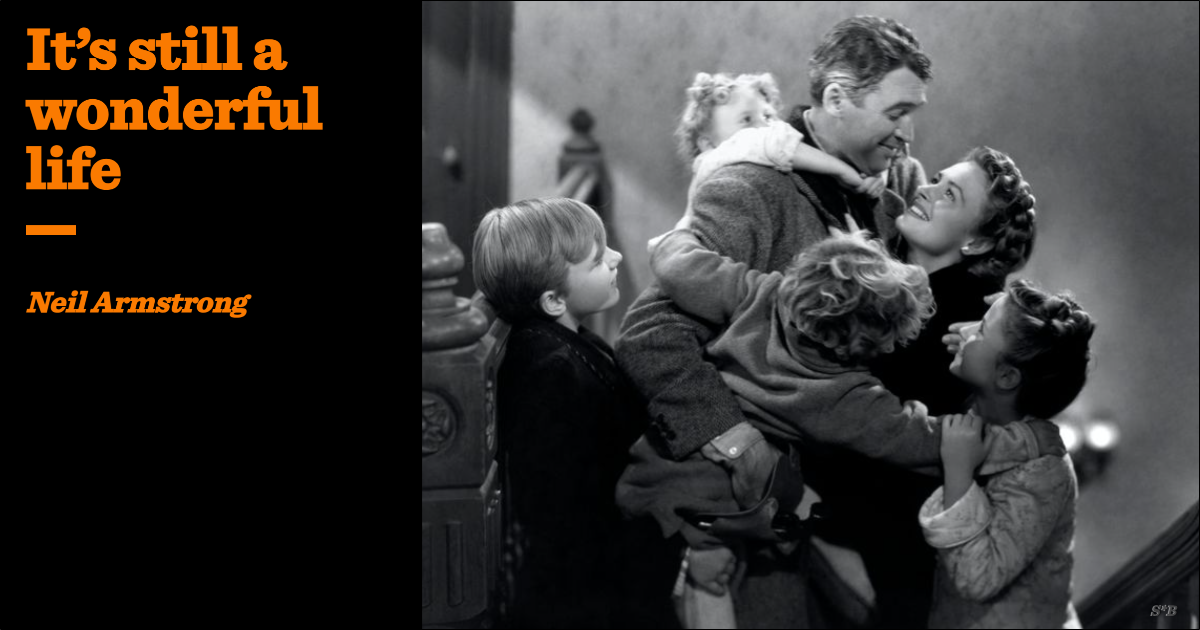
And then it’s all about the last 10 minutes, when George gets his mojo back and realises he wants to live after all. He races through the town, wishing everyone a Merry Christmas, and gets home to reunite with his wife (played by the utterly luminous Donna Reed) and their kids and to find that the townsfolk have raised the missing funds for him. And Clarence gets his wings.
It is pure, unalloyed joy. It’s a double fist-pump and a “YESSSS!” I am not a religious man but it’s a prayer and a carol and a blessing rolled into one. If you can watch that sequence without getting at least a little misty-eyed, well, you’re made of sterner stuff than me. And David Lynch. And hard-bitten old cynic Humphrey Bogart who screened the film every year for his family. And the Pope, who I understand is a religious man and who recently declared it one of his favourite films. And Jimmy Stewart himself who said it was his favourite of the 80 movies he made (and he made classics such as Rear Window and Vertigo).
Those last 10 minutes meant that Peter Capaldi could title his short, comic, Oscar-winning film about a gloomy, doomy Czech writer, Franz Kafka’s It’s A Wonderful Life (1993) and we all got the joke. They meant that when the killer writes “It’s A Wonderful Life” in blood next to his body of his victim in The Exorcist III (1990), it’s more than just shocking, it’s a desecration.
They mean that when I’m scouring the Christmas Radio Times and see that It’s a Wonderful Life is on BBC2, I’ll be tuning in. Yet again. I’ve watched the film maybe 30 times. I’ve watched the last 10 minutes many times more. They never get old.