For many of us who call the Middle East home, the year is ending the way it began: with fragile hope.
Despite violations, a ceasefire in Gaza has mostly been holding, outlasting a January ceasefire that held for eight weeks before collapsing.
In much of Gaza, the end – for now – of heavy airstrikes is allowing families to reunite, return to damaged homes, hold funerals, bake children’s birthday cakes, and celebrate long-delayed weddings.
Why We Wrote This
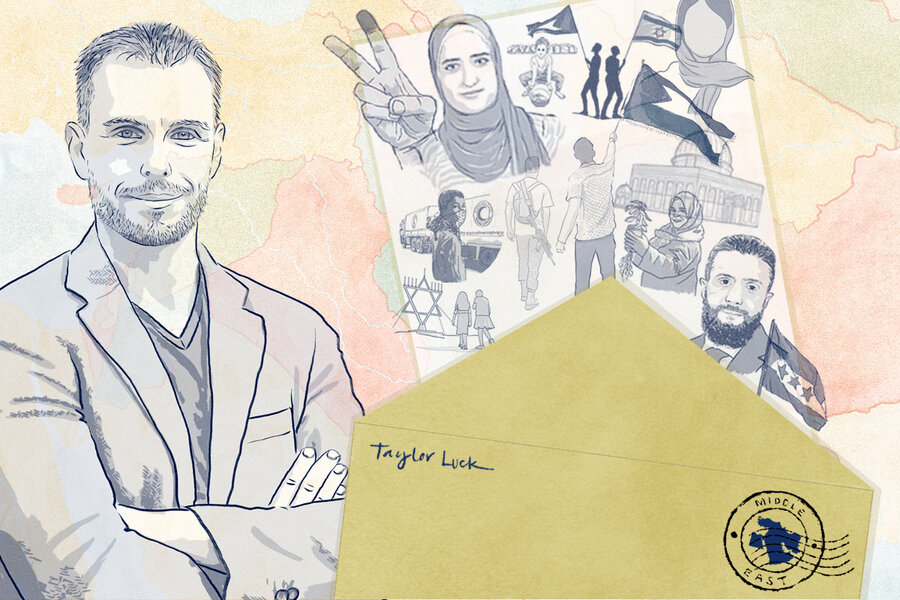
For years, Taylor Luck, the Monitor’s Arab world correspondent, has had a broad assignment, covering his beat with a close eye and an attentive ear on the events, thoughts, and moods prevalent in the region. As such, he’s been an early, even prescient, trendspotter. He has been an integral part of our coverage of the war in Gaza – which, as he notes, takes a toll on the journalists involved – and of the new Syria unfolding before his eyes. That his wide travels in the region this year are convincing him that there is cause for hope this season should be welcome news to us and to the world.
The release of the remaining living Israeli hostages is healing broken families who advocated for two years for their return. The return of the remains of those who died is giving closure to grieving Israeli families.
It was an encouraging end to a challenging year that gave me and our Middle East reporting team a renewed appreciation of home and a revived faith in the power of credible hope.
Personally and professionally, even amid the grinding and brutal war in Gaza and the year’s rising death count, I saw hope in unlikely places.
In Iraq, I saw a country begin to stand on its own two feet, free of international intervention, after two decades of war and sectarian violence.
I met Shiite clerics, Sunni businessmen, and Kurdish investors and activists working together on projects from real estate to water networks to renewable energy. It was time, they told me, to put their country above sect and ethnicity.
“We have moved on from two decades of occupation, war, and ISIS,” Ammar al-Hakim, a Shiite cleric and head of the National Wisdom Movement, told me in Sulaymaniyeh. “Now is a chance for Iraq to be a nation that pursues peace and prosperity for all Iraqis. We are putting our nation first.”
Over five separate trips to Syria, I witnessed a country long torn by war begin to heal. Just weeks after the ouster of strongman Bashar al-Assad, and amid scattered sectarian reprisal attacks, I was present in Homs when Christians, Sunnis, Shiites, and Alawites came together to formulate a plan to maintain civil peace in their shared hometown.
One of the most striking memories of the year was watching Syrians return home after a decade spent abroad or in displaced persons camps, determined to rebuild. Many were living in a single room in the heart of collapsing multistory buildings, armed only with cinder blocks, bags of cement, and a spade.
“We have won our country back,” Taha Hader, a returnee, told me as he surveyed his barrel-bombed-out house in Darayya, south of Damascus. “Even if our houses are destroyed, we finally have a home again.”
Home was a continuous theme in Israel and in Gaza during 2025, resonating with interviewees and reporters alike.
Both of the year’s ceasefires sparked a mass migration of hundreds of thousands of Palestinians from temporary camps in central and southern Gaza back to Gaza City and the north. Families have pitched tents on the piles of rubble that were once their homes, showing that the tie to the ground you live on is an unbreakable bond.
Our colleague Ghada Abdulfattah spent much of the year displaced after Israeli artillery shells severely damaged her family home in Deir al-Balah, in central Gaza, in late 2024. After months of living with relatives, she and her family have now returned to their crater-pocked home, struggling to find warmth in the face of winter’s winds and seeping rains.
But, as she points out, “a house is better than a tent.”
In Israel, Dina Kraft spent much of the year rushing down into her Tel Aviv apartment building’s basement bomb shelter in the middle of the night, as Houthi or Iranian missiles fell.
Both she and Ghada carried the personal and professional exhaustion of a two-year war that has challenged our collective morality and stamina.
Owing to life’s unforeseen circumstances, I ended 17 years of living full time in Jordan. I traded my apartment for a pair of suitcases. With my worldly belongings locked up in a storage unit in the dusty industrial outskirts of Amman, I crisscrossed the Middle East without a permanent address.
During these vagabond months, I was touched by people’s hospitality and generosity. Friends and strangers alike let me in – both literally and emotionally – at a time of turmoil and transition.
I was treated like a member of the family by former Monitor correspondent Fatima Abdulkarim in the West Bank, even as the area around her home was under siege from the violence of Israeli settler attacks and the restrictions of Israeli military checkpoints.
In Damascus and Daraa, I broke bread regularly with new Syrian friends and learned how to navigate electricity cuts and wildly fluctuating exchange rates as if it were second nature.
Yet along my travels, hardships and violence were hard to escape. On multiple occasions, conflict threatened to ignite the entire region.
During the Israel-Iran war this summer, which saw American aircraft bomb Iran, I regularly watched from a rooftop studio apartment in central Amman as Iranian rockets and Israeli and American interceptors ignited the night sky overhead.
The Iranian missiles that broke through would eventually land near Dina’s home in Tel Aviv, and even threaten my colleagues Fatima in the West Bank, and Ghada in Gaza. Like Jordanians, I had no bomb shelter to run to.
And every day the civilian death toll in Gaza climbed, even as widespread hunger set in.
But in my time roaming the region, I experienced something stronger, more urgent even than outrage or despair.
Across divides – religious, national, ethnic, or political – I heard a similar message spoken in different tongues and accents, whether they belonged to Israelis or Palestinians, Druze or Sunnis, Iraqi Arab tribesmen or Kurds.
All voiced a yearning for peace, for normalcy, for a return to daily life. A powerful desire for an end to chaos and violence, and the start of healing. A longing for the mundane.
The region’s move toward diplomacy and cooperation, and the flawed, fragile – but still surviving – Gaza ceasefire is giving life to these desires.
The impossible suddenly feels possible. For the first time in two years, tomorrow looks like it could be brighter than today.
This Christmas, as Christians in Gaza and Syria gather in prayer, reflection, and celebration, as Israelis conclude Hanukkah, and as Muslims gather for meals after Friday prayers, Middle Eastern homes – no matter their shape or permanence – are humming with a faint yet vibrant optimism.
As the peoples of the Middle East, and my colleagues and I, embrace our loved ones, we are daring to believe 2026 could see these yearnings made real.