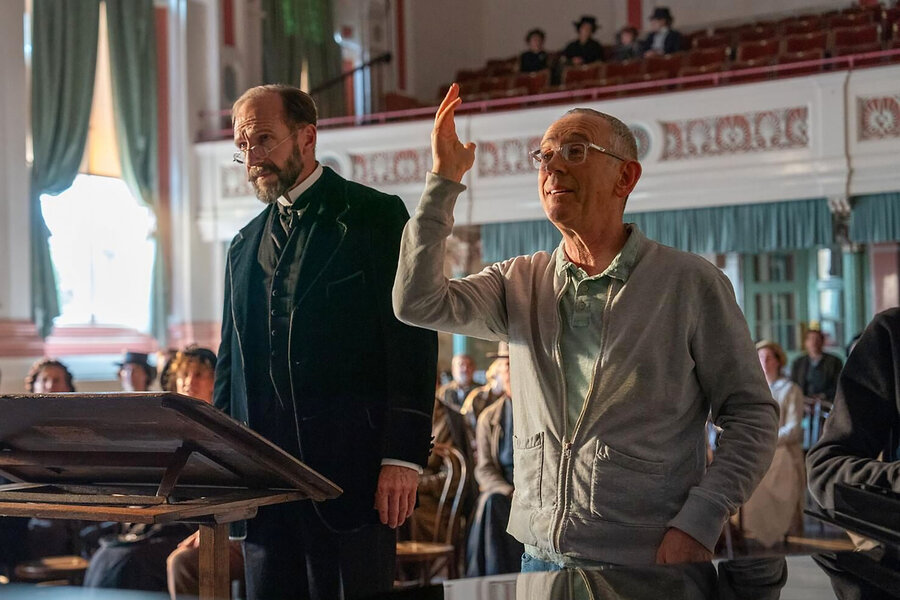
Set in a fictional mill town in Yorkshire, England, two years into World War I, “The Choral” can be described as old-fashioned in the best sense. The period details are lovingly applied; the script, by the great Alan Bennett, is beautifully crafted; and the performances, led by the marvelous Ralph Fiennes as the town’s reluctant choirmaster, are all standouts. It’s the kind of movie that doesn’t get made much anymore, and more’s the pity.
Because the war is draining the town of its young men, the local choral society, headed by the mill’s owner, Alderman Bernard Duxbury (Roger Allam), is desperate to recruit male voices under the mandatory conscription age of 18. He’s also frantic to hire a new choirmaster. The likeliest candidate, Dr. Henry Guthrie (Fiennes), carries some baggage. He once had a conducting stint in Germany. Despite Guthrie’s enthusiasm for Bach’s “St. Matthew Passion,” he’s an atheist. And the townspeople are unclear about his sexual orientation. As Duxbury mutters to his colleagues, “Let’s just say I’d prefer a family man.”
But this is not a movie about a proliferation of prejudices. Duxbury, who lost his only son in the war, truly loves music. He stands up for Guthrie because he recognizes artistry when he sees it. In the context of “The Choral,” music-making isn’t only an aesthetic experience. Singing together, however amateurish and compromised, is a way to inspire hope. The uplift stirs even Guthrie, whose world-weary exasperation is vastly diminished by the power of song.
Why We Wrote This
Music made with others, especially during difficult times, offers not only grace but a sense of community. That’s what citizens of an English mill town discover as their young men go off to fight in the Great War. In the film “The Choral,” the need to keep singing becomes an act of profound beauty and faith.
The director Nicholas Hytner – who has helmed three other Bennett screenplays, including “The Madness of King George” – is essentially a man of the theater, not a visual stylist. But with a rock-solid script and a slew of ardent actors, he’s right in his element here. The storyline is replete with plots and subplots as we watch the community’s inhabitants come alive. Among them is Lofty (Oliver Briscombe), whose job is to deliver the dreaded telegrams from the war department relaying the deaths of loved ones. His best friend, Ellis (Taylor Uttley), is a scamp who regards even a new widow’s grief as an opportunity to seduce. Mary (Amara Okereke), a Salvation Army trooper, wears her uniform as a badge of honor. By common consent, she also has the voice of an angel.
Bella (Emily Fairn) hasn’t heard from her soldier beau, Clyde (Jacob Dudman), in over a year and doesn’t know whether to grieve or move on. When he unexpectedly returns, having lost an arm in combat, their reunion is in no way conventionally heartwarming. It’s typical of “The Choral” that, despite its air of heightened conviviality, it doesn’t soft-pedal the sadness. The young men in the choir, many of them age 17, know they are soon destined for the battlefield. The nationalistic fervor that ran through the town in the early years of the war has given way to an expanding fear.
Jacob, who starred in the choir before the war, doesn’t want to rejoin. He’s too rattled by what he’s seen in the trenches. Recognizing his gifts, Guthrie convinces him otherwise. He tells Jacob that the young man has seen up close what few others have witnessed, and so life has offered him a chance to pour out his soul in song. This scene between them, and Jacob’s subsequent recitation of battlefield horrors to the assembled choir, is the film’s emotional high point.
Its comic high point comes near the end, with the arrival of the great British composer Sir Edward Elgar (Simon Russell Beale), whose oratorio “The Dream of Gerontius” the choir has adapted for its impending single performance. The oratorio concerns the death of an old man and his journey into paradise. Guthrie, with the war in mind, has revised it so that a soldier – played by Jacob – is Gerontius. At first jovial, Elgar sputters with rage when he finds out how his oratorio has been altered and withdraws his permission to stage the production. You can’t blame him exactly, but Beale’s Elgar is such a pompous preener that you don’t mind seeing him roiled. It’s the funniest cameo I’ve seen all year.
But even here, with their dreams apparently dashed, members of the disparate community come together. They recognize what Elgar, in this instance, does not. In troubled times, music-making is no mere luxury. It’s spiritual sustenance.
“The Choral” is rated R.