Favourite Christmas chocolates from Celebrations to Dairy Milk have soared in price in recent years while getting lighter as ‘shrinkflation’ continues to hit shoppers.
Terry’s Chocolate Orange has gone up in price from £1.49 in December 2021 to £2.25 this month, while also reducing in size from 157g to 145g over the same period.
This means the popular product weighs 8 per cent less and costs 51 per cent more than four years ago – while the price per 100g has risen from 95p to £1.55.
Another item hit by shrinkflation is Mars Celebrations, with tubs having changed from £4.25 for 650g in 2021 (65p per 100g) to £6.11 for 500g (£1.22 per 100g).
The price has therefore risen by 44 per cent while the tubs weigh 23 per cent less, according to the data analysed by BBC News from market researchers Assosia.
Cadbury‘s Dairy Milk has also seen a significant change over the same period, from £1.86 for 200g in 2021 (93p per 100g) to £2.75 for 180g now (£1.53 per 100g).
The bars now weigh 10 per cent less but cost 48 per cent more, based on the figures which were compiled from prices across Tesco, Sainsbury’s, Asda and Morrisons.
Manufacturers are battling against the soaring wholesale cost of cocoa along with extreme weather in West Africa and diseases, including cacao swollen shoot virus.
The price of cocoa butter – the fat extracted from cocoa beans used to make white chocolate – is rising even faster as cocoa beans produce more solids than oils.
Reena Sewraz, retail editor of consumer group Which?, told the Daily Mail: ‘Each year there are three things we can count on at Christmas: the decorations go up earlier, food prices go up, and chocolate tubs get smaller and smaller.
‘The problem with shrinkflation is that when supermarkets and manufacturers quietly give shoppers less for the same price or more, they feel cheated.
‘You can make sure you are getting the best value by checking the price per 100g and comparing with different pack sizes and even different brands.’
Some manufacturers trying to save money are replacing expensive ingredients such as cocoa with cheaper ones, which has been described as ‘skimpflation’.
For example, Toffee Crisp now has such a small quantity of cocoa in that it must be labelled as being ‘encased’ in a ‘milk chocolate flavour coating’.
UK regulations mean products deemed as milk chocolate must have at least 20 per cent cocoa solids and 20 per cent milk solids.
Julia Buech, senior consumer foods analyst at Rabobank, said prices for chocolate bars across western Europe have risen by more than 50 per cent since 2021 and by 18 per cent since last year.
She told the Guardian it was a ‘dramatic shift for a category built on affordable indulgence’, while firms across the continent were facing increased Labour costs with ‘minimum wages going up in many countries’.
A spokesperson for Mars Wrigley UK, which makes Celebrations, told the Daily Mail: ‘We know that the cost of living is front and centre for shoppers, particularly during the holidays, which is why we remain focused on providing great, high-quality snacks at the best possible value for money.
‘We will always absorb pricing pressures where we can, but rising manufacturing costs – driven in part by well-documented increases in the cost of cocoa – have meant that we’ve had to adjust some of our product sizes.
‘It’s not a decision we take lightly, but it ensures families can still enjoy their favourite Celebrations without compromising on quality or taste.’
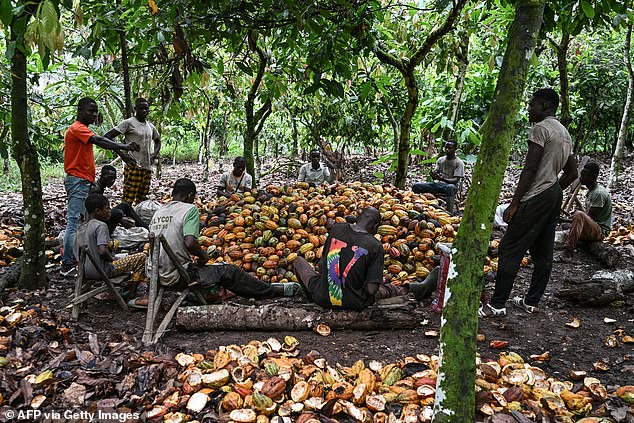
Producers harvest cocoa on a plantation at Agboville in the Ivory Coast on December 4
Join the debate
Does shrinkflation make YOU feel cheated at the checkout?
Mondelez, which makes Dairy Milk, said cocoa and dairy ingredients were costing more and increasing prices was a ‘last resort’.
A spokesperson said: ‘We understand the economic pressures consumers face and any changes to our products is a last resort for our business.
‘As a food producer, we are continuing to experience higher input costs across our supply chain, with ingredients such as cocoa and dairy costing far more than they have done previously.
‘This means our products continue to be much more expensive to make and while we have absorbed these costs where possible, we still face considerable challenges.
‘As a result of this difficult environment, we have had to make the decision to slightly reduce the weight and increase the list price of our Cadbury Dairy Milk products over a number of years so that we can continue to provide consumers with the brands they love, without compromising on the great taste and quality they expect.’
‘This means our products continue to be much more expensive to make and while we have absorbed these costs where possible, we still face considerable challenges.
‘As a result of this difficult environment, we have had to make the decision to slightly reduce the weight and increase the list price of our Cadbury Dairy Milk products over a number of years so that we can continue to provide consumers with the brands they love, without compromising on the great taste and quality they expect.’
The Daily Mail has also contacted Chocolate Orange manufacturer Carambar & Co for comment.
A spokeswoman for the Food and Drink Federation, which represents UK manufacturers, told the Daily Mail: ‘Cocoa prices quadrupled between 2022 and 2024, reaching a 45-year high.
‘Alongside other rising costs – such as national insurance increases and a new packaging tax – manufacturers are paying 40 per cent more for ingredients and energy than they were in January 2020.
‘As a result, in some cases food manufacturers will have had to make changes to product sizes to continue offering shoppers the products they love at reasonable price points.’
Last week, data from Worldpanel by Numerator found average chocolate prices at supermarkets are now up 18.4 per cent on the same time last year.
Researchers added that overall annual grocery price inflation across 75,000 products at all stores stood at 4.7 per cent for the four weeks to November 30.
A separate inflation tracker from Which? released this week found Britons are paying up to 70 per cent more for their Christmas food at supermarkets this year with chocolate and turkey soaring in price.