Staying in touch with loved ones this Christmas just got a little bit easier for thousands of people across the country.
Over 100 new mobile masts have been upgraded to bring 4G to Britain’s rural communities.
Of the 105 enhanced masts, 44 are located in Wales, 33 in Scotland, and 28 in England.
To see if your area will be getting a much-needed signal boost just in time for the holidays, you can use our interactive map below.
According to the Department for Science, Innovation & Technology (DSIT), these new mobile towers will provide 9,500 premises and 400 businesses with high-speed connections.
Collectively, they will provide better signal to an area extending more than 1,550 square miles (4,000 square kilometres).
That is equivalent to a region two and a half times larger than Greater London.
Telecoms Minister Liz Lloyd says: ‘More of Britain’s rural communities are finally getting the connection they’ve been waiting for as we deck the hills with 4G coverage.’
These major upgrades will provide a 4G network for customers of all mobile network providers through the Shared Rural Network.
This is a joint programme between the government and the mobile network operators EE, Virgin Media O2 and VodafoneThree to improve rural coverage across Britain.
In 2020, the network providers pledged £500 million to fill out so-called ‘partial not-spots’, where there is coverage from only one service provider.
This was backed by up to £500 million in funding from the Government, to bring mobile coverage up to 95 per cent by 2025.
Today, as the project’s deadline rapidly approaches, the Shared Rural Network has already surpassed its initial goals.
Currently, 96 per cent of the country is covered by 4G signal, up from 92 per cent in 2021.
Ms Lloyd adds: ‘These 100 upgraded masts mean businesses can ring up sales, families can video call their loved ones this Christmas without buffering mid-conversation.
‘Whether you’re in the Welsh valleys, the Scottish Highlands, or England’s national parks – rural communities are finally getting the connections they deserve.’
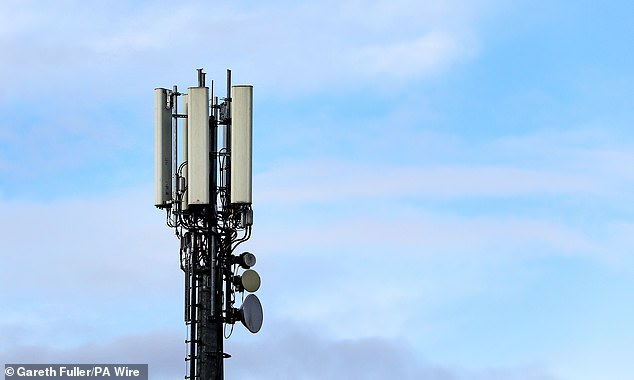
Over 100 new mobile masts have been completed to bring 4G to Britain’s rural communities in England, Wales, and Scotland
This programme has provided coverage for 280,000 homes and 9,900 miles (16,000 km) of roads, offering better connections for emergency services.
DSIT claims that these new connections will also be a boost for the tourism industry in rural areas, allowing visitors to stay connected while enjoying nature.
New coverage is now available in 10 national parks across England, Scotland, and Wales – including Eryri National Park and the Lake District.
However, there are still significant areas where 4G coverage is only offered by one or two providers.
Only 70 per cent of Scotland is forecast to have coverage from all four providers, with only 63 per cent of the Highlands and Islands region being fully covered.
That is a significant improvement from only 26 per cent of the Highlands and Islands prior to the Shared Rural Network, but it still leaves many people without a stable connection.
Likewise, only 74 per cent of Mid and West Wales will have coverage from all four providers – up from 51 per cent prior to the Shared Rural Network.
England, meanwhile, has significantly better coverage, with at least 83 per cent of all regions covered by all four providers.
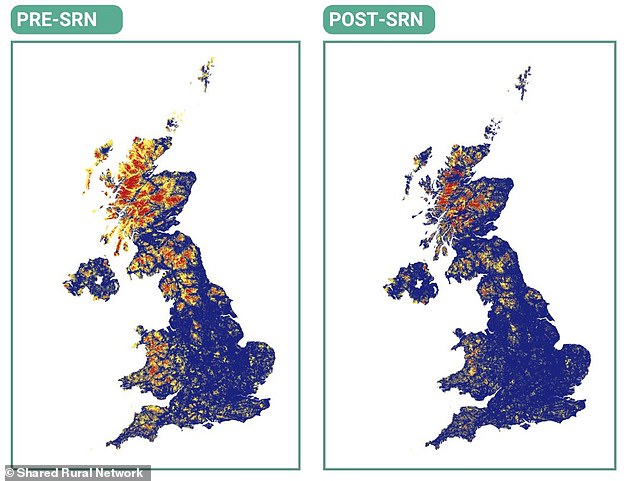
This expansion is provided by the Shared Rural Network (SRN), which has created cell towers which can be used by all major network providers. These maps show the regions covered by all four providers (blue), covered by at least one provider (yellow), and no providers at all (red) before and after the introduction of the SRN
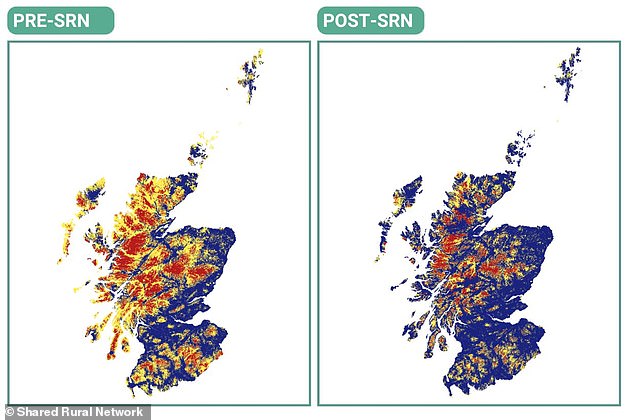
The SRN has dramatically improved connection in rural regions, but some areas, such as the Scottish Highlands and Islands, still have large areas of partial and total not spots (red and yellow)
For example, the area covered by at least one provider in North Wales has increased from just 63 per cent to 83 per cent in the last five years.
Additionally, even the most remote regions have seen significant improvements in connectivity since the implementation of the plan.
Ben Roome, CEO of Mova, the Shared Rural Network delivery partner, says: ‘Christmas is a time for connection and this year more rural communities than ever can share that spirit.
‘With the 100th site activated, in Llanfair on the border between England and Wales, these publicly funded masts can connect families, friends and businesses across a cumulative area of over 4,000 square kilometres, irrespective of mobile provider.’
EXPLAINED: THE EVOLUTION OF MOBILE BROADBAND UP TO 5G
The evolution of the G system started in 1980 with the invention of the mobile phone which allowed for analogue data to be transmitted via phone calls.
Digital came into play in 1991 with 2G and SMS and MMS capabilities were launched.
Since then, the capabilities and carrying capacity for the mobile network has increased massively.
More data can be transferred from one point to another via the mobile network quicker than ever.
5G is expected to be 100 times faster than the currently used 4G.
Whilst the jump from 3G to 4G was most beneficial for mobile browsing and working, the step to 5G will be so fast they become almost real-time.
That means mobile operations will be just as fast as office-based internet connections.
Potential uses for 5g include:
- Simultaneous translation of several languages in a party conference call
- Self-driving cars can stream movies, music and navigation information from the cloud
- A full length 8GB film can be downloaded in six seconds.
5G is expected to be so quick and efficient it is possible it could start the end of wired connections.
By the end of 2020, industry estimates claim 50 billion devices will be connected to 5G.
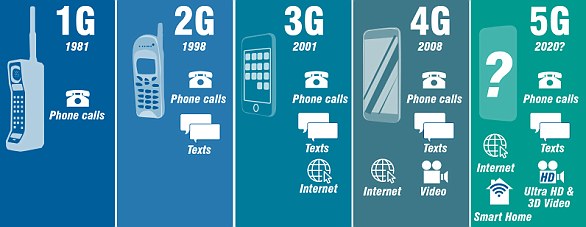
The evolution of from 1G to 5G. The predicted speed of 5G is more than 1Gbps – 1,000 times greater than the existing speed of 4G and could be implemented in laptops of the future