Those fortunate few individuals whose innocence may not have been tainted by being terminally online are likely, when visiting museums, galleries, or great houses, to take the information they are presented with at face value. Surely, they may think, these information booklets couldn’t possibly be biased — those little bits of text on the wall could not have a hidden agenda. I envy these people, who proceed through the world simply absorbing and quickly forgetting what they are told, not stopping to question why their instincts are telling them that the information just doesn’t feel right.
British cultural heritage institutions present themselves as neutral custodians of the past — distilling and disseminating our country’s history into easily digestible factoids suitable for easy consumption amid a pleasant family day out. Unfortunately, this is not always the case. A growing body of evidence suggests that this neutrality is becoming increasingly selective, and nowhere is this clearer than when it comes to dealing with Christianity.
Over the past few years, organisations like English Heritage and the National Trust have repeatedly downplayed and distorted Christianity’s central role in Britain’s history. What is most striking is not necessarily the historical illiteracy on display; rather, it is that Christianity is consistently treated as embarrassing and contentious, and is often erased from the narrative altogether.
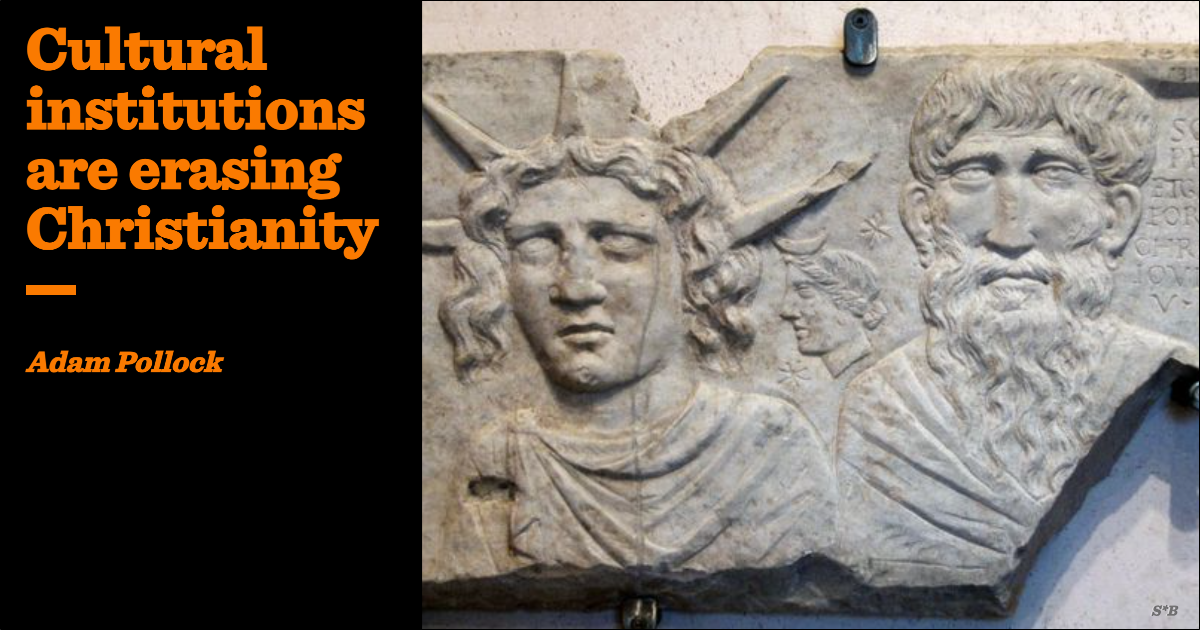
This week, English Heritage shared a post on social media claiming that the date of Christmas derived from a pagan festival honouring the late Roman sun god Sol Invictus. The insinuation — that Christians appropriated this festival, rather than having a very real reason to celebrate on this date — is appalling. The charity admitted that they “got this wrong” and deleted the post, but to believe that this was a simple mistake would be to give them too much credit.
Earlier this year, the organisation also received criticism after designing Easter-themed promotional materials for children that neglected to mention that Easter had anything to do with Christianity or Jesus. Instead, it claimed that it had its roots in the celebration of yet another pagan god, who historian Bijan Omrani argued is likely more made-up than the rest of them.
Sebastian Milbank criticised this organisational aversion to Christianity in these pages, asserting, “Christianity as the formerly hegemonic faith of this country is seen as threatening, covertly evangelising and inappropriate. In many parts of the cultural establishment, celebrating our history is seen as disgraceful and dangerous — questioning and subverting it honourable and fair-minded.” He was correct.
It is not just English Heritage that appears to be erasing the Christian aspect from British cultural history. Last month, the National Trust prohibited a documentary filmmaker from filming at Saint Cuthbert’s Cave in Northumberland due to the film having a “religious affiliation”. The cave, where the Saint is claimed to have lived as a hermit before his relocation to the Holy Island of Lindisfarne, is a site with enormous religious importance in the northeast of England. The decision allegedly came from within the ruling ranks of the National Trust, with reports stating that it “has been mandated from the highest level of the NT.” There is no defensible reason why the National Trust should seek to not promote this.
To understand the National Trust’s position on Christianity, one only has to look at its internal communications. At the end of 2023, the organisation distributed to its volunteers an “inclusivity and wellbeing” calendar for the year ahead. As is usual with calendars, religious festivals and holidays were listed: Diwali, Eid, Ramadan. Christmas and Easter, however, did not get so much as a mention. So much for inclusivity.
Defenders of these institutions argue that these decisions are always taken to ensure that everyone in the modern polycultural British society feels welcome and included. I am not sure how inclusivity can be interpreted to require the suppression of the country’s majority, foundational faith. On the contrary, a genuinely pluralistic society should be honest about its cultural and religious foundations, lest it find itself welcoming newcomers on the back of a historic lie.
The Christian faith has shaped Britain’s morality, legal traditions, architecture, politics, education, and language
What makes this trend particularly worrisome is that these institutions play a huge role in shaping public understanding of our nation’s history. Millions of people from both Britain and abroad encounter Britain’s past each year through their exhibitions, tours, and promotional materials, not least to their millions of followers across social media. When Christianity is reframed in this way as little more than an incidental add-on to British history, it distorts the true foundation of the country and, in turn, makes us value our traditions even less.
Britain is no longer a uniformly Christian country in terms of belief or practice, for better or for worse, but it remains a Christian country by its formation. To acknowledge this is not to seek to impose Christianity on others, but to tell the truth about who we are and how this once-great country came to be. The Christian faith has shaped Britain’s morality, legal traditions, architecture, politics, education, and language. To downplay the role of Christianity in Britain is to render the past unintelligible.