On an otherwise gray and quiet street in Kramatorsk’s commercial center, a storefront sign of block letters in bright primary colors announces something extraordinary inside: “Aquarium of Amazing Fishes.”
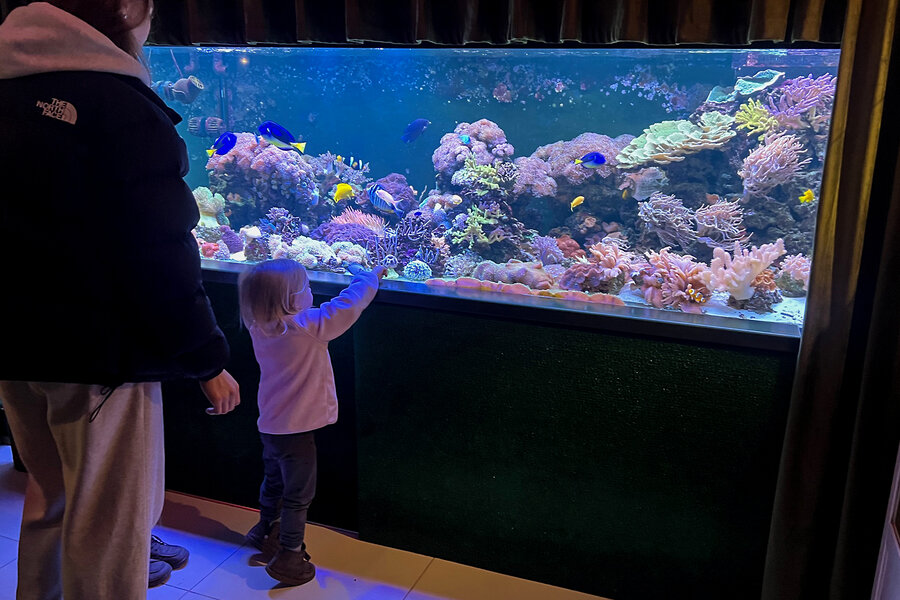
The vibrantly colored, child-friendly outdoor sign that invites the visitor to marvel at the otherworldly life and variety of Earth’s oceans, lakes, and rivers is no disappointing oversell. Inside are large, brightly lit tanks of salt- and freshwater species.
The efficiently arranged space of just seven tanks arrayed along one corridor might be a special spot anywhere. But in Kramatorsk, “Aquarium of Amazing Fishes” is something of a sanctuary, and a miracle.
Why We Wrote This
“Aquarium of Amazing Fishes” is a gift to Kramatorsk, Ukraine, from a local couple who wanted to share their enchantment with tropical seas and rivers. Today, it allows visitors to dream of worlds beyond a war that has made their city a battle zone.
The front line of Russia’s war on Ukraine is less than 20 miles away, as Kramatorsk sits precariously within the 30% of the disputed eastern Donetsk region still in Ukrainian hands after nearly four years of fighting.
Russian President Vladimir Putin says that one way or another, he will take all of Donetsk. The dull booms of warfare punctuate Kramatorsk’s atmosphere on a daily basis, while Russian drones, missiles, and glide bombs strike the city almost every night.
But inside the aquarium, riotously colored saltwater fish, schools of silvery piranhas, and even one seemingly communicative manta ray allow visitors to dream of worlds beyond a war that has made the land where the oceanic sanctuary sits a battle zone.
Aquarium of Amazing Fishes is a gift to the people – and especially the children – of Kramatorsk from Roman and Iryna Dubinin, a local couple who wanted to share their enchantment with the world’s tropical seas and rivers with those who otherwise might not ever know them.
“We wanted to create something here in Kramatorsk that would give people who don’t have the opportunity to go to the sea a kind of window into the wonder and beauty and amazing variety of the worlds living under the waters,” says Ms. Dubinin. “There are some aquariums and oceanariums in bigger cities in Ukraine,” she adds, “but never anything like this in this region.”
The Dubinins’ original objective to educate and inform about the world’s underwater creatures while sharing their love of the seas has gradually shifted as the war has intensified and moved closer.

Howard LaFranchi/The Christian Science Monitor
Now the idea is just as much to provide a calming respite and a momentary escape.
“At first our thought was to focus on children, coming in with their families or with their school class, to give them some idea of the amazing life in the world’s bodies of water and why it is important to preserve them,” say Mr. Dubinin.
“But as the war moves closer, we find we have more soldiers coming in, sometimes they sit in front of a tank and watch the living world in front of them. It seems to be calming,” he adds. “Some have told us that’s why they come in.”
Humble origins
Aquarium of Amazing Fishes has its origins in the first home aquarium Mr. Dubinin had when he was a boy. As so often happens with tropical fish enthusiasts, he gradually added another tank, and then another, as his fascination with fish and amphibians grew.
When he married Iryna, she had to adapt to the 3,500-liter (925-gallon) aquarium in their home. But together they explored and loved the watery worlds of Crimea – until Russia illegally occupied and annexed that part of Ukraine in 2014. They branched out to international waters, in particular the Red Sea, where they thrilled to the brightly colored fishes, corals, and sea plants arrayed before them.
Then, while visiting one of Iryna’s uncles living in Genoa, Italy, they entered an oceanarium. An idea was born.
“We said, ‘We could create something smaller but just as beautiful and fascinating for Kramatorsk,’” Iryna says. A year later, in spring 2020, the aquarium opened its doors.
From day one, admission to Aquarium of Amazing Fishes has been free of charge. A QR code does invite visitors to contribute to a fish food fund. The aquarium has Facebook and Instagram pages, and is especially keenly followed by émigré Kramatorsk families.
On a recent Sunday afternoon, the pace of visits is slow, reflecting both a depopulated city and public concerns about random acts of war. But a family of four comes in, the two little girls pointing and exclaiming at the darting fish in one saltwater tank. Then a soldier, then a mother and her teenage daughter.
“We come here every once in a while, it’s a quiet place that offers a calming experience,” says Svitlana, who with teenage daughter Oleksandra stands before a tank of freshwater cichlids. “It feels a little hidden from the world, and from what’s going on out there.”

Howard LaFranchi/The Christian Science Monitor
Power supply
But unfortunately, not completely removed. Svitlana says she and Oleksandra came especially to see the tank of turtles they had enjoyed at a previous visit – only to discover that the turtles had been evacuated to a safer home with a more reliable electricity supply in Dnipro.
Indeed, Mr. Putin’s current campaign of relentless targeting of Ukraine’s energy infrastructure – aimed at demoralizing a resilient population facing a harsh winter – is a growing worry for the Dubinins.
Already they have lost a school of piranhas during a power outage. On the other hand, requests from evacuating families to take on orphaned tropical fish are becoming routine.
And now the increasingly frequent targeting of the power stations that provide Kramatorsk, and the fishes of the aquarium, with life-sustaining electricity have the Dubinins sadly but matter-of-factly considering their next steps.
These days when they consider the prospect of evacuating all their fish and closing up the Aquarium of Amazing Fishes, they speak less and less in the conditional tense.
“We see the world roll out the red carpet for the terrorist Putin and we know no one is going to require him to stop his war,” Mr. Dubinin says. “So we have to be realistic.”
He says that when the city orders a mandatory evacuation of children, “that will be our red flag, that is when it will be time.” And when that happens, “it will be a sad day for this city,” he says. “It will have lost something special.”
But then he looks away to the tanks he built with his own hands to create a place where visitors could enter the world of amazing fish, and he offers a different thought.
“Even when that happens,” he says, “we will still hope for the day when we can once again offer a small piece of the world’s beautiful water worlds to Kramatorsk.”
Oleksandr Naselenko supported reporting for this story.