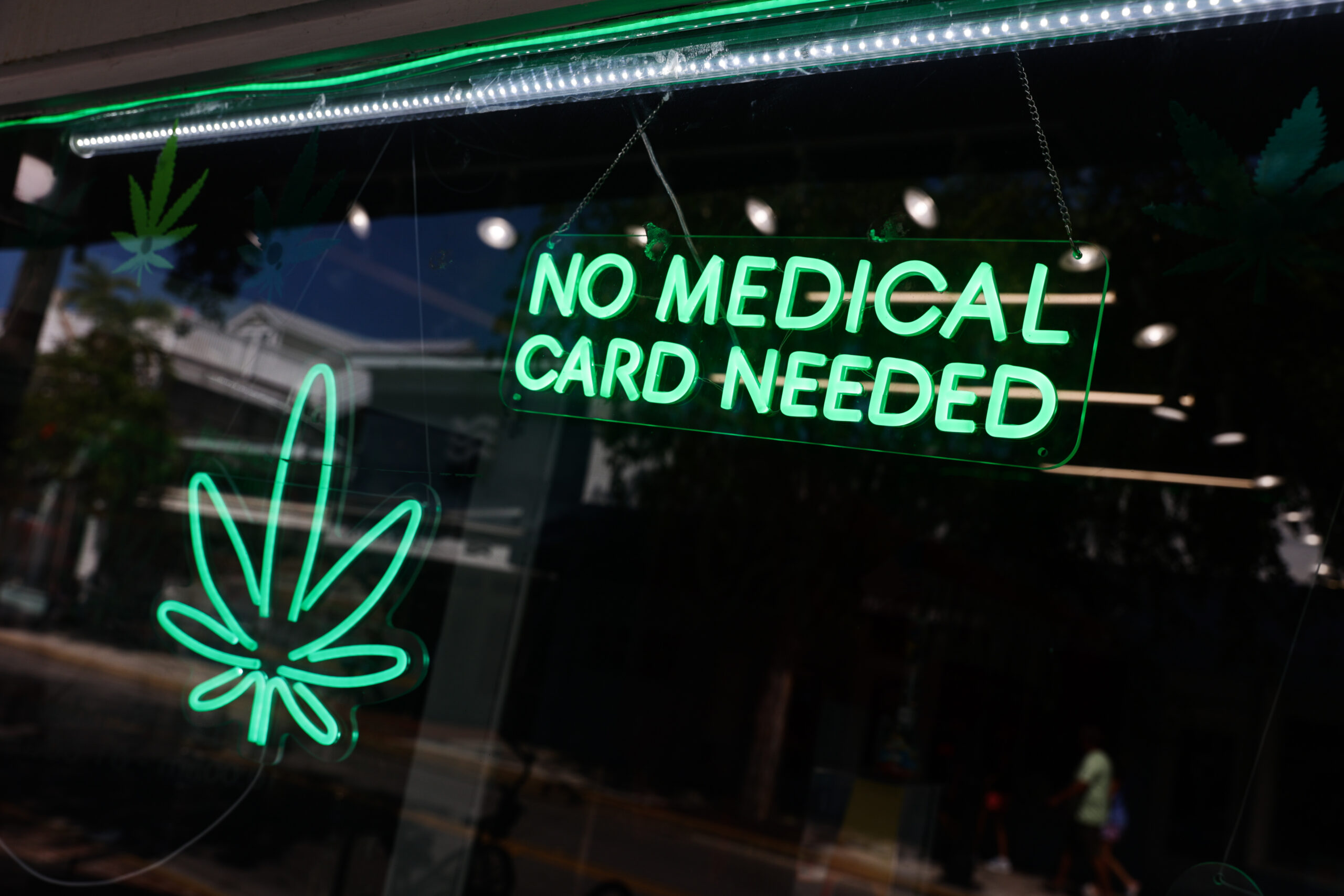
President Donald Trump last Thursday signed an executive order to reclassify marijuana under federal law, moving the drug from Schedule I to the less restrictive Schedule III. “A lot of people want to see it,” Trump had told reporters in the Oval Office on Monday, adding later in the week that the reclassification order “will make it far easier to conduct marijuana-related medical research, allowing us to study benefits, potential dangers, and future treatments.”
Classified as a Schedule I substance under the Controlled Substances Act—alongside heroin and ecstasy—marijuana had remained federally illegal despite widespread state-level legalization, a status that had largely barred cannabis companies from the U.S. banking system and forced them to rely on higher-cost financing.
Some view marijuana rescheduling as politically calculated, aimed at reclaiming the popular support that Trump held last year, particularly among Gen Z voters, whose support for the president has hemorrhaged amid rising unaffordability and a series of foreign-policy choices, beginning with U.S. strikes on Iran—which many Americans correctly perceived to have been on behalf of a foreign government rather than our own—and escalating with more recent U.S. military action near Venezuela.
With about 71 percent of adults under 30 saying marijuana should be legal for both recreational and medical use, rescheduling could provide the administration with a legislative accomplishment to woo back Gen Z, a demographic for which it otherwise has little to point to, and a potential way to win back lost ground before the midterms.
But the administration’s openness to removing federal barriers to the cannabis industry appears driven by more than just electoral calculus; it follows months of sustained engagement between the White House and a small group of industry executives who previously helped secure Trump’s endorsement for a marijuana ballot initiative in Florida last year.
Ahead of that endorsement, Trump met with Trulieve CEO Kim Rivers and Florida GOP Sen. Joe Gruters, according to both the lawmaker and industry sources. Rivers and Trulieve spent more than $92 million to support the “Smart and Safe Florida” campaign backing that ballot initiative.
Though the weed amendment ultimately failed, the relationship forged between Trump and the cannabis industry—facilitated by chief of staff Susie Wiles, who previously worked for the firm Ballard Partners, which lobbied on behalf of Trulieve—has lasted through Trump’s first year back in the White House, where the president has discussed marijuana policy in recent Oval Office meetings with senior advisers and executives including Rivers and ScottsMiracle-Gro CEO Jim Hagedorn, as first reported by The Washington Post. Shares of major U.S. cannabis companies rose on the announcement, with firms like Canopy Growth climbing nearly 12 percent in one day.
The executive order, though instantly celebrated by the industry, has reignited a debate over marijuana and public health: While reform advocates and cannabis investors see rescheduling as a long-overdue rollback of outdated drug policy, critics argue it primarily benefits large corporate producers—loosening financial and regulatory guardrails and delivering major tax advantages even as the industry markets increasingly high-potency THC products and faces mounting concerns over addiction and youth exposure.
Charles Fain Lehman of the Manhattan Institute is among the executive order’s critics, arguing in recent essays that marijuana legalization and rescheduling discount unavoidable tradeoffs, enable the spread of increasingly high potency THC products, heighten risks of dependency and youth exposure, and fail to eliminate black-market activity.
“Today’s decision represents a surprising departure from the president’s usually sound judgment on drug control policy,” Lehman told The American Conservative. “Rescheduling marijuana will not meaningfully make research easier, make medication more available, or free people from prison. It will hand billions of dollars to the state legal industry. That’s its primary effect. It’s disappointing that this is where we ended up.”
As SFGate noted, customers at dispensaries too are unlikely to notice any change, since those operations remain federally illegal. However, Schedule III, “would send a massive tax break to legal operators who would now be eligible to take normal business deductions off their federal taxes.”
Subscribe Today
Get daily emails in your inbox
In an interview with former Rep. Matt Gaetz (R-FL) on Thursday evening, Truelieve CEO Kim Rivers assured Americans that the additional capital created by the executive order will be used in joint ventures with universities to research various chronic diseases. “We are so excited to deploy capital into research areas…now we can go and do meaningful clinical trial research using actual marijuana products,” Rivers said on the Matt Gaetz Show, previewing a time-release product to treat Parkinson’s disease.
But Saagar Enjeti, a cohost of Breaking Points, reported Thursday that Trump officials privately acknowledged in a call that evidence supporting medical marijuana research claims was weak, emphasizing instead how rescheduling would amount to a major tax break for large cannabis companies. Tax breaks for large cannabis companies—like those passed in the Big Beautiful Bill—are unlikely to win back the Gen Z support the administration has lost, as younger voters increasingly expect policies that address their economic needs.
The marijuana debate reveals a perverse contradiction: In the name of freedom and personal liberty, government policy and cultural pressure has unleashed a series of addictive vices that now exert profound psychological control over Gen Z, enriching big porn, big gambling, and big weed while financially constraining a generation. The executive order may please corporate investors, but it leaves an honest conversation about marijuana policy and its social consequences unaddressed.